

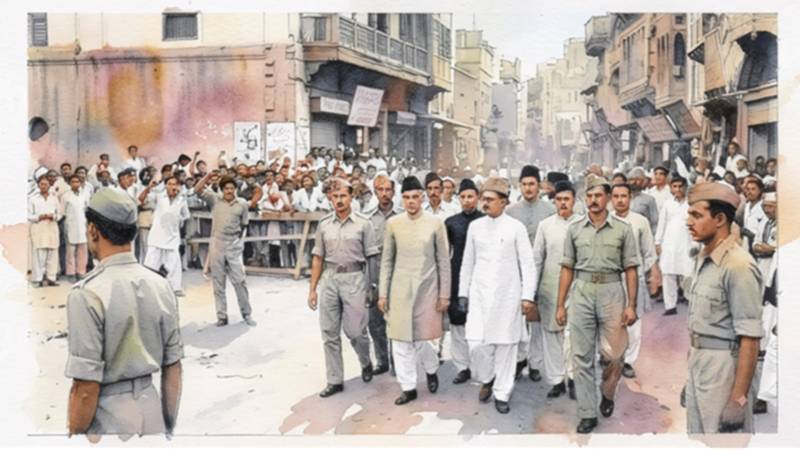
Contrary to the claims of Islamophobes and Islamists, Muslims are not a monolith. The 2017 book Muslims Against the Muslim League shows the rabid Muslim opposition to what some view as a miracle against all odds - Pakistan. It shows that the Muslims of the subcontinent did not universally support the idea of a haven away from majoritarianism.
And if Muslims vociferously disagree with one another, then why must Mother India be externally foisted on them? This is especially so if Mother India had to be invented for her vivisection to be mourned. Such nationalistic narratives cannot be forced with – “Love me or else” (a la Farhan Chak).
The 2020s manifest the fear of majoritarianism and subjugation expressed over a century ago. The persecution of Muslims in India is off the roof. Cow mob lynching, Israeli style bulldozer demolitions, police complicity in violence, systemic housing and employment discrimination, co-opted judiciary, socio-economic boycotts, indiscriminate use of pellet guns, valourisation of rapists, constitute a small list of institutionalised and systemic violence against Muslims.
Raw, Naked, Toxic Nationalism
The 2020s also allow us to shift the focus from individuals to systems. Systemic thinking allows us to reject the narrative of scapegoating one man (Jinnah) as the arch villain. It also allows us to recognise that Indian Islamophobia cannot be blamed on one man. Modi didn’t invent hate; he only stirred what was always simmering amongst middle class, highly educated and economically secure Hindu nationalists.
Modi is only one in the pantheon of Hindu nationalist voices (Dr Subramanium, Dr Ranganathan) that may disagree with one another but are united in their deep rooted bigotry against Muslims. This parallels the Israeli Knesset where difference of opinion between Netanyahu, Bennett and others is sidelined in their common oppression of the Palestinians.
Such hate against Muslims is entrenched within well-oiled institutions. In contrast, the railing of the TLP or even poor white nationalists comes from the lower middle class that is economically disenfranchised. The institutions are stacked against them. Terrorism then is the manifestation of grievances that could not be channelled through draconian state measures. Alternatively, state repression and terrorism are two sides of the same coin. The difference is that one is kosher and the other condemned.
Modi didn’t invent hate; he only stirred what was always simmering amongst middle class, highly educated and economically secure Hindu nationalists
Discriminatory attitudes are not confined to Indian soil. Islamophobic comments emanate from Hindu nationalists residing in several GCC and Western cities. The Facebook page of Indian American Muslim Council is littered with laughing emojis on the persecution of Muslims. Whataboutery and deflection abound. This is schadenfreude.
Such sneering contempt is not reserved for stereotypically conservative Muslims with kohl, skull caps, and Sunnah beards. It is all pervading. Liberal Muslims, journalists, students, academics, and judges, none are spared. Education and upward mobility do not insulate Indian Muslims from the toxic hate of Hindu nationalists.
The Cockroach Janta Party leader is clear. Had he been Muslim, he would have been in jail. Still, the use of pellet guns and violence was tempered compared to that unleashed in Kashmir. It reminds one of Pastor Niemoller. First, they came for Kashmiri Muslim children and youth with pellet guns. Eventually, they came for the pure, upper caste Hindu stock.
Muslims Against the Muslim League
It is this context that allows one to revisit Muslims Against the Muslim League to ask, what were they really thinking. A poignant reflection comes from former Indian politician Mohammad Adeeb, who laments that they are being punished for not siding with Jinnah. Yet, he is not alone. A whole constellation of Muslim leaders opposed Jinnah.
For the far-right Ahrar, the excommunication of Ahmadis seemingly trumped fears of Hindu majoritarianism. Some orthodox Muslims adopted a quietist stand given that Muslims faced the brunt of the British in 1857. Others opposed Jinnah for one reason or another.
These include Madani engaging in radical hermeneutics to justify his donning the Gandhi cap. He created the narrative that Adam descended in Ceylon and migrated to India, that human beings thus emerge from India. He demolished Savarkar’s argument that Muslim holy places lie outside India, arguing that the Muslim connection to India is unbreakable. It is stronger through burial in Indian soil compared to Hindu cremation.
However, the politics of collaboration left Madani, the Frontier Gandhi, and even Maulana Azad neither here nor there. The Hindu nationalist narrative has not been kind to them. The likes of J. Sai Deepak are highly critical of Madani. At best, the Frontier Gandhi is caricatured through the appeasing dolt Wali Mohammed in the movie Gadar (2001). The Hindu nationalist narrative confers a place to Muslims but only as lackeys or security guards to serve the Hindu interest.
Other Muslims had their own worldviews in opposition to Jinnah. Maududi was driven by pan-Islamism, the tribal Baluch by their independence, and the Shias of UP by fears of Sunni domination. Allama Mashriqi and Allah Bakhsh Soomro both had their own reasons for Hindu-Muslim unity.
Yet, none of these provided a viable alternative to address Muslim anxiety around the loss of cultural and political status and the fear of being economically dominated by the more affluent and educated Hindu community. That anxiety and fear could not be addressed by orthodox Muslims co-opted by the Congress or Marxist Muslims with their marginal significance.
Casteism is the root of Indian Islamophobia
Jinnah had far surpassed Mashriqi and Soomro. Sarojini Naidu called him the ambassador of Hindu-Muslim unity, not them. He had been there and done that. Pulling Muslims together was and is like herding stray cats. This explains his uncompromising projection as the sole spokesman. He hit the nerve by saying:
“It is the height of defeatist mentality to throw ourselves at the mercy and goodwill of others. … Do not be disturbed by the … taunts … used against the Mussalmans – Communalists, toadies, and reactionaries. The worst toady … surrenders unconditionally to the Congress and abuses his own community. … These … abuses are intended to create an inferiority complex amongst the Mussalmans and to demoralize them …” (p. 247)
His counsel remains relevant as Muslims are dehumanised as “jihadis”, “porkis”, “madrassachaps” by the dominant Hindu nationalists today. It cautions against becoming a self-hating Muslim. Life is about living based on one’s own values and not being hectored by someone else’s narrative. As the Bard said, this above all, to thine own self be true.
The Punjabi and Bengali Hindus understood this when they rejected becoming minorities and called for partition of their respective provinces. The problem arises when those who fear becoming minorities refuse the same freedom to others.
Hyderabad and Goa can be annexed but Kashmir can’t be granted self-determination. “POK” must be annexed but Baluch separatism stoked. Underneath all this is raw, naked, and toxic hatred against Muslims - the erstwhile Dalits who resisted caste by conversion first to Buddhism and then Islam. The root of Indian Islamophobia lies in ancient casteism.
Quaid e Azam’s legacy is secure
Critics of Jinnah reduce him to a lawyer of the Muslims, deem him vague, or accuse him of authoritarianism. However, Jinnah can be best understood by someone who has tried to bring divergent communities together and then been made to fail by the intransigent incumbent. It is not about the individual but the system. The Congress failed him.
Verse 2:120 is relevant here - “Never will the Jews or Christians be pleased with you, until you follow their faith”. It cautions against appeasement. Collaboration should not become self-abnegation. Jinnah carved his own space against the British, Hindu nationalists, orthodox Muslims, and others with pet narratives of their own. He remains the Quaid e Azam.
A moth-eaten Pakistan was foisted upon him, but a haven against majoritarianism remains. The question is not if he had a blueprint for a post partition Pakistan where institutions had to be built from scratch and where the strongest institutions of the military and the civil service maintained the status quo.
The real question is what the others did to alleviate the concerns of the communities from where Jinnah drew his law minister and foreign minister – the Dalits and Ahmadis. The question is what was subsequently done for the peasants and the working poor against elite landowners and capitalists.
It is such questions that should animate Pakistan on its 79th. The elite have found gains through diplomacy. The poor of Pakistan still don’t get their peanuts.
A haven against majoritarianism was long achieved. The case for it only becomes stronger in the 2020s with fascism across the border. Jinnah’s haven is secure. The extractive and exploitative system of the elite is not.