

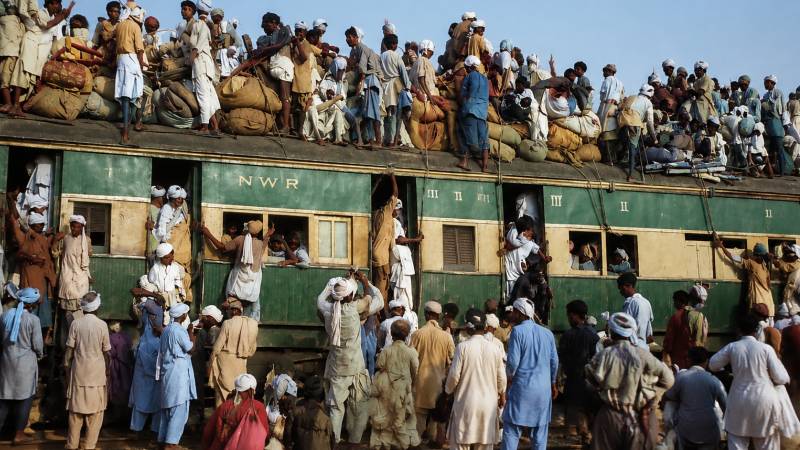
Pakistan and India will celebrate their 79th Independence Day on August 14 and 15, respectively. Each will commemorate the day with its own state narrative. However, partition is a different story for those who crossed the border than for those shaped by the idea while remaining in either India or Pakistan. Generations that inherited a demarcated border often swallow the state narrative whole, dismissing humanist plea to remember our shared past as naïve. They are staunch supporters of a pure land that should deal in realpolitik with its neighbors. On the other hand, there are those who lost everything to partition, migrated to the faith-based majority land, yet still believe in the humanness of their ancestral land. My family on the paternal and maternal sides, along with relatives, migrated from Talwandi-Chuddrian, Amritsar, now in Indian Punjab, to Pakistan’s Punjab.
My grandfather, Muhammad Siddiq Khan, born in 1923 in India, died in 2024 in Pakistan, still believing in the land he grew up in and the neighbors he had in India. He often told us stories about the Partition and how he settled on this side of Pakistan. Despite scars from a sword attack that nearly took his life, he believed that not all people are the same and that those who committed atrocities were alien to those who were in physical and mental pain. My grandfather’s oral story finds a brilliant cinematic mirror. The movie, directed by Imtiaz Ali and available on Netflix, Mein Vaapas Aaunga (I will come back), shows that most of the aggressors were unfamiliar with the people and the land. Moreover, no side was spared. Migrants from both sides faced immense atrocities. In the book The Great Partition, written by Yasmin Khan, the author writes that Rawalpindi became a bloodbath in Pakistan, and it was reciprocated by the heinous massacre in Amritsar in India. Both sides carried out immense violence.
On both sides, people’s history is missing, and it is now being restored and actively discussed. While people’s history is missing, the other narrative is prevalent: the state narrative, which tells only one side of the story. This narrative is based on “otherness,” making the other side alien and unlike the inhabitants. The propaganda focuses on hating the people on the other side of the border. If people come to know that both sides have faced atrocities and that perpetrators and aggressors were on both sides, then hate would be swallowed by empathy.
Sadat Hassan Manto wrote about the atrocities of the Partition. He says that the deaths of millions of Muslims and Hindus did not damage either religion, but it dented humanity. In the famous short story Toba Tek Singh, which features Bishan Singh, a Sikh patient in a mental asylum, Manto depicts the indecision of those who did not subscribe to the prevailing idea of Partition, as well as the women who were not accepted because their self-esteem was violated. They were not accepted by anyone. They had nowhere to go. Rather, like the protagonist, they died in no-man’s-land, which was not claimed by either Pakistan or India. Such confusion was prevalent in those times, as can be seen in Mustansar Hussain Tarar’s Khas-o-Khashak Zamany Kay.
This confusion stemmed from a shared agrarian identity. As Jatts, both Muslims and Sikhs were bound by the rhythms of the land, oblivious to the sudden injection of communal hatred. They could not comprehend why a distant political decree forced them to abandon lands fertilized by their ancestors. Those lands had seen their best times and struggles as they tilled and prepared them for harvest. Furthermore, religion was not a point of contention among these people. They had maintained religious harmony since time immemorial. The only topic that could involve lifelong animosities was land titles, and such titles did not favor religious fervor. Rather, people of the same religion could be at odds with each other. People of opposite faiths could be best friends, such as Chaudry Bakht Jahan and his Sikh companion in the novel.
It is a tragedy that the new generation, raised on the sterile, manufactured state narrative of 'otherness,' struggles to separate modern geopolitics from our shared historical humanity.
Another of Manto’s short stories, Naya Qanoon (New Law), can be understood in the context of those who migrated in search of better opportunities or an equitable future. The plot of the story is set against the backdrop of the Government of India Act, 1935. The protagonist, Mangu Qawchowan, believes that after the 1935 Constitution is passed, the inhabitants will once again lay claim to the land. In the context of migration, those who migrate will have a better future. However, as the story ends, the common people at both ends suffer. Only the elites who had a secure future before the partition are having the time of their lives. They want the citizens of their respective countries to live in political realities.
The political reality is that Pakistan and India are two sovereign nations. Rising tensions have returned the region to a harsh political climate. The hawks on both sides do not allow the doves to fly in peace or for communal harmony to grow. In one of the dialogues in the movie Mein Vaapas Aaunga, the actor Nasiruddin Shah says, “Murr kay nahi dekhna” (Don’t look back). However, the heart wants to look back and make peace with the past. It wants a peaceful border and the serenity that surrounds the resting place of Guru Nanak. It wants to return, forget political realities, and celebrate humanness.
I have never heard my ancestors express hatred toward Sikhs or Hindus. Their trauma was separate from their humanity. It is a tragedy that the new generation, raised on the sterile, manufactured state narrative of “otherness,” struggles to separate modern geopolitics from our shared historical humanity. If we are to honor those who suffered, we must reject this inherited hatred and choose our ancestors’ empathy.