

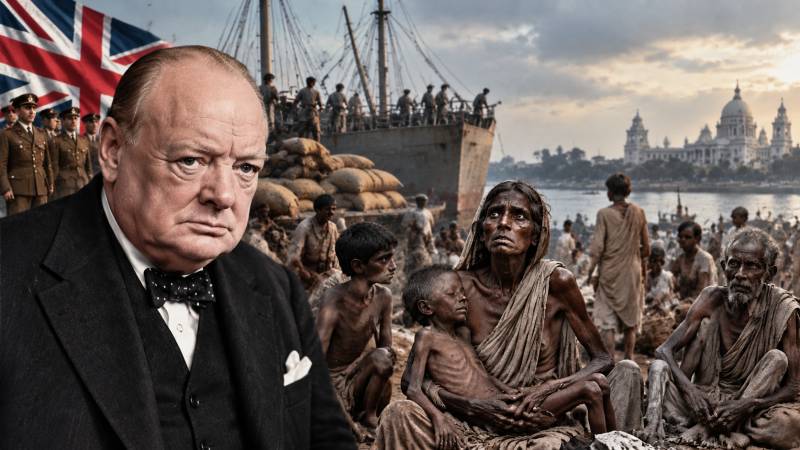
The Bengal Famine of 1943 stands as one of the most damning atrocities of British imperial rule, where an estimated two to three million people perished and millions more were reduced to total physical and economic devastation. This staggering loss of life was no tragic accident of nature. It was an engineered catastrophe born of imperial arrogance, wartime chauvinism, and structural neglect. At the center of this tragedy stood Prime Minister Winston Churchill, whose deeply ingrained contempt for colonial subjects dictated policies that systematically sacrificed Indian lives for imperial interests.
Churchill’s hostility toward India alarmed even his closest cabinet colleagues. Leopold Amery, the Secretary of State for India, grew so appalled by the Prime Minister’s rhetoric that he privately wrote in his diary that he saw little difference between Churchill’s outlook on colonial populations and that of Adolf Hitler. As Madhusree Mukerjee documents in Churchill’s Secret War (2010), Churchill routinely sneered at warnings of mass starvation, dismissing Indians as a "beastly people with a beastly religion" who brought disaster upon themselves by "breeding like rabbits." When Viceroy Lord Wavell cabled London with desperate, repeated appeals for emergency grain, Churchill’s response was as callous as it was telling: he demanded to know why, if food was truly so scarce, Mahatma Gandhi had not yet died.
The Bengal Famine remains an unassailable indictment of British colonial rule exposing a regime where European strategic reserves took precedence over human life, forever shattering the myth of a benevolent British Empire.
This prejudice translated directly into lethally destructive policies. Fearing a Japanese advance, the British military executed scorched-earth "denial policies" across Bengal, seizing food stocks and confiscating more than 66,000 rural wooden boats. By destroying the primary transport, commerce, and fishing network of coastal Bengal, the British state shattered the regional economy, stranding millions without food or livelihood. As starving families filled Bengal’s roads and the gutters of Calcutta, wheat shipments systematically sailed past the Indian coast to construct bloated military stockpiles in the Mediterranean and safeguard reserves in the United Kingdom.
In Winston Churchill: His Times, His Crimes (2022), historian Tariq Ali points out that Churchill's War Cabinet supported by the broader British political establishment enforced an explicit imperial hierarchy that treated colonial lives as disposable. Offers of aid were actively blockaded: grain shipments from Canada and Australia were rebuffed under the pretext of scarce shipping, even while non-essential supplies moved freely across imperial trade routes. Most damningly, when Subhas Chandra Bose offered 100,000 tons of Burmese rice over Radio Syonan from Singapore, the British administration refused to acknowledge the gesture, prioritizing imperial pride and political censorship over saving hundreds of thousands of human lives.
Provincial governance offered no relief. The Bengal government under Chief Minister Khwaja Nazimuddin and Civil Supplies Minister Huseyn Shaheed Suhrawardy operated a broken procurement system plagued by political favoritism. Suhrawardy appointed the private firm M. M. Ispahani Ltd. owned by a prominent Muslim League benefactor, as the sole purchasing agent for procurement. The decision drew fierce contemporary criticism for eliminating competitive bidding and creating an uncoordinated, crony-ridden distribution network. As the official 1945 Woodhead Commission later confirmed, provincial authorities failed to grasp the magnitude of the disaster, allowing black-market hoarders and profiteers to run rampant while the Central Government of India refused to enforce a national food policy.
The ultimate moral bankruptcy of the imperial state lies in its blatant double standard. When Nazi U-boats threatened British civilians, London mobilized every ship, capped prices, and guaranteed equal rations for all. In Bengal, three million colonial subjects were abandoned to starve. The Bengal Famine remains an unassailable indictment of British colonial rule exposing a regime where European strategic reserves took precedence over human life, forever shattering the myth of a benevolent British Empire.