

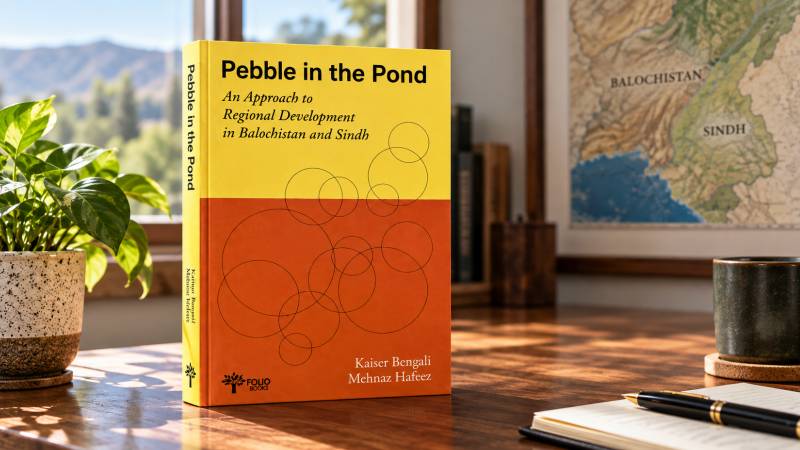
For someone familiar with basic physics, the title Pebble in the Pond has an immediate intellectual charm. A pebble dropped into still water creates a disturbance at one point, but its effects do not remain there. Ripples travel outward, carrying the consequences of a local intervention far beyond its place of origin. Kaiser Bengali and Mehnaz Hafeez use this image in their 2026 book, Pebble in the Pond: An Approach to Regional Development in Balochistan and Sindh. Their central argument is that instead of scattering limited public resources across countless settlements, governments should identify strategically located growth centres, concentrate infrastructure and services there, and allow their economic and social benefits to spread into surrounding areas. The metaphor is elegant, but it also invites scrutiny. In physics, ripples do not travel indefinitely with equal strength. Their amplitude diminishes with distance, while obstacles and boundaries can redirect or weaken them. Development spillovers work similarly. Their success depends on the strength of the “medium” through which development travels: roads, transport, markets, public institutions, household incomes, security, digital connectivity and administrative capacity.
At the heart of the study is a familiar Pakistani paradox. Sindh and Balochistan possess substantial natural resources, yet large parts of both provinces continue to experience poor development outcomes. Bengali and Hafeez argue that the problem is not simply inadequate government spending. Governments may spend substantial amounts, but expenditure is often fragmented across too many schemes, sectors and locations. Development programmes become overloaded with projects, many of which are carried forward year after year while new schemes are added. Schools, roads, dispensaries and other facilities may be constructed, yet the overall pattern can lack the concentration necessary to transform a regional economy. This challenges a deeply embedded habit in Pakistan's development discourse: equating expenditure with development. A government can spend public money honestly and still spend it ineffectively. A school in one settlement, a dispensary in another, a short road somewhere else and a small market elsewhere may all exist physically without reinforcing one another. The result can be a collection of completed projects without a coherent development system. The origin of Bengali's idea is revealing. During a journey from Rawalpindi to Gilgit in 1980, he observed isolated settlements spread across difficult terrain and began considering the practical impossibility of reproducing every public service in every small habitation. This led him towards the idea of job-creating centres where people could access employment and essential services and from which benefits could extend outward.
The intellectual partnership with Mehnaz Hafeez gives the study much of its practical strength. Her expertise in Geographic Information Systems allows the authors to map settlements in relation to population, roads, water availability and surrounding communities. Their exercise identifies 20 potential urban growth centres in Sindh and 14 in Balochistan, alongside 153 rural centres in Sindh and 165 in Balochistan. The objective is to identify settlements capable of functioning as development hubs rather than allowing administrative boundaries or constituency politics alone to determine public investment. This combination of economics and geography is perhaps the book's most compelling feature. Pakistani planning is often departmental: education plans schools, health departments plan hospitals, irrigation plans water schemes and works departments plan roads. Yet people do not live inside departments. They inhabit places where roads, schools, healthcare, water, markets and employment interact. A hospital in an inaccessible settlement is not genuinely accessible. A school may fail if teachers cannot travel or live nearby. A marketplace cannot flourish if producers cannot reach it. Bengali and Hafeez therefore give geography a seriousness that conventional planning often lacks. Their maps transform development from a list of individual projects into a spatial system.
Instead of scattering limited public resources across countless settlements, the state should identify strategically located growth centres, concentrate infrastructure and services there, and allow their economic and social benefits to spread into surrounding areas.
This raises an important question: is equal dispersal always equitable? Ten poorly functioning dispensaries may provide a more geographically equal distribution of buildings than two properly functioning health centres, but they may provide less actual healthcare. Similarly, five poorly staffed schools may be less useful than one strong institution connected to a wider catchment. Yet the “pebble” metaphor also reveals a major weakness. Development spillovers will weaken unless the surrounding environment can transmit them. A school in a regional centre does not automatically educate a child living twenty kilometres away. A hospital does not help a patient who cannot afford transport. A market does not increase a farmer's income if there is no reliable road connecting the farm to it. A job opportunity may not benefit a woman whose mobility is constrained by insecurity, transport or social conditions.
Accessibility should therefore be measured not merely in kilometres or road presence, but in time, cost and social mobility. Two villages may be the same distance from a hospital but have radically different levels of access. One may have reliable transport and a metalled road; another may face seasonal disruption, high travel costs or difficult terrain. GIS is powerful, but every map is necessarily selective. Another question is what should be centralised and what should remain local. The concentration model makes sense for specialised hospitals, vocational institutes, wholesale markets and advanced educational institutions. But primary healthcare, maternal and child services, early schooling and emergency response may need to remain close to communities. A sensible strategy could therefore involve a hierarchy: basic services at village level, intermediate services at cluster level and specialised facilities at larger regional hubs.
Perhaps the most formidable challenge is institutional. A map can identify where investment should go, but it cannot force government departments to cooperate. Pakistan's development problems are also problems of execution, maintenance and continuity. A hospital can be placed in the ideal location and still remain dysfunctional if doctors do not attend. A technical institute may exist without instructors. A road may be built and subsequently deteriorate because maintenance budgets disappear. Integrated development must therefore be understood literally. Roads, schools, health facilities, water, electricity, markets, digital connectivity and local government need to be coordinated. A school without teachers is a building, not an educational system. A hospital without staff is infrastructure, not healthcare. A road leading to no productive activity is movement without transformation. There is also a political-economy problem. GIS can provide objective criteria, but politics does not disappear when mapping technology is introduced. Someone must decide which variables matter, how they are weighted, which centres receive funding first and which are excluded. Development planning cannot eliminate politics, but it can make decision-making more transparent through publicly available criteria, open maps, independent review and community consultation.
Another concern is efficiency for whom. Concentrating investment where the largest number of people can benefit may maximise social returns, but the poorest and most geographically isolated communities may be least likely to qualify as growth centres. If efficiency becomes the only criterion, already marginalised communities could become even more peripheral. The answer may therefore be to combine concentration with a minimum universal-service floor. Remote communities may not justify a major hospital, but they still require primary healthcare, schools and access through mechanisms such as mobile clinics, digital health and transport support. The book's analytical framework is more developed than its implementation pathway. Once growth centres are identified, several questions remain: Which centres should be developed first? What investment package is required? How much should be allocated to roads, schools, water, markets and employment? Which department coordinates the programme? How should success be measured? What happens if a designated centre fails to attract private investment?
Development is not simply about how much money is spent, but where, how and whether individual investments reinforce one another. The growth centre matters, but the network around it may matter even more.
A useful next step would be to turn the model into a controlled development experiment. Sindh and Balochistan could select a limited number of urban and rural centres from the authors' proposed lists and establish baseline indicators for income, school enrolment, healthcare access, transport time, market activity, employment, female mobility, land prices, migration and business formation. Coordinated investment could then be implemented over five years while researchers measure outcomes in both the centres and surrounding settlements. This could reveal how far the developmental “ripple” travels, how quickly its effects decline, which investments generate the strongest spillovers and whether weak governance reduces their impact.
Time should also be incorporated into the model. GIS captures a particular moment, but development is dynamic. Roads change connectivity, climate change affects water availability, floods disrupt transport, and industries can create or weaken settlements. A centre that is strategically important today may not remain so twenty years from now. Growth-centre designations should therefore be periodically reviewed using updated demographic, economic, climatic and transport data. The book is timely because Pakistan's political system often rewards individual projects. A politician can inaugurate a road, school or building. Integrated development is less visible. Bengali and Hafeez challenge this project-based approach by asking governments to measure outcomes rather than inputs: not how many dispensaries were built, but how much travel time to effective healthcare declined; not how many schools were sanctioned, but how many children gained access to qualified teachers; and not how many roads were constructed, but what economic activity improved connectivity actually generated.
The authors' interdisciplinary partnership is another strength. Bengali brings experience in economics, planning and public policy, while Hafeez provides the geospatial tools needed to translate development arguments into actual locations. Their collaboration demonstrates that economists cannot plan effectively without geography, just as geographers cannot map effectively without understanding institutions and economic behaviour. Future work could broaden this framework further by incorporating sociology, anthropology, gender studies, climate science, transport engineering and local-government expertise. Such disciplines could help explain how communities use space, how mobility differs between social groups, how climate affects water security, how accessibility should be measured in time rather than distance, and whether proposed growth centres are institutionally viable.
Ultimately, Pebble in the Pond changes the way regional development can be discussed. Instead of asking simply whether resources were spent, it asks whether the pattern of expenditure is capable of producing wider transformation. It challenges the tendency to explain underdevelopment solely through lack of funds or corruption by introducing another possibility: poor spatial logic. Money can be sanctioned, released and honestly spent yet still produce disappointing outcomes if projects are too fragmented to reinforce one another. The physics metaphor therefore returns with full force. A pebble creates ripples not because the pebble itself travels across the pond, but because the surrounding water transmits the disturbance. In development, that “water” is the system of roads, markets, transport, institutions, schools, healthcare networks, supply chains, information flows and public trust. If the medium is connected, the effect can propagate. If it is fragmented, the energy dissipates close to the source. The growth centre matters, but the network around it may matter even more.
Pebble in the Pond is therefore both a diagnosis and an invitation. Its diagnosis is that development spending in Sindh and Balochistan can become fragmented into isolated schemes that lack the concentration needed to transform regional economies. Its invitation is to think spatially: identify strategic nodes, concentrate sufficient resources to create critical mass, and design public investment as a connected system rather than a catalogue of projects. Its limitations—particularly questions surrounding accessibility, local versus centralised services, migration, institutional coordination, political influence and implementation provide important areas for further work. But these limitations also make the book a useful starting point for a larger debate. Its central proposition is straightforward: development is not simply about how much money is spent, but where, how and whether individual investments reinforce one another.