

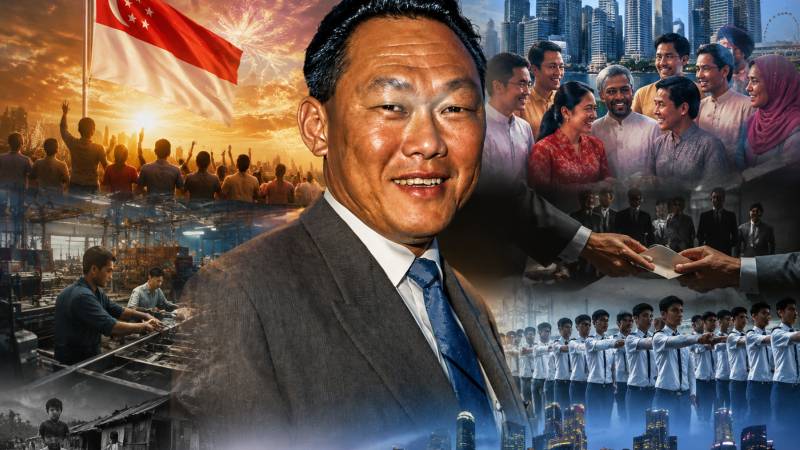
A little over 700 square kilometres in size, scarcely a quarter of Rhode Island, Singapore was expelled from the Malaysian Federation in August 1965 and left to chart its own course. By every conventional measure, it was an economic liability rather than a strategic opportunity. It possessed no oil, no gas, no natural resources and little agricultural land. Even its water was imported from Malaysia. Its population was made up of Chinese, Malays and Indians, each with its own language, traditions and identity, leaving little in the way of a shared national vision. Few would have wagered on its survival, let alone imagined that this tiny island would evolve into one of the world's leading financial centres. At the heart of that transformation stood a young Prime Minister named Lee Kuan Yew.
Lee realised early on that Singapore had almost no natural resources. It depended on imported water and had no true shared national identity. Instead of trying to overcome those disadvantages through size or geography, he focused almost entirely on policy. He believed Singapore's future would depend on getting a few big decisions right rather than hundreds of small ones. His approach centred on four key areas. The first was language and national unity. The second was building an economy by attracting global investment and intellectual capital. The third was bringing corruption under control. Lastly, he focused on creating a disciplined and orderly society.
One of the main reasons Singapore was expelled from the Malaysian Federation was because it advocated multicultural politics over race based politics. Prime Minister Lee was acutely aware that ethnic tensions could escalate into violence if one community was given preference over another. After its separation, he was clear from the start that English was the working language, linking Singapore to global commerce. The multicultural element came through by recognising Malay, Mandarin and Tamil as official languages, while retaining Malay as the national language. Religious freedom was guaranteed, but public order always took precedence. Every major religion was recognised with a public holiday, reinforcing the idea that every community had an equal place in Singapore. However, a united society alone could not sustain Singapore. It also needed an economy.
One of Lee's most decisive moves came in the economy. Rather than trying to navigate an economic crisis alone, he chose to import something Singapore lacked just as much as natural resources, intellectual capital. In 1961, Dutch economist Albert Winsemius visited Singapore and advised Lee to forget ideology, create jobs, industrialise rapidly, attract foreign capital and keep the system clean. His argument was simple. If multinational corporations trusted Singapore, investment would follow. Lee embraced that good advice. He opened the economy, introduced policies that were investment friendly, kept corporate taxes competitive and created a stable regulatory environment where businesses knew the rules would not change overnight. At the same time, Singapore welcomed global managerial and intellectual talent instead of viewing it as competition. Decades later, a country once dependent on importing expertise now exports it. Wealth, it turned out, was never buried beneath Singapore's soil. It was built in its boardrooms. Those same investors, however, expected something else before committing their capital, a government they could trust.
Instead of trying to overcome those disadvantages through size or geography, he focused almost entirely on policy... His approach centered on four key areas: language and national unity, building an economy by attracting global investment, bringing corruption under control, and creating a disciplined society.
The next step was to eliminate corruption. Lee knew good governance required more than good intentions. If public officials and ministers were expected to resist temptation, they had to be compensated competitively. Salaries across the public sector were increased substantially, reducing the financial incentive for corruption. In return, however, came a zero tolerance policy. Corruption attracted severe fines, lengthy prison sentences and little room for leniency. Institutions in charge of enforcing the law were independent, well resourced and empowered to act swiftly. Over time, investors began placing their trust not only in Singapore's economy, but also in its institutions.
Lee also wanted the people of Singapore to feel protected and secure. He introduced the Housing and Development Board, which moved hundreds of thousands of people from slums into public housing. Lee believed discipline was equally as important as prosperity. Heavy fines for offences such as littering and chewing gum, together with constant public campaigns, encouraged people to take pride in their surroundings. It became known as his vision of Asian Values, a simple belief that a disciplined society was more likely to become a successful one, enforced through a balance of carrots and sticks.
These policies transformed Singapore, but they also came at a price. Critics point towards Operation Coldstore, the detention of political opponents without trial, restrictions on the press and limits on political dissent. Lee later admitted to having indulged in "some nasty things" in pursuit of what he claims to have believed was in the interest of Singapore. Whether those decisions were justified is still a question historians and political thinkers continue to debate. What is far more difficult to dispute is that they delivered results.
Singapore today has one of the highest GDPs per capita in the world, among the highest standards of living and one of the cleanest public sectors anywhere. Perhaps Lee's greatest final act of leadership was stepping down in 1990 instead of remaining in office until his death, allowing a smooth transition of power under his own watch. It is also worth noting that Singapore has had only four Prime Ministers since independence. Whether by design or circumstance, long-term policy continuity and political stability have become some of the country's greatest strengths.