

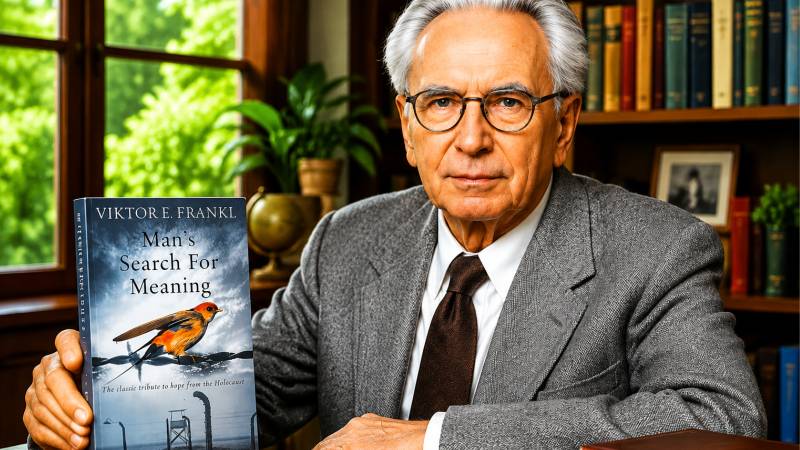
“Everything can be taken from a man but one thing: the last of the human freedoms to choose one’s attitude in any given set of circumstances, to choose one’s own way.” Viktor Frankl
Viktor Frankl (1905-1997) was an Austrian neurologist, psychiatrist, philosopher, and Holocaust survivor. He wrote 39 books, of which the best-selling autobiographical one Man’s Search for Meaning is based on his sufferings as a prisoner in Nazi concentration camps, where he lost his parents, wife and brother. This book remains highly consequential not because humanity has learned from suffering, but because suffering remains one of the defining realities of our age. Today, millions of people around the world live under war, displacement, occupation, surveillance and dehumanisation. Frankl’s central question of how does one retain humanity when stripped of dignity, freedom and hope, remains highly relevant.
Unlike many psychological theories that focus on pleasure or power, Frankl developed “logotherapy” that the primary human drive is the search for meaning, not pleasure or power. He argued that even amid unimaginable suffering, human beings retain one final freedom: the ability to choose their response to circumstances. In concentration camps, Frankl watched fellow prisoners perish not only from hunger and disease but from the collapse of inner purpose. These prisoners lost all sense of future and died psychologically before their physical death. Conversely, some survived because they clung to some hope- however faint- of seeing loved ones again, completing some unfinished work, or preserving moral integrity in circumstances designed to destroy it.
Frankl did not claim that suffering was noble or easy. Rather, he insisted that meaning could be discovered despite suffering. Today, when millions are made to normalise violence and oppression as inevitable facts of political life, this distinction is important. Modern persecution may differ from those of the concentration camps, yet the underlying mechanisms of dehumanisation remain same. Entire populations are reduced to “data”, killing of innocent civilians becomes “collateral damage”, dissidents become “traitors”, freedom fighters become “terrorists”, immigrants become “parasites”. Once people are stripped of individuality, cruelty becomes easier to justify. Frankl understood this process intimately. Concentration camps sought not merely to kill but to erase one’s identity itself. Prisoners lost names, possessions, autonomy and social identity. Today, we see similar patterns in states denying the humanity of targeted groups. The language may have changed; the moral logic has not.
Consider children growing up amid the bombardment in Gaza or Lebanon, families trapped in Sudan’s civil war, or the Rohingya Muslims confined to densely populated refugee camps in Bangladesh. Consider migrants drowning in the Mediterranean while wealthy nations debate border control more passionately than human life. Across the world, political systems communicate the same brutal message: your suffering does not matter.
Once people are stripped of individuality, cruelty becomes easier to justify. Despair becomes manageable when people see no purpose beyond pain itself.
Frankl’s insights challenge both victims and observers in such moments. For victims, he offers psychological resistance. When external freedoms disappear, preserving inner meaning becomes an act of defiance. In camps where prisoners were reduced to numbers, acts of kindness, prayer, humour or love became forms of resistance. This idea is vital because authoritarian systems survive not only on physical control but on emotional exhaustion. Oppression succeeds when people internalise the belief that resistance is meaningless. Frankl rejected this surrender as he believed meaning can survive even where justice does not.
Frankl’s work also confronts those who witness suffering from a distance. We have adapted to the sight of human suffering through endless images of bombed hospitals, starving children and dead victims, producing compassion fatigue rather than moral urgency. The TikTok videos may change but the victims remain. Frankl warned when societies lose deeper moral purpose and their political cultures are driven by consumerism, greed and profit, an “existential vacuum” results. This “moral numbness” is perhaps one of the greatest dangers of our time.
Frankl’s also believed that a society without meaning becomes vulnerable to hatred because hatred offers false certainty. Oppressive systems flourish when fear overwhelms moral imagination. The current genocide in Gaza and its support by many liberal Western governments demonstrate how even educated societies descend into and support barbarism, while convincing themselves they are acting rationally. Around the world, democratic norms are eroding as dissent is criminalised, journalists are threatened, universities are pressured into silence and minorities are scapegoated. History shows that persecution rarely begins with mass killing but with language that normalises exclusion and indifference.
Frankl’s emphasis on individual moral choice becomes especially important here. He observed that even within concentration camps, some prisoners retained compassion while some guard retained traces of conscience. Human beings, he argued, are never fully determined by circumstances alone. We remain responsible for our choices, however restricted.
Frankl rejected selective ethics- condemning atrocities by rivals but excusing similar one by allies. Meaning rooted in human dignity must apply universally or it collapses into hypocrisy. Grief and suffering acknowledged honestly was central to his philosophy. Despair becomes destructive when people see no purpose beyond pain itself. This insight holds lessons for societies traumatised by war or repression as they cannot heal solely through economic reconstruction. They require narratives of shared humanity capable of transcending cycles of revenge. The search for meaning cannot remain an individual psychological exercise detached from social justice. A meaningful society is one where dignity, truth and compassion are protected collectively, especially for the weak and vulnerable.
Man’s Search for Meaning speaks to the central struggle of the human condition: whether suffering will reduce us to bitterness and cruelty or deepen our capacity for humanity. Frankl emerged from the concentration camps convinced that even in history’s darkest moments, human beings retained the possibility of moral choice. That belief may appear fragile amid today’s wars and persecutions, yet abandoning it entirely would mean accepting a world where power alone determines whose lives matter- precisely the kind of world Frankl warned us against.