

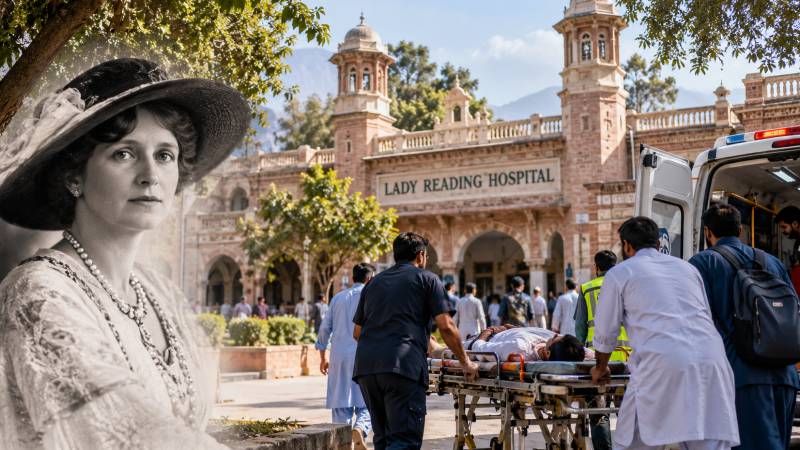
The Lady Reading Hospital (LRH) in Peshawar once again found itself at the epicentre of tragedy this week following the devastating collapse of a school building in the provincial capital. With more than 30 schoolchildren and a teacher reportedly killed and dozens more seriously injured, LRH received 61 casualties within a matter of hours. As with virtually every major emergency in Khyber Pakhtunkhwa, the hospital stood as the frontline of the life-saving medical response. Yet, beyond the immediate tragedy, the hospital's history offers another reason to reflect on its significance: for nearly a century, an institution associated with a British Jewish woman has served generations of Pakistani Muslims.
Historical narratives of South Asia are predominantly framed through the prisms of political conflict, communal factionalism, the traumatic legacy of Partition, and the institutional mechanics of British colonial rule. While imperial statecraft is frequently commemorated through grand architecture, including forts, palaces, and administrative monuments, a parallel history exists alongside these familiar symbols. It is a history defined by quiet acts of humanism that crossed religious, ethnic, and geographic divides. The Lady Reading Hospital in Peshawar stands as one of the most prominent monuments to this parallel legacy.
The establishment of the hospital is intimately tied to Alice Edith Isaacs, Marchioness of Reading. As the wife of Rufus Isaacs, the 1st Marquess of Reading and Viceroy of India from 1921 to 1926, Alice occupied a central place within the imperial establishment. Yet her public life was largely defined by civic philanthropy, maternal healthcare, and child welfare across the subcontinent. Local accounts frequently attribute the hospital’s origins to a Viceregal visit to Peshawar in February 1925, during which Lady Reading was reportedly injured in an equestrian accident while riding in the area. Institutional records credit her with a foundational donation of Rs. 52,000 (with some secondary accounts recording Rs. 50,000), which helped galvanise a broader fundraising campaign supported by local elites and philanthropists. This collective effort culminated in the construction of the hospital’s iconic Bolton Block, formally inaugurated in 1927.
In an era where historical narratives are increasingly weaponised along rigid religious, ethnic, and national lines, the enduring legacy of Lady Reading Hospital asserts a quieter, universal truth: human vulnerability knows no dogma, and compassion recognises no borders.
In an era where historical narratives are increasingly weaponised along rigid religious, ethnic, and national lines, the enduring legacy of Lady Reading Hospital asserts a quieter, universal truth: human vulnerability knows no dogma, and compassion recognises no borders. Over time, LRH grew from a colonial-era hospital into one of Khyber Pakhtunkhwa's principal tertiary healthcare institutions. It has served families from across the province, residents of the former tribal agencies, refugees, civil servants, and working-class communities. Its growth and continued operation owe much to generations of Pakistani doctors, nurses, administrators, and support staff who have cared for patients and sustained its services. Lady Reading’s gift opened the chapter, but generations of Pakistanis wrote the book.
Today, when families arrive at LRH in search of emergency treatment, the religious identity or nationality of its original benefactor is unlikely to be their concern. They come because someone they love is injured or ill, and they need medical help. What matters is whether the hospital can provide it. That is how institutions acquire a life beyond their origins. Lady Reading, Alice Edith Isaacs, could not have known all the people who would eventually depend on the hospital associated with her name. Nor could she have anticipated the political and historical changes through which it would pass. Yet her contribution became part of a larger story, sustained by local philanthropy and the work of generations of Pakistanis.
Empires disappear, governments change, and political boundaries shift. Institutions that serve the public can endure through these changes, provided society continues to sustain them. Lady Reading Hospital's history reminds us that compassion does not belong to any single religion, nationality, or political tradition. A good deed can travel beyond the boundaries that divide people, touching lives its author will never know.