

Borders are designed to separate. They tell us where one country ends and another begins, who belongs and who does not. Few borders have done this more violently than the one that cut Punjab in two in 1947. It created two Punjabs, placed millions on opposite sides of a line, and turned neighbours into citizens of rival states.
Yet listen closely, and the border begins to dissolve. The same songs echo at weddings in Lahore and Ludhiana. The same jokes survive in villages separated by visa regimes. The same language is spoken all over the world wherever children with Punjabi ancestry and grandparents live. Politics divided Punjab. Culture refused to.
That is why there was something quietly significant about watching Diljit Dosanjh perform on The Tonight Show Starring Jimmy Fallon. It wasn't simply another South Asian success story or another celebrity appearance on American television. It was a reminder that one of the world's most influential cultures no longer fits neatly inside the borders of a nation-state.
Punjab has never belonged entirely to India or Pakistan. It belongs just as much to the millions who carried it with them.
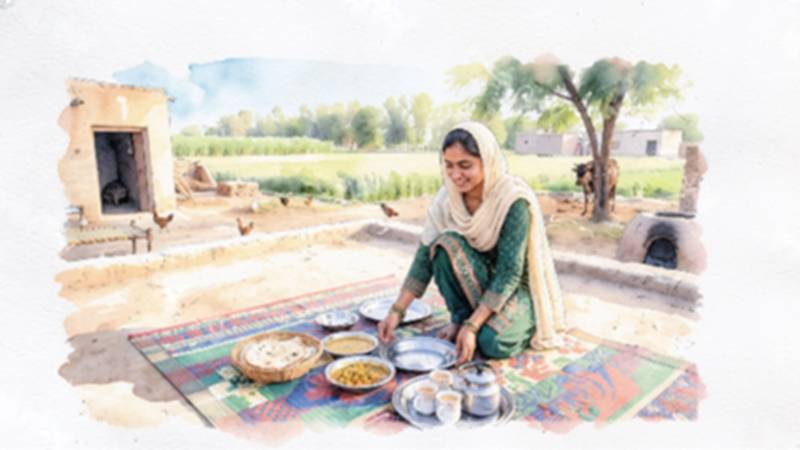
Punjab has always been bigger than the line drawn across it – for millions of people, it survives not as a territory but as a language spoken at home, food shared around a table and stories passed from one generation to the next
The story does not begin with streaming, nor does it begin with Diljit Dosanjh. Long before Spotify playlists and Coachella stages, Punjabi voices travelled across borders that politics insisted should remain closed. If you grew up in either Indian or Pakistani Punjab, chances are the soundtrack wasn't confined by the border. Abrar-ul-Haq's irreverent hits found listeners across Punjab. So did Naseebo Lal's powerful folk singing and Gurdas Maan's timeless ballads. These weren't ‘Indian’ or ‘Pakistani’ songs in the way politicians like to sort culture. They were simply Punjabi. People claimed them because they recognised something of themselves in them.
That's what makes Punjab different. Partition split the land, but it never really split the culture. The border is real; you feel it in visa applications, security fences and decades of political mistrust. But then you watch thousands of Sikh pilgrims cross through the Kartarpur Corridor to visit one of their faith's holiest sites in Pakistan. Or you attend a Punjabi wedding in Birmingham where the playlist moves effortlessly between artists from both sides of the border, and nobody stops to ask which country a song came from.
Punjab has always been bigger than the line drawn across it. For millions of people, it survives not as a territory but as a language spoken at home, songs played at weddings, food shared around a table and stories passed from one generation to the next. That's why it can feel just as present in Lahore or Amritsar.
For decades, we assumed that globalisation would make cultures more alike. Instead, Punjab suggests something different. It shows how a deeply rooted regional culture can travel the world without becoming less itself. It asks audiences to meet it on its own terms, carrying its own language and history.
If one wants to explore further the history and culture of Punjab, Jugnu Mohsin is giving a masterclass on the sociopolitical and cultural history of Punjab on her YouTube channel, JugnuNama.
That may be the real Punjabi moment. Not that the world has finally discovered Punjab. Instead, it is that Punjab has quietly demonstrated something politics rarely can: nation-states may divide people, but culture still has the power to gather them back together.