

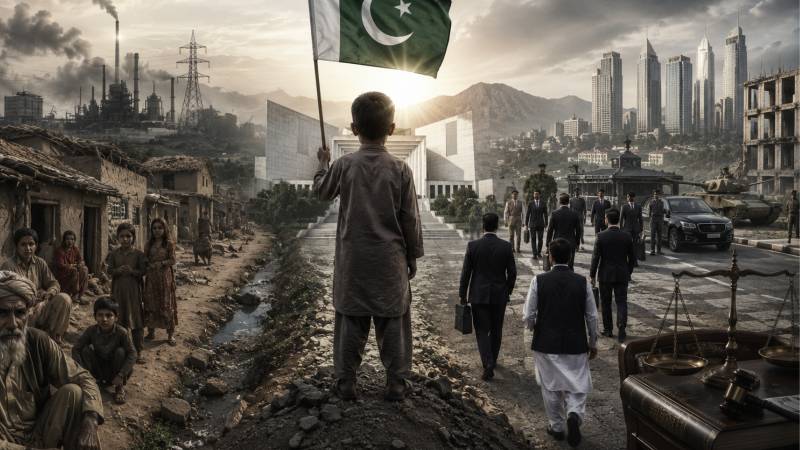
Pakistan's 79th birthday, or more commonly Independence Day, is around the corner. The PM, the President, the bureaucrats, and the feudal and tribal lords would take part in celebrations and felicitate the nation on freedom, make renewed political commitments, and reiterate their repeatedly betrayed promises. Amidst pledges and reaffirmations, the two questions would, this year too, remain unanswered, if not unasked: Is independence a lived reality for the masses in Pakistan? And do speakers and stakeholders truly care for the freedom of the masses?
Of all the schisms that define our society—polarized polity, socio-economic divide, digital divide, educational divide, ethnic and legal divide—the freedom divide, or a disproportionate freedom between the rulers and the ruled, triggers the most fallout for the country. That is, the differential extent of freedom enjoyed by the rulers and the ruled, and its implicit redefinition up to absoluteness by the stakeholders, sweeps away most of the freedom that the partition of the subcontinent had promised. In other words, the power elite has all freedom—regardless of its morality, legality, and constitutionality—and is at liberty to do what serves it. Corruption. Mismanagement. Abuse of authority. Oppression of the people. This includes the cultivation of systematic slavery, submission, and compliance.
The ruled, however, have had even their rights and liberty crucial for their survival largely curtailed. Life of dignity. A minimal freedom of thought. And liberty to choose what's and who's good that affects them. The little freedom the people have been left with is being made to surrender, particularly by the incumbent dispensation, as the minimal rights and liberty that life demands have largely and systematically been constrained over the decades. All in the imperatives and name of potential prosperity. Vague national interests. Ambiguous national security. Selectively defined patriotism. Sham democracy. And a clergy lording over the fate of the people's faith. All defined by the powerful and proverbial victors.
Of all the schisms that define our society—polarized polity, socio-economic divide, digital divide, educational divide, ethnic and legal divide—the freedom divide, or a disproportionate freedom between the rulers and the ruled, triggers the most fallout for the country.
Paradoxically and predictably, the more people are made to surrender their liberty on the promise of prosperity and national security, the more the people find themselves insecure, impoverished, and enslaved. The ironic outcomes reflect a bitter reality: all the surrender of people’s liberty is truly sought for and capitalized by the powerful lot for their vested interests. Not always that of the nation.
The capitalization of stolen public liberty in all names and pretexts has disproportionately emboldened and entrenched the stakes of the powerful elite more than the people. The institutions and individuals, having outstepped their bounds via constitutional and legal tweaks and encouraged by the surrendered public liberty under different pretexts, do all at their will and engage in all acts that serve their vested interests, with all the costs ultimately borne by the erstwhile marginalized people.
From the extended institutional mandate to the selective allotment of funds; from extending the mandate of NAB to 50 million to fixed electoral practices; from the concentration of wealth to the almost absolute immunity—the freedom offers absolute liberty to the powerful lot. They might say the worst independence is better than the best slavery—what if the worst independence transforms into the worst form of slavery? The powerful's promise of constraining public liberty as national security and interest is tantamount to Uncle Sam's promises of civilizing the countries of the world via planned regime change operations.
Unless the meanings and definitions of liberty, national security, national interest, patriotism, and democracy are defined in line with constitutional provisions, we as a society would be chained in multiple layers of slavery painted with the promise of independence. And unless we celebrate partition as the ultimate manifestation of freedom, the chains would keep us beholden.
Pakistan's independence delivered sovereignty and identity but struggled with nation-building, coups, elite pacts, and security dilemmas. Formal independence isn't "slavery," yet the gap between constitutional ideals and practice fuels cynicism. Sustainable progress requires stronger civilian institutions, accountability, economic openness, and reduced tutelary military roles—not just rhetoric.