

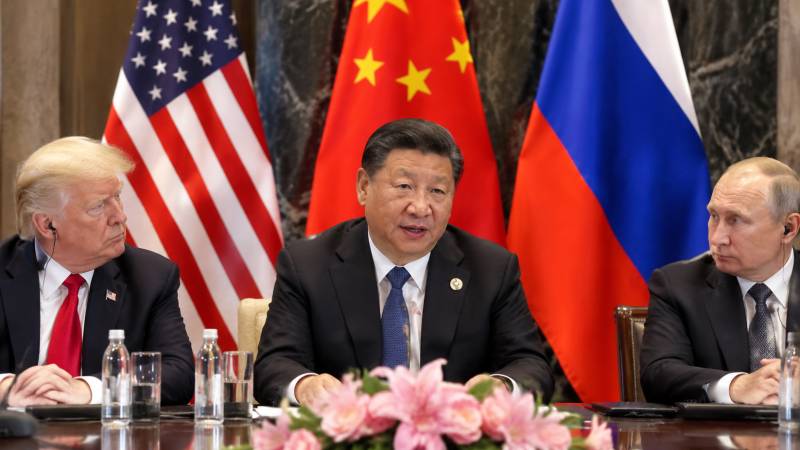
On 19 November 2026, Chinese President Xi Jinping hosted the first trilateral meeting of the leaders of China, the United States, and Russia at Kylin Villa in Shenzhen. The ninety-minute session, held alongside the APEC summit, led to a four-point declaration. The three permanent members of the UN Security Council agreed to support UN reform for better responses to global challenges, increase the production and supply of refined petroleum products to help stabilize energy flows, uphold state consent and official immunities to prevent misuse of jurisdiction by the International Criminal Court and similar bodies, and reaffirm that a nuclear war cannot be won and must never be fought. They also agreed to continue dialogue on reducing nuclear risks and preventing proliferation.
Chinese state media called the meeting groundbreaking. Xi described it as positive, constructive, and fruitful. The format, with China as host and the other two powers accepting the invitation, shows a practical approach to multipolar coordination. This is not a return to the spheres-of-influence diplomacy of the mid-twentieth century. The meeting did not result in territorial settlements, enforcement mechanisms, or a timetable for more talks. Its value is in establishing direct dialogue among the three largest nuclear and economic powers at a time when bilateral channels are strained, and two conflicts are ongoing.
The nuclear section repeats a long-standing position but also opens the door for talks on reducing risks. As strategic stability is challenged by new technology and the lack of formal arms-control agreements, the promise to keep talking is important. The energy section addresses a shared interest in refined-product markets, which have been tightened by sanctions and disruptions from the Iran conflict. Putting increased supply on the agenda shows a desire to reduce wider economic effects beyond those directly involved in the conflicts. The language on state immunities and the ICC matches long-held views in Beijing and Moscow and supports China's principle of sovereign equality. UN reform is presented as a shared duty of the permanent members. These are modest but meaningful points of agreement. They do not solve the war in Ukraine or the conflict with Iran, and do not claim to. Putin said the declaration did not set ambitious goals. Trump called the talks successful. The participants themselves recognized there were no dramatic breakthroughs.
What sets Shenzhen apart is China's ability to bring leaders together. While many have said that great-power coordination is now impossible, China managed to get all three leaders in the same room and agree on a joint statement. Holding the meeting alongside a larger Asia-Pacific event shows Beijing’s preference for including dialogue within bigger multilateral gatherings. For countries that support multipolarity, seeing the three leaders together means more than just a photo opportunity. It shows that the biggest powers can still find common ground on nuclear risk, energy, and institutional rules, even as broader competition continues.
In many capitals outside the three, the meeting is seen as proof that managed coexistence is still possible. In Islamabad, the joint statement stands out for its focus on state immunity and energy stability, which are important to governments that prefer bilateral relations and are cautious about broad jurisdictional claims. The meeting does not change Pakistan’s ties with Beijing or Washington, but it shows that major powers can still reach limited agreements when their interests align. Pakistani analysts note that the nuclear-risk language matches their preference for reducing risks. The fact that China hosted the meeting without asking countries to give up existing partnerships shows that multipolar formats do not have to force zero-sum choices.
For countries that support multipolarity, seeing the three leaders together means more than just a photo opportunity. It shows that the biggest powers can still find common ground even as broader competition continues.
Saudi and Gulf observers have paid attention to the petroleum section. Although the statement does not mention specific volumes or deadlines, the promise to increase refined-product supply is a helpful sign during a tight market. Direct commercial deals are still the main tool of Gulf energy policy; the Shenzhen statement does not replace them, but it is not ignored. The three major powers’ recognition of the need for more stable supply helps reduce some policy uncertainty. Iranian commentators have noticed the focus on immunity and nuclear risk, pointing out that the declaration does not dictate an outcome for the current conflict. Tehran’s decisions are still shaped more by bilateral pressure and regional deterrence. The renewed support for sovereign immunities matches Iran’s objections to selective use of international criminal law. Turkish observers note that middle powers were not included, but they see the format as matching Ankara’s preference for working on specific issues rather than joining rigid groups. The fact that the three could meet and agree on a joint statement without demanding alignment fits with the idea of multi-alignment.
European reactions have been more reserved. Officials in Berlin and Paris called the summit mostly a photo opportunity and repeated that decisions about European security cannot be made without Europe’s involvement. This response is not surprising; it highlights the difference between a meeting meant to create a channel among the three powers and a conference aimed at settling Europe’s political future. The permanent members of the Security Council still have special responsibilities for nuclear risk and institutional reform. The Shenzhen format does not replace current European security talks; it focuses on a smaller set of issues where the three powers share interests.
That same week, the Quad held a brief meeting during the ASEAN summit in Manila. India, which currently chairs the group, did not host the meeting; it took place in a non-member country after a planned summit in New Delhi fell through. The contrast with Shenzhen is telling. While New Delhi highlights its strategic independence and the limited results of the Quad meeting, the main discussion among the three largest powers took place elsewhere, hosted by China. Right now, large middle powers are more often participants in secondary formats than co-creators of major great-power dialogue. The brief Manila meeting, compared with the more substantial but still limited outcome of the Shenzhen trilateral, shows the current ranking of diplomatic influence. India is still a key regional power, but at this time, it is not an equal partner in the talks that shape the limits of great-power coordination.
Shenzhen does not signal the start of a new order, and it does not claim to. It shows that China brought the other two leaders together, that they agreed on a joint statement about nuclear risk, energy, sovereign immunities, and UN effectiveness, and that they saw the outcome as a starting point, not a final deal. For countries that value ongoing communication among the permanent members and prefer dialogue over escalation, this is a real achievement. The wars continue, and major disagreements remain, so more meetings will be needed if the dialogue is to become more meaningful. The fact that the first meeting happened in Shenzhen, with China hosting, clearly shows where the ability to organize ongoing great-power coordination lies right now. At a time of competing ideas about world order, getting the three largest powers together to agree on a joint statement is rare. China has shown it can do this. Whether this channel will reduce risks or just manage them depends on whether all three are willing to keep talking. The first step has now been taken, with China leading.