

“You can lead a horse to water, but you can’t make it drink.”
The world is full of great stories, successful people and valuable advices. Books, interviews, documentaries and podcasts have made the lessons of extraordinary lives more accessible than ever. Yet advice only works when people are willing to listen and act on it. Sir Richard Branson’s story is one such case study, and it could fill several films without running out of material. Here are some lessons to be drawn from a life that has rarely followed the conventional script.
Sir Richard Branson was hardly the model schoolboy. By his own account, he struggled academically, finding even basic arithmetic difficult. He also struggled with dyslexia, which could easily have become a genuine limitation, or at least an explanation for why he should expect less of himself. He chose neither. Branson has never hidden his dyslexia; instead, he takes pride in what he has achieved despite it. More importantly, he learnt to play to his strengths rather than remain preoccupied with his weaknesses. The lesson is simple: you cannot choose the cards you are dealt, but you can decide how well you play them.
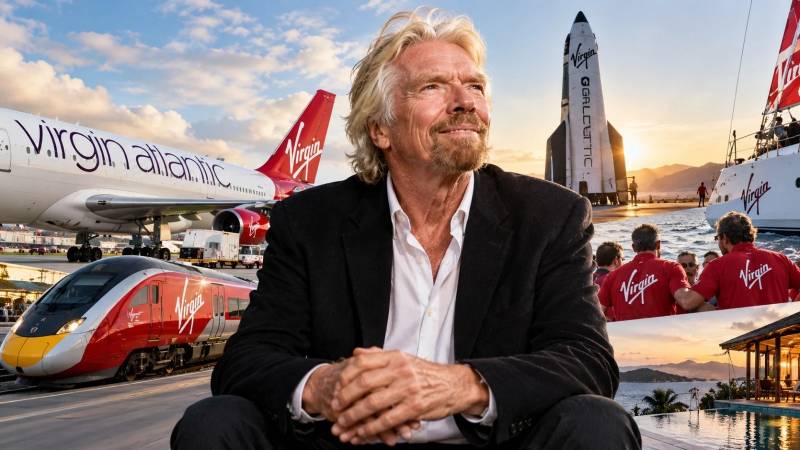
Diversification is another important lesson from Branson’s career. Growing up, many of us are told that the sensible approach is to choose a field, stick to it and build consistency. Branson clearly did not receive that memo. Virgin began in the 1970s as a mail-order record business, which eventually grew into Virgin Records. Then came the rather unusual decision to enter the aviation industry. After becoming frustrated with the service provided by an airline he had travelled with, Branson saw an opportunity to do things differently. This eventually led to the launch of Virgin Atlantic, which went on to compete with established carriers such as British Airways. Other ventures followed, spanning railways, mobile services, hospitality and financial services, among other sectors.
Dyslexia did not define him, industry boundaries did not contain Virgin, and problems often became opportunities to explore new possibilities. Perhaps that is what makes Branson such an interesting example of entrepreneurship: he has spent much of his life questioning why things must be done the way they have always been done.
It is the sort of diversification a schoolteacher might politely describe as “not quite focused enough”. Yet there was a method behind it. Wherever Branson identified a problem, he saw the potential for a business. His approach was not simply about entering a new market; it was also about offering customers a better experience. There are plenty of airlines, railways, mobile networks and hotels, so why should anyone choose Virgin over the alternatives? The answer lies in the brand Branson built around a simple promise: to offer people a better experience. Virgin Atlantic, for example, became known for challenging the conventions of air travel, introducing innovations such as seat-back entertainment and, later, its fully flat-bed Upper Class Suite.
Branson’s focus, however, was not limited to customers. He has repeatedly spoken about creating a culture in which employees feel proud to work for Virgin and are encouraged to keep reinventing the brand. Virgin itself describes its purpose as putting its people and customers at the heart of its products and services. Perhaps that is the more lasting lesson: a logo can identify a company, but the experience people associate with it is what gives a brand its reputation.
Branson’s life has not always been easy. During the COVID-19 pandemic, he spoke about experiencing what he described as the lowest point of his life, as Virgin’s businesses came under enormous pressure. He has said that keeping himself busy with work left him with little time to dwell on his emotional state, while physical activity was another important part of his routine. In one interview, he spoke of engaging in four to five hours of physical activity a day. Rather than stepping away from the crisis, he worked to protect his businesses and employees. He described Virgin as being rather like his child, arguing that a child cannot simply be neglected when things become difficult. This may not be an approach that works for everyone, but Branson’s response was straightforward: when circumstances could not be changed, he focused on changing how he responded to them.
The lessons from Sir Richard Branson’s career will not create another Richard Branson, nor do they constitute a secret formula for success. Nevertheless, there is much to learn from a life that has produced and built so much. Different people will draw different lessons from his journey, depending on where they are in their own lives and careers.
Branson has repeatedly refused to let conventional thinking define his ambitions. Dyslexia did not define him, industry boundaries did not contain Virgin, and problems often became opportunities to explore new possibilities. Perhaps that is what makes Branson such an interesting example of entrepreneurship: he has spent much of his life questioning why things must be done the way they have always been done. And, rather impressively, he has built quite a business out of refusing to accept “that’s how it’s done” as the final answer.