

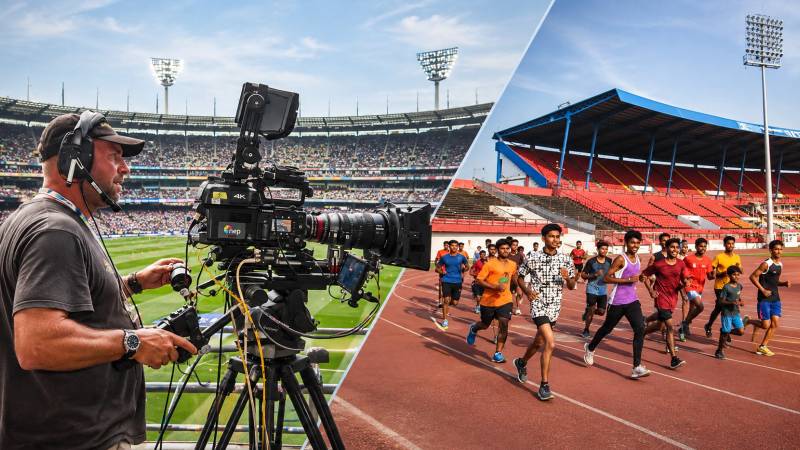
When examining the evolution of South Asian sports, a stark divergence emerges between two national broadcasters. On one side, India’s Doordarshan operated as a foundational catalyst, planting the seeds of multi-sport excellence that today manifest in major international medal hauls. On the other, Pakistan Television’s sports broadcasting presents a cautionary tale of a state-controlled system that largely faltered in its mandate, buckling under bureaucratic inertia and failing to nurture a vibrant grassroots sporting culture. Observers across the region frequently argue that missed opportunities by state media crippled the development of non-cricket sports in Pakistan, while India successfully democratised access and helped build a formidable sports economy.
A national broadcaster’s primary duty is not merely to telecast lucrative matches to urban audiences, but to act as a mirror and motivator for the entire country especially at the grassroots level. Doordarshan recognised early on that a child in a remote town cannot aspire to become what they cannot see. By consistently broadcasting national championships in athletics, hockey, wrestling and badminton, Doordarshan brought heroes from obscure districts into millions of households. This persistent visibility helped create a psychological blueprint for ambition, inspiring generations to step onto local fields and pursue sports beyond recreational games.
Conversely, sports analysts and critics frequently note that PTV Sports remained constrained by a rigid, bureaucratic framework. Instead of acting as a nursery for diverse athletic talent, it evolved into a narrow platform primarily focused on high-profile cricket. Regional tournaments, domestic athletics, hockey and squash—sports that once brought Pakistan global glory were relegated to obscurity. Without screen time, local heroes attracted few sponsors, received limited community backing, and offered little visible inspiration for young people at the grassroots level.
The structural philosophy of state broadcasting also shaped how both nations transitioned into the modern era of sports entertainment. Doordarshan’s early democratisation of sports helped build a massive viewer base. When India liberalised its economy and private sports networks entered the market, they found an audience already familiar with and passionate about a wide array of sports. This healthy competition between public and private broadcasting helped create an economy in which athletes in disciplines such as shooting, boxing and track and field could acquire commercial value.
In contrast, sports broadcasting in Pakistan remained trapped within a state-controlled monopoly for too long. Industry reviews and public sentiment frequently highlight how PTV’s administrative bottlenecks, coupled with its sluggish adaptation to modern market economics, constrained sports development. Rather than fostering a competitive broadcasting ecosystem capable of generating revenue for regional sports federations, the system struggled even to establish sustainable domestic broadcasting rights, leaving non-cricket sports underfunded and neglected.
Without consistent television coverage, local athletes struggle for visibility, sponsorship and public support, weakening the entire sporting ecosystem.
Furthermore, the economic ripple effects of broadcasting strategies cannot be overstated. When a state broadcaster actively covers regional tournaments, local sponsors, municipal authorities and regional sports bodies take notice, creating a sustainable financial cycle that can ultimately benefit individual athletes. In regions where sports broadcasting failed to evolve, athletes were often left stranded, forced to self-fund their journeys to international competitions while watching their administrative bodies succumb to institutional apathy.
The long-term cost of a failing national broadcaster is measured in lost potential and declining medal tallies. Because public and private media helped keep diverse sports alive in the public consciousness, India’s modern athletic ecosystem successfully transitioned into a multi-sport powerhouse, regularly securing strong medal hauls at continental and global events. Meanwhile, sports commentators and fans frequently express concern over Pakistan's steep decline in fields such as hockey, squash and track and field. When a national broadcaster fails to invest in grassroots storytelling, the entire sporting pyramid can weaken from the bottom up. Without adequate coverage of domestic sporting structures, federations struggle, talent pipelines deteriorate, and international representation shrinks.
The contrast between Doordarshan and Pakistan’s state sports broadcasting underscores a vital truth: a national broadcaster is more than a television channel—it can be a custodian of a nation’s sporting culture. While Doordarshan helped build a bridge from local playgrounds to international podiums, Pakistan’s state broadcasting system failed to consistently look beyond immediate and commercially safe programming, leaving grassroots sports underserved. This institutional neglect contributed to sporting environments in which elite talent could wither before ever reaching the international stage. For any nation hoping to cultivate genuine sporting dominance, the lesson is clear: long-term glory begins when the camera turns its lens towards the local fields where dreams are first born.