

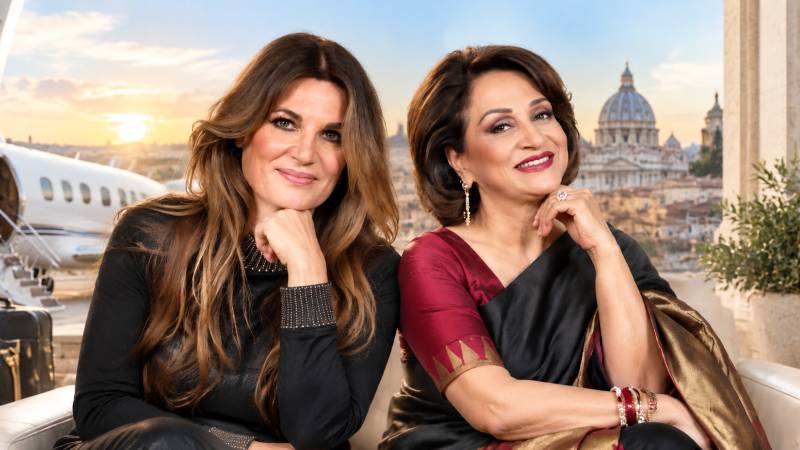
Jemima Goldsmith is 52 and has married again. Bushra Ansari spent about 36 years in her first marriage and later married again, to a younger man. Let me say this before anyone misunderstands me: I have deep admiration for both these women. They are two of my favourite women icons, for very different reasons. I am not interested in turning their marriages into gossip, morality tales or feminist trophies. Their lives belong to them. But their stories make me ask an uncomfortable question: when will ordinary Pakistani women be given the same social space to exercise personal choices as they grow older?
I also think of Erica Jong, a famous American author, ironically reminded of her pretty recently by a revered male reader of some of my writings, unasked, of course, because she refused the idea that a woman becomes socially interesting only up to a certain age. Jong wrote about desire, freedom, relationships, ageing and the unruly interior life of women without asking permission to sound respectable. I don't invoke her as a model for Pakistani women; our histories, classes and social realities are obviously different.
I invoke her because sometimes another woman's refusal reminds you that the rule was never a law of nature. It was a rule someone made. Not celebrity women. Not exceptionally wealthy women. Not women protected by enormous social capital. Not women whose names themselves provide a certain armour. The rest of us.Because ageing itself is not experienced equally by women. And class matters. A lot.
Money cannot buy happiness. It cannot guarantee a decent marriage, emotional peace, health, or a life without betrayal. But money, family name, education, professional standing, social networks and international mobility can buy something else: room. Room to defy. Room to say no. Room to leave. Room to remarry. Room to be eccentric, visible, difficult, even wrong. Class does not necessarily buy happiness or peace. It can, however, make defiance less expensive.
I think about Bushra Ansari with genuine affection and admiration. I also think about Jemima Goldsmith, whose recent second marriage at 52 has once again put an older woman's personal life into public view. She divorced Imran Khan in 2004 and has now married Cameron O'Reilly, 62, more than two decades later. Good for her. Why shouldn't a 52-year-old woman marry again? Why should a woman's romantic life have an expiry date? But then I ask myself how many Pakistani women of 52 have anything resembling the same social room.
Why should a woman have to be wealthy, famous, extraordinarily brave or exceptionally protected simply to say that she wants companionship, work, love, travel, writing, a different life, or simply the right to make a choice without explaining her age every time?
I ask this as a Pakistani woman myself. One passport. Single. No permanent paid job. I work as a consultant, a mazdoor consultant, if I am being honest about the insecurity underneath the respectable word “consultant”. I am aware of the intellectual and social risks of putting autobiographical lines into a piece like this, particularly as an “indecent writer” whose work is sometimes read more closely for the woman behind the argument than for the argument itself. So here is my disclaimer before someone supplies one for me: this is not my zaroratte-rishta piece.
Those who read my work closely have probably already guessed that there have been different Sahibs in my life, different kinds of men, different kinds of connections, different stories. After having had a life; a complicated one, with its own tenderness, losses, loyalties, disappointments and surprises. I find it almost impossible to look out for a man anymore. Or at least a Pakistani man. No offence.That sentence is partly a joke and partly not.
There are people in one's life who alter one's understanding of trust without becoming villains in retrospect. I have no wish to rewrite a long life as a courtroom transcript. I can have sweet memories. I can acknowledge someone's mentorship, influence or goodness in particular parts of my life. I can remain grateful for what was genuinely given. And I can still refuse to acquit a person of behavioural anomalies, unfairness or things that hurt.
Life is rarely black and white. Perhaps that is why I am suspicious of arguments about women, ageing and relationships that pretend it is. This is where our conversations about ageing women become too neat. We say women should be independent. Fine. But independent with what? An inherited house, a pension, a supportive family, a strong professional network, a bank account that can absorb the consequences, children who will stand beside her? For many urban, educated Pakistani women, especially those carrying years of family responsibilities, the issue is not simply whether they want freedom. It is what happens after they exercise it.
A woman leaves a bad marriage. Who helps with the rent? A woman refuses an abusive relationship. Who believes her? A divorced woman falls in love again. Who says, “Why not?” A widow says she wants companionship. Who doesn't laugh? A woman in her fifties talks about desire. Who doesn't turn it into a joke? And an older woman speaks about a powerful man who behaved abusively? Ah. Then the class act begins.
Suddenly there are questions. What was her own class? What was his class? What did she expect? Why was she there? Why did she speak now? Was there some misunderstanding? Was she too ambitious, too bold, too westernised, too emotional, too old to be making such a fuss? Or, after all that analysis, the anti-climax: “Oh, these feminists.” Sometimes the conduct of the powerful man disappears behind a fog of social interpretation. The woman becomes the case study or a diagnosis. The man remains the Sahib. And I have to ask: whose dignity are we actually protecting?
There is another little cruelty in our vocabulary: “sugar mummy”. We laugh. An older woman — “cougar”, clap clap clap for the English language with a younger man is quickly turned into a joke about money, desperation, cosmetics, sexuality or ageing badly. But the older man with a much younger woman often receives a different vocabulary: successful man, second marriage, young bride, family arrangement, respectable match.
Women can participate in this policing too. We call younger women “gold diggers” when they marry wealthy older men, as though their motives require investigation while the older man's motives require none. I don't want to romanticise either arrangement. Adults can marry for love, companionship, attraction, security, family expectations, money, or some complicated mixture of all of these. My point is narrower: why do we interrogate women's motives so differently from men's, and why does an older woman's desire become funny so quickly?
There is a Pakistani television story that I still remember for precisely this reason. Behadd, the 2013 telefilm written by Umera Ahmad and directed by Asim Raza, put Nadia Jamil's character, Masooma, a widow and mother, at the centre of a relationship with a younger man played by Fawad Khan. She was older than him, a mother, and a friend of his sister. The daughter's attachment to her mother becomes a central emotional conflict.
But this was not the first time Pakistani television had imagined a younger man and an older woman in a psychologically complicated relationship. Decades earlier, Ashfaq Ahmed's Maah-e-Kaan (1975) explored a young-man/older-woman relationship in a very different and much more psychologically layered frame. I have written about Maah-e-Kaan elsewhere in Urdu, and I mention it here because our television imagination has occasionally been more daring than our social conversation.
ماہِ کنعان: وہ منظر جو بچپن سے میرے ساتھ آیا
I remember thinking about Behadd: here was something unusual on Pakistani television. A younger man could look at an older woman and see a woman. Not someone's mother. Not someone's widow. Not someone's respectable middle-aged auntie. A woman. Imagine that.
Perhaps that is why these fictional stories stay with me. They give women, at least for a while, an imaginative space that real life often refuses them. Television can give women choices that society often doesn't. And this is where I return to Bushra Ansari and Jemima Goldsmith. I don't want to use either woman as proof that Pakistani women are now liberated. Their circumstances, class positions, public visibility and resources are different. But their stories expose something useful.
Age is not the whole story. Age plus money. Age plus class. Age plus family. Age plus economic security. Age plus social capital. Age plus whether people think you are “respectable”. These combinations produce very different lives. A rich woman can still be lonely. A famous woman can still be hurt. A privileged woman can still experience sexism. But privilege can provide a cushion that another woman simply does not have. Sometimes that cushion is what makes defiance possible.
I keep thinking about the ordinary woman — the teacher, doctor, NGO worker, bureaucrat, artist, consultant, widow, divorcee, unmarried woman, single mother who has spent thirty years carrying everybody else's burdens. She reaches fifty, then fifty-five, perhaps sixty, and suddenly society wants her to become grateful for invisibility. No more wanting, no more experimentation, no more anger, no more talking about sex, no more saying, “This happened to me.” بس اب عمر ہو گئی ہے . As if age itself is a punishment.
Perhaps this is the deeper class politics of growing old. Some women are allowed to age loudly, visibly, rebelliously. Some are allowed to marry again. Some can make mistakes in public and survive them. Others must calculate every move because one wrong decision can mean economic insecurity, family rejection, professional isolation or simply becoming the woman everyone discusses after she leaves the room.
So no, I am not arguing that Bushra Ansari or Jemima Goldsmith represent the average Pakistani woman. They don't. That is precisely why I admire them without pretending their lives are mine. I am asking something more modest and perhaps more radical: why should autonomy become a class privilege when ageing is universal? Why should only some women be allowed a second act? Why should a woman have to be wealthy, famous, extraordinarily brave or exceptionally protected simply to say that she wants companionship, work, love, travel, writing, a different life, or simply the right to make a choice without explaining her age every time?
Perhaps the real feminist question about ageing is not whether women can live longer. It is whether they can live more freely for those extra years. Because adding years to a woman's life is not the same thing as adding life to her years. And if freedom after fifty is available mainly to women who can afford the consequences of defiance, then we haven't democratised women's choices. We have merely made them easier for the privileged. Kab milegi woh ijazat? Not permission from a husband. Not permission from children. Not permission from society. Permission from the society that finally understands that an ageing woman is still a person: still inconvenient, still desiring, still capable of beginning again, still — very much — alive.