

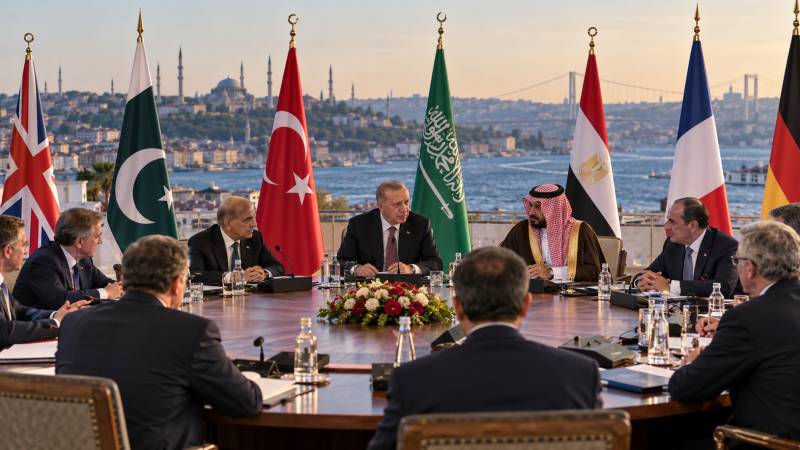
A particular kind of diplomatic gathering reveals more about the state of the world than a dozen grand declarations. It is the meeting that would have seemed unnecessary a decade ago, when the assumption was that Washington and its closest allies set the terms and everyone else negotiated within them. Istanbul showed how thoroughly that assumption has eroded. On 23 October 2026, Türkiye convened Pakistan, Saudi Arabia, Egypt and itself—the R4—with Britain, France and Germany, the E3. The seven-country meeting addressed Palestine, Yemen, the Strait of Hormuz, maritime security and the war in Ukraine. It was the first gathering in this format, held amid mounting regional instability and a growing need for direct consultation between European and regional powers.
Nobody should mistake a meeting for a realignment. These seven countries disagree on important questions, maintain different relationships with Washington and Beijing, and protect their own interests. That is precisely why the meeting matters. They have concluded that, on certain questions, none can afford to leave the others outside the room. For Pakistan, the significance is immediate. Islamabad has spent decades being discussed in the context of other people’s security problems. It now has a chance to help shape the diplomatic responses to them. Sustaining that role is another matter. Britain, France and Germany are not diminished powers. Their economies, industrial capacity and diplomatic networks remain substantial. Yet the problems they face increasingly lie beyond European decision-making alone. A European position on the Gulf means little without Gulf cooperation. A maritime security initiative cannot be implemented by communiqué. A Middle East formula is unlikely to survive reality if the countries most exposed to its consequences have little ownership of it.
Turkiye understands this better than most. NATO membership has not stopped it from pursuing an independent regional policy or keeping channels open to governments on opposing sides of major disputes. Its position between Europe, the Black Sea, the Caucasus and the Middle East gives Ankara strong reasons to resist confinement to a single strategic camp. Saudi Arabia has broadened its diplomatic and economic relationships while driving a major domestic transformation. Egypt brings regional weight through the Suez Canal and its role in Arab diplomacy. Pakistan contributes different assets: a nuclear deterrent, substantial military capabilities, a strategic relationship with China, and political connections across the Gulf and wider Asia. These countries are not equal in every measure of power and do not speak with one voice. Their leverage comes from different sources. Those sources increasingly matter to decisions major powers cannot settle alone. The old hierarchy has not disappeared. It has simply become harder to operate without negotiation.
Any serious account of the changing order that treats China as secondary is already outdated. Beijing’s influence rests on the factories that supply global markets, the infrastructure it finances, the technology it develops, and the commercial relationships it has built across the developing world. UN Trade and Development figures show the ten BRICS members’ share of global merchandise exports rising from roughly 12 per cent in 2003 to 24 per cent in 2024. Intra-BRICS trade reached about $1.17 trillion in 2024, up from $84 billion in 2003. China has been central to that expansion.
Geography is an asset only when put to work. A corridor that cannot move goods competitively is a line on a map. A port that fails to attract sustained commercial activity is an unrealised opportunity.
These numbers do not make BRICS a coherent political bloc. Its members compete, disagree and maintain ties with the United States and Europe. China has not displaced the Western financial system. Developing countries still face expensive borrowing and external shocks. Yet the shift expands options. More potential trade partners and investment sources mean greater bargaining room. Alternative infrastructure and financing arrangements, if financially sustainable, increase choice.
China has given developing countries a major economic partner outside traditional Western centres. The terms still require scrutiny; Chinese financing is not automatically advantageous, and dependence on one partner is not independence. For Pakistan, the China relationship remains an asset of unusual strategic value. The task is to extract more productive investment, stronger exports, technology transfer and industrial capacity from it, while maintaining commercial ties with Europe, the Gulf and other Asian economies. A stronger China partnership should widen Pakistan’s choices, not narrow them.
The India–Pakistan confrontation of May 2025 placed South Asia’s military balance and the risks of nuclear escalation under renewed international scrutiny. For Islamabad, the aftermath brought greater diplomatic attention and an opening to engage partners on deterrence, crisis management and regional stability. It did not resolve Pakistan’s economic weaknesses or guarantee a permanent improvement in its international position. Military credibility can affect an adversary’s calculations; it cannot repair public finances, build export industries or persuade investors to overlook unreliable regulation.
Pakistan’s geography has always been an argument in its favour. The country sits beside the Arabian Sea, near China’s western regions and within reach of the Gulf, Central Asia and South Asia. Its relationships give it access to diplomatic environments that do not always communicate easily. Geography is an asset only when put to work. A corridor that cannot move goods competitively is a line on a map. A port that fails to attract sustained commercial activity is an unrealised opportunity. A country consulted in a crisis but unable to offer dependable economic partnerships will see its influence rise and fall with the headlines.
Pakistan should use the post-2025 opening to facilitate communication where it has access, support de-escalation where interests converge, and convert strategic relationships into trade, investment and industrial cooperation. It need not claim a role in every dispute to become a consequential regional actor. The Makkah Joint Defence Agreement, signed by Pakistan, Saudi Arabia and Türkiye on 7 August 2026, adds a concrete security dimension. An armed attack against one signatory is to be regarded as an attack against all three. Pakistan’s Foreign Office has described the pact as defensive and not directed against any country. The arrangement combines different strengths: Pakistan’s military experience and nuclear deterrent, Türkiye’s defence industry, and Saudi Arabia’s financial resources and central position in Gulf affairs. Scope exists for cooperation in training, intelligence-sharing, defence production and strategic consultation.
The hard work begins after the signing. Partners must determine how commitments operate in a crisis, how decisions are coordinated, and how differing national priorities are managed. A defence agreement can strengthen deterrence, but credibility rests on clarity and implementation, not the language of the announcement. Qatar belongs in the wider picture through a different channel. Its mediation record and relationships across competing camps give it diplomatic utility that does not require membership in a defence pact. Egypt’s role in the R4 format should not be confused with membership in the Makkah agreement. Regional cooperation need not mean every partner joins every institution. The aim should be more effective regional diplomacy, not another inflexible bloc.
Pakistan’s greatest obstacle may not be a shortage of diplomatic opportunities. It may be the gap between external relevance and domestic economic performance. Foreign policy cannot indefinitely compensate for weak productivity, a narrow export base, unreliable energy supplies or uncertain rules for investors. Defence cooperation should be judged by whether it develops local skills, supports manufacturing, transfers technology and builds lasting capabilities, not merely by the equipment acquired. Islamabad needs to measure international agreements by concrete results. Does an investment raise exports? Does a transport project lower the cost of moving goods? Does a defence partnership build local production or create another procurement obligation? Can the country meet its financial commitments without undermining economic stability? These questions do not diminish geopolitics. They determine whether geopolitics produces lasting national power. Influence is earned repeatedly. It depends on reliability, judgement, economic capacity and the ability to offer partners something more substantial than a shared sense of strategic urgency.
Istanbul did not announce the end of Western power, the rise of an Eastern bloc or the triumph of middle powers. It showed something more practical: countries with different alliances and ambitions are finding that their interests require direct engagement even when agreement remains difficult. China’s economic reach has widened options for developing countries. Türkiye has demonstrated the value of keeping channels open across competing camps. Saudi Arabia is investing in a broader economic and strategic future. Qatar continues to offer distinct mediation capacity. Pakistan has the relationships and capabilities to contribute. It must now show it can turn them into results.
The opportunity is real but not unlimited. A more distributed distribution of power will not make the world less competitive. Smaller and middle-sized states may gain bargaining room, yet they will also face pressure from several directions. Strategic autonomy will depend as much on the strength of institutions and economies as on the number of partnerships maintained. Pakistan should approach this moment with ambition rather than self-congratulation. It can deepen ties with China without closing doors to Europe, strengthen cooperation with Saudi Arabia and Türkiye while preserving channels for regional diplomacy, and work with Qatar where mediation serves shared interests. The objective is not to be indispensable to everyone. It is to become a country whose participation matters because it can deliver. Pakistan’s post-2025 opportunity will be measured not by the prominence of the meetings it attends, but by what it can negotiate, what it can build, and what its citizens gain. That is the difference between being strategically relevant and possessing the national strength to make that relevance count.