

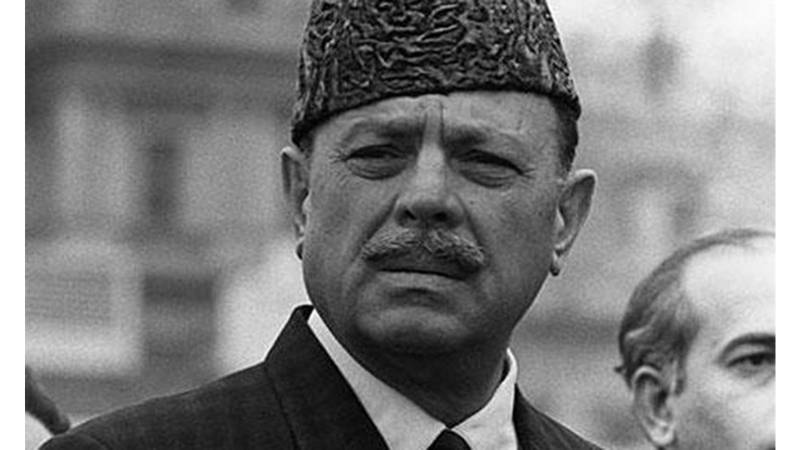
General Ayub Khan, the commander-in-chief of the army, seized power in a bloodless coup. He said it was his patriotic duty to save the nation from corrupt politicians. He set a precedent that would be imitated not once or twice but thrice by other army chiefs. Later, when civilians would ostensibly run the country, the army would rule from behind the scenes.
Jinnah’s vision for Pakistan was fated to die multiple times at the hands of those who professed to be honouring him with their actions. Their introductory speeches to the nation would always be delivered with Jinnah’s portrait hanging on the wall behind them.
Jinnah had envisaged Pakistan as a homeland for the Muslims of British India which would be governed in the Westminster style of governance—ie, a secular democracy. He could never even have imagined Pakistan being governed by generals.
Jinnah’s political vision contained several strands, whose interrelationships continue to be debated by historians:
- Constitutional government: Sovereign legislative institutions and government under law.
- Equal citizenship: Religious identity should not determine a citizen's political status.
- Religious freedom: The state should protect the freedom to practice one's religion.
- Social welfare: Pakistan should improve the lives of ordinary people, particularly the poor.
- Muslim self-determination: Pakistan should provide a homeland in which Muslims could develop their political and cultural life.
The clearest statement of his civic vision came in his address to the Constituent Assembly on the 11th of August 1947. Jinnah declared that citizens should be equal regardless of religion and that religion should have no bearing on the business of the state. He also stressed constitutional responsibility, impartiality, and the protection of religious beliefs.
Why October 1958 Matters
The events of October 1958 directly challenged the constitutional aspirations associated with Jinnah. They occurred in two stages.
In the first stage, on the 7th of October 1958, President Iskander Mirza abrogated the 1956 Constitution, dissolved the national and provincial assemblies, banned political parties, and imposed martial law. He appointed the commander-in-chief of the army, General Ayub Khan, as the chief martial law administrator. The national elections anticipated for early 1959 were cancelled.
US intelligence assessed that the coup was likely a preemptive move to stop upcoming elections that threatened to empower Bengali interests
In the second stage, on the 27th of October 1958, Ayub forced Mirza from office and assumed the presidency. The military now stood at the centre of political authority, rather than being subordinate to a functioning constitutional democratic order.
October 1958 was not merely another change of government. It marked the destruction of the existing constitutional framework and the cancellation of the anticipated transition to nationwide elections.
Had Jinnah’s Vision Already Begun to Unravel?
This is where the argument becomes more complicated. There is a strong case that 1958 was a culmination of earlier institutional failures rather than the moment when everything suddenly changed.
- 1948: Jinnah dies. Pakistan loses its founding leader before its constitutional order is settled.
- 1951: Prime Minister Liaquat Ali Khan is assassinated. The country loses its first prime minister amid an unsettled political transition.
- 1954: The first Constituent Assembly is dissolved. The constitutional process suffers a major setback.
- 1956: Pakistan adopts its first constitution. A parliamentary framework is formally established, nearly nine years after independence.
- 1958: Martial law is imposed. The constitution is abrogated, and representative institutions are dissolved.
The dissolution of the Constituent Assembly in 1954 is particularly important. It demonstrates that the weakening of parliamentary sovereignty preceded Ayub Khan's takeover. The Senate of Pakistan's historical account documents this sequence, including the eventual adoption and subsequent abrogation of the 1956 Constitution.
The military takeover did not occur in an otherwise stable democracy. Political instability, administrative dominance, conflicts among political leaders, and tensions between East and West Pakistan had already undermined the emerging constitutional system.
This matters because it distinguishes two arguments:
- The decisive-break argument: 1958 marks the point when the state openly abandoned constitutional parliamentary government.
- The gradual-decline argument: The institutions required to realise Jinnah's vision had been weakened over the preceding decade, making the 1958 takeover possible.
These explanations are compatible. One describes the culmination of a process; the other identifies the moment when that process produced a decisive institutional rupture.
It is useful to review what Ayub Khan had to say about the events of October 1958. His writings consist of Friends Not Masters: A Political Autobiography (1967) and Diaries of Field Marshal Mohammad Ayub Khan, 1966–1972, edited by Craig Baxter and published posthumously in 2007.
An important distinction is that the autobiography offers Ayub’s retrospective justification for taking power, while the diaries reveal his thinking during the final years of his presidency and afterward.
The diaries begin in 1966, eight years after the coup. They are therefore not a contemporaneous record of his decision-making in October 1958.
What Ayub Wrote in Friends Not Masters and in His Diaries
Chapter 6, entitled “The Revolution,” provides his most direct account. Ayub begins his narrative on the 4th of October 1958, as he travels to Karachi. He writes: “The hour had struck. The moment so long delayed had finally arrived.”
He then describes the political situation as intolerable, arguing that civilian politicians had become trapped in intrigue and incompetence. Ayub says President Iskander Mirza had already decided to intervene. When Ayub met him in Karachi on the 5th of October, he asked whether Mirza had made up his mind. Mirza replied that decisive action was necessary.
Ayub characterises the intervention as: “It was the last bid to save the country.” His narrative is revealing because it does not depict the military takeover as a completely spontaneous response to events on the 7th of October. He acknowledges discussions with Mirza before martial law was imposed. He also describes how military preparations were made and how the takeover was implemented. His account therefore establishes that the military intervention was contemplated before the constitutional order was formally abolished.
Ayub reproduced his public statement of the 17th of October, in which he argued that martial law would remain until the government had addressed the country’s political, economic, and administrative problems. He identified land reform as an early priority, with a Land Reforms Commission established on the 31st of October. This was central to his justification: military intervention would supposedly make possible reforms that civilian politicians had been unable or unwilling to implement.
Ayub’s account presents the relationship with Mirza as increasingly untenable after the 7th of October. The important distinction is that Ayub was already Chief Martial Law Administrator before he removed Mirza. Thus, the 27th of October was not the beginning of military intervention but the elimination of the remaining competing authority at the top of the regime.
Ayub’s diaries offer a different perspective. Ayub began keeping them on the 2nd of September 1966. In his introductory note, he explained that writing Friends Not Masters from memory had been difficult and that he wanted to preserve a contemporaneous record for a possible sequel. The diaries cover his final years in office, his transfer of power to Yahya Khan in 1969, and the breakup of Pakistan in 1971.
Consequently, they are especially useful for examining whether Ayub’s understanding of military intervention changed after he experienced another transfer of power to an army commander.
Of course, Ayub’s diaries offer his viewpoint. How valid are his views? A particularly important document is the American State Department intelligence memorandum dated the 9th of October 1958, just two days after martial law was imposed. It reached a conclusion that differed substantially from Ayub’s account.
American intelligence assessed that Mirza and Ayub were apprehensive about the general elections scheduled for February 1959. The memorandum suggested they feared the emergence of a government more responsive to Bengali interests and demands for greater provincial autonomy.
This raises a significant question about Ayub’s justification. Was the intervention primarily intended to rescue Pakistan from political disorder, as Ayub maintained? Or was it also intended to prevent an electoral outcome that might redistribute power away from the existing establishment? The two explanations are not necessarily mutually exclusive, but they suggest very different interpretations of the coup.
The most revealing comparison may be seen from this table:
| Question | Ayub’s retrospective explanation | Other historical evidence |
|---|---|---|
| Why intervene? | Political breakdown and administrative disorder | Also concerns about the approaching elections |
| Why abolish the Constitution? | Existing institutions could not govern effectively | The intervention eliminated constitutional constraints |
| Why retain martial law? | To implement essential reforms | It also consolidated military authority |
| What happened to civilian politics? | Presented as discredited and ineffective | Elections were cancelled and parties banned |
Primary Sources
The central historical point is that Ayub did not deny participating in the destruction of constitutional government. He argued that circumstances made it necessary. Whether those circumstances justified military intervention is a separate question—and one that becomes particularly interesting when his account is compared with contemporary diplomatic records and Pakistan's impending elections.
There is also another source which can be used to assess the veracity of Ayub’s statement. Sir Morrice James discusses Ayub extensively in his book, Pakistan Chronicle, which was published in 1993. The book covers the October 1958 coup, Ayub’s presidency, the 1965 war, and his eventual departure from office in 1969.
James is an especially valuable witness because he served as Britain’s High Commissioner to Pakistan from 1961 to 1966 and knew Ayub personally. He recounts how Ayub returned from East Pakistan and learned that Iskander Mirza had allegedly approached a senior air force officer about arresting three army generals. Ayub confronted Mirza, who denied the allegation.
According to James, during the night of the 26th to the 27th of October, Ayub dispatched Generals Azam, Burki, and Shaikh to demand Mirza's resignation. During the confrontation, General Azam reportedly drew his revolver. Mirza signed the resignation document and was subsequently sent under guard to Quetta.
This account is particularly interesting because it broadly corroborates the explanation subsequently offered by Ayub’s son, Gohar Ayub: that Mirza’s alleged conspiracy precipitated his removal.
James admired Ayub's administrative abilities and personal integrity but was critical of his intellectual limitations and political judgement. He described Ayub as a hardworking administrator who disliked inefficiency, disorder, and self-serving behaviour.
However, James also believed Ayub had difficulty explaining his long-term political objectives to ordinary Pakistanis. His military style did not translate easily into popular political leadership. James observed that after several years in power, Ayub had become increasingly convinced of his own judgement and less receptive to criticism.
James characterised Ayub’s regime as: “essentially a Punjab-Pathan autocracy seasoned with émigrés from the UP.” James was particularly critical of Ayub's handling of Kashmir and the decisions leading to the September 1965 war. He believed Ayub relied excessively on Zulfikar Ali Bhutto and Aziz Ahmed, despite their lack of military experience. More significantly, James questioned the assumption that India would refrain from expanding the conflict across the international border.
He also described Ayub’s growing anxiety when Pakistan began running short of military supplies. The war appears to have significantly altered James's assessment of Ayub's leadership.
One of the most poignant passages concerns James’s visit to Ayub’s Islamabad residence in September 1969, six months after Ayub relinquished power. James described a drawing room filled with photographs of Ayub meeting world leaders and a life-size portrait of the former president. Ayub invited James and his wife to stay for dinner, explaining that he had no other engagements. James reflected on the contrast between the powerful president he had once known and the retired leader who now lived largely in the past.
To conclude, let me repurpose a statement that US President Franklin D Roosevelt (FDR) made after Japan launched a surprise attack on Pearl Harbor in Hawaii on the 7th of December 1941. In Pakistan’s history, the 27th of October 1958 is a date that shall live in infamy. But unlike the external attack on the US that caused FDR to make that statement, Pakistan was attacked from within on that date.