

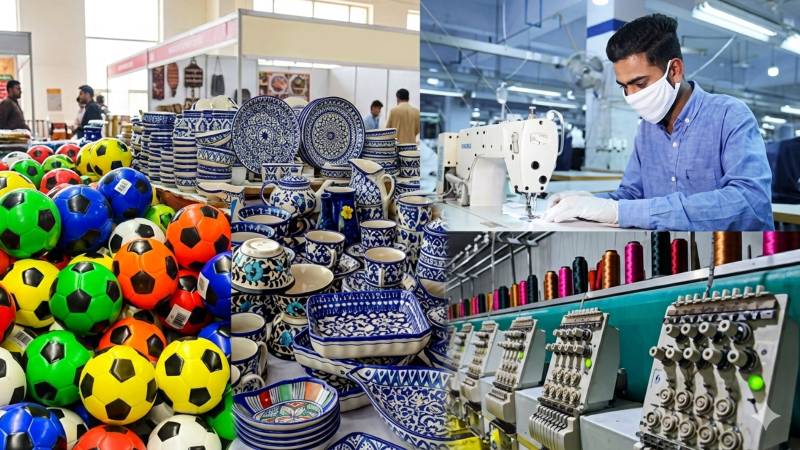
Small and Medium Enterprises (SMEs) have been the quiet architects of Asia's remarkable economic transformation. While large corporations often dominate public attention, it is thousands of small and medium-sized enterprises that generate employment, stimulate innovation, diversify production and strengthen economic resilience. Across Asia, countries that advanced from low-income to middle- and high-income status recognised that SMEs were not peripheral to development but a strategic pillar of industrialisation, export expansion and technological progress.
Pakistan presents a striking contrast. Despite repeated policy commitments over several decades, its SME sector continues to operate well below its potential. Although SMEs account for the overwhelming majority of business establishments and employ nearly four-fifths of the non-agricultural workforce, their contribution to GDP, exports and technological innovation remains modest by regional standards. The constraint is therefore not a shortage of entrepreneurial talent but the absence of an enabling policy environment that allows enterprises to modernise, expand and compete.
The experiences of Malaysia, China, Vietnam and South Korea demonstrate that successful SME development is neither accidental nor driven by market forces alone. Each country adopted policies suited to its own circumstances, yet all shared one fundamental conviction: sustainable growth depends upon institutions that encourage enterprise, remove structural barriers and connect small businesses to domestic and global markets. Their experience offers valuable lessons for Pakistan as it seeks to revive economic growth, create productive employment and strengthen export competitiveness.
Across Asia, governments recognised that SMEs face structural constraints which individual entrepreneurs cannot overcome alone. Limited access to finance, outdated technology, shortages of skilled labour and burdensome regulation often prevent promising businesses from moving beyond survival. Instead of relying on periodic subsidies or fragmented support schemes, successful governments concentrated on creating an enabling ecosystem. They expanded access to finance, invested in technical and vocational education, encouraged technology adoption, developed industrial clusters and integrated SMEs into manufacturing and export supply chains.
The results were both economic and social. SMEs generated employment on a scale that large industries alone could never achieve, broadened the industrial base, reduced regional disparities and fostered innovation across diverse sectors. Their flexibility enabled them to respond quickly to changing market conditions, while their close links with larger enterprises strengthened domestic production networks and improved export competitiveness. In many Asian economies, globally recognised companies began as small enterprises operating within supportive institutional environments.
Rather than dispersing responsibility among numerous public agencies, successive governments established a coherent framework that aligned SME policies across ministries and maintained continuity beyond changes in political leadership.
The most enduring lesson from Asia is that entrepreneurial success depends not only on the abilities of individual business owners but also on the quality of the institutions that support them. Where governments provided policy continuity, efficient regulation and coordinated support, SMEs became powerful engines of productivity and economic growth. Where institutions remained fragmented, inconsistent or weakly implemented, entrepreneurial energy was constrained rather than transformed into national prosperity.
For Pakistan, the importance of SMEs is no longer in question. The real challenge is to replace policy declarations with effective implementation and to create institutions that consistently enable businesses to innovate, invest and compete. Asia's experience offers not a blueprint to be copied but a framework from which practical lessons can be adapted to Pakistan's own economic realities.
Malaysia demonstrates the value of institutional continuity and coordinated policymaking. Rather than dispersing responsibility among numerous public agencies, successive governments established a coherent framework that aligned SME policies across ministries and maintained continuity beyond changes in political leadership. Financial support was complemented by technology upgrading, vocational training, quality certification and business advisory services. SMEs were systematically integrated into industrial estates and export-oriented manufacturing, enabling them to move from low-value activities to higher-value production. The Malaysian experience illustrates that sustained institutional coordination is often more important than generous financial incentives. Entrepreneurs invest, innovate and expand when policies remain stable, predictable and mutually reinforcing.
China followed a different but equally successful path. Its remarkable SME expansion was driven by industrial clusters, proactive local governments and openness to investment. Concentrations of specialised enterprises created economies of scale, encouraged knowledge sharing and strengthened supplier networks, while sustained investment in infrastructure, logistics and digital commerce expanded access to domestic and international markets. Rather than treating SMEs as isolated businesses, China embedded them within dynamic industrial ecosystems where competition, collaboration and innovation reinforced one another. The lesson for Pakistan is straightforward: productive industrial clusters supported by efficient infrastructure generate far greater economic value than scattered enterprises operating in isolation.
Vietnam's transformation illustrates the power of gradual but consistent reform. Following economic liberalisation, the government simplified business registration, improved regulatory transparency and encouraged private investment without attempting disruptive institutional change. Many reforms were first introduced through pilot programmes before nationwide implementation, enabling policymakers to refine them through practical experience. This pragmatic approach strengthened investor confidence and encouraged thousands of small enterprises to enter the formal economy. By steadily integrating SMEs into regional and global value chains, particularly in labour-intensive manufacturing, Vietnam emerged as one of Asia's fastest-growing export economies. Its experience demonstrates that disciplined implementation and policy consistency often achieve more than ambitious reforms that remain confined to official documents.
South Korea represents perhaps the most sophisticated model of SME development. From the early stages of industrialisation, SMEs were regarded not as competitors to large corporations but as indispensable partners in national development. Through supplier development programmes, technology transfer, applied research and specialised export finance, small enterprises became integral components of globally competitive manufacturing networks. Close collaboration among government, universities and industry accelerated innovation, while sustained investment in research and development enabled many SMEs to evolve from subcontractors into producers of sophisticated, high-value products. South Korea confirms that long-term competitiveness depends not simply on increasing the number of enterprises but on continuously strengthening their technological capability, productivity and innovative capacity.
Although these countries adopted different development strategies, their experiences reveal common principles. None relied on subsidies alone, nor did they expect market forces to overcome structural barriers without public support. Governments invested in institutions rather than temporary schemes, promoted innovation rather than dependency, encouraged exports rather than inward-looking production and regarded SMEs as strategic partners in national development. Above all, policies remained consistent over many years, giving entrepreneurs the confidence to invest, expand and compete.
For Pakistan, the message is unmistakable. Successful SME sectors are not created by policy announcements or periodic financial packages. They emerge from institutions that consistently remove barriers to enterprise, encourage technological upgrading and maintain policy continuity. Pakistan need not replicate another country's model; it must adapt these proven principles to its own economic realities and institutional capacities.
The contrast with Pakistan is both striking and instructive. Despite constituting the overwhelming majority of business establishments and employing nearly four-fifths of the non-agricultural workforce, Pakistani SMEs continue to make a disproportionately modest contribution to GDP, exports and industrial innovation. The weakness lies not in entrepreneurial ability but in the institutional environment within which enterprises operate. Although successive governments have announced SME policies and support programmes, implementation has remained fragmented across multiple institutions with overlapping responsibilities, limited coordination and weak accountability. Entrepreneurs require stable and predictable policies to invest with confidence; uncertainty and policy discontinuity discourage long-term investment and innovation.
A coherent national strategy is therefore essential. Improving access to finance should remain the first priority through expanded credit guarantees, stronger development finance institutions, Islamic financial products and digital lending platforms that assess business potential rather than collateral alone. Equal attention must be given to technology and human capital. Vocational education, technical training, automation, artificial intelligence, digital commerce, quality certification and stronger collaboration between universities and industry should become central pillars of SME policy. Without continuous technological upgrading and a skilled workforce, Pakistani enterprises will find it increasingly difficult to compete in regional and global markets.
Export competitiveness must become the defining objective of future SME policy. Financial assistance alone cannot transform SMEs unless it is accompanied by easier access to international markets, industrial clusters, supplier development programmes, market intelligence, internationally recognised quality standards and efficient logistics. Successful Asian economies viewed SMEs not merely as instruments of employment generation but as drivers of productivity, exports and industrial modernisation. Pakistan must adopt the same strategic perspective if it is to strengthen its external competitiveness and broaden its export base.
Regulatory reform is equally important. Transparent taxation, streamlined business registration, predictable compliance requirements and effective institutional coordination would encourage more enterprises to enter the formal economy and invest for long-term growth. Public policy should focus less on announcing new initiatives and more on implementing existing ones effectively and evaluating them against measurable outcomes. Sustainable progress depends not on the number of schemes introduced but on the quality and consistency of their execution.
Asia's experience offers one overriding lesson: governments cannot create entrepreneurship, but they can create the conditions in which entrepreneurship flourishes. The real competitive advantage of nations lies not in the number of their enterprises but in the quality of the institutions that enable them to innovate, grow and compete. Countries that built strong institutions transformed SMEs into engines of industrialisation, technological advancement and export growth. Those that relied primarily on policy declarations achieved far more modest results.
Pakistan possesses no shortage of entrepreneurial talent, business resilience or private-sector initiative. What it requires is a governance framework that rewards innovation, encourages investment and removes unnecessary barriers to enterprise. If policymakers replace fragmented implementation with coordinated action and long-term institutional commitment, SMEs can become the foundation of a more diversified, competitive and inclusive economy.
The future of Pakistan's economy will depend less on discovering new opportunities than on enabling the existing enterprises to realise their potential. The lessons from Asia are clear and practical. The challenge now is not whether Pakistan understands what must be done, but whether it has the resolve to translate sound policy into sustained implementation. The answer to that question will determine whether SMEs remain an underutilised resource or become the driving force of Pakistan's economic transformation.