

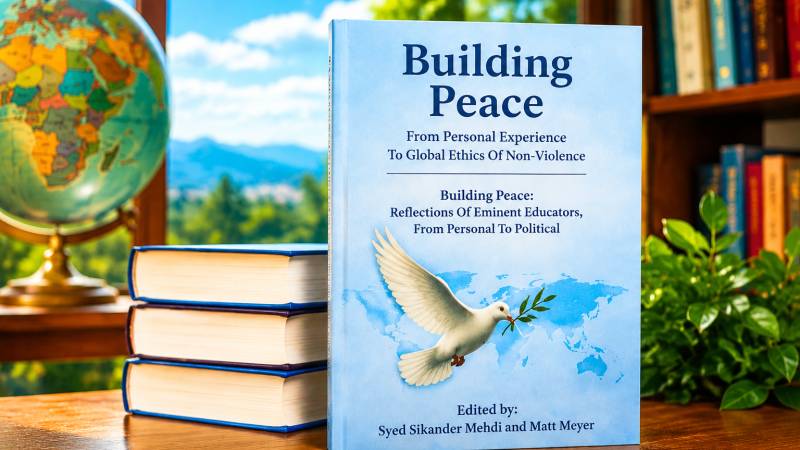
Book: Building Peace: Reflections Of Eminent Educators, From Personal To Political
Edited by: Syed Sikander Mehdi and Matt Meyer
Publisher: Palgrave Macmillan, Springer Nature, 2026
At a moment when war, political polarization, racial and religious intolerance, disinformation, ecological insecurity and renewed nuclear anxieties are reshaping the international order, Building Peace: Reflections of Eminent Educators, From Personal to Political arrives as both an academic intervention and a moral appeal. Edited by Syed Sikander Mehdi of the University of Karachi and Matt Meyer, associated with the International Peace Research Association and the University of Massachusetts Amherst's Resistance Studies Initiative, the volume does not treat peace merely as an abstract concept in international relations. Its more ambitious purpose is to ask how peace is learned, taught, practised and sustained, and how individual moral journeys can ultimately influence political institutions and wider societies.
That subtitle, “From Personal to Political,” is crucial to understanding the book. Unlike a conventional edited collection in which specialists present detached theoretical analyses, the contributors repeatedly connect scholarship with autobiography. The editors deliberately invited leading peace educators to reflect not only on concepts but also on the experiences, struggles, encounters and intellectual influences through which they became peace scholars, teachers and activists. The personal and political are therefore not parallel narratives in this volume; they continually intersect.
The result is a substantial collection whose contributors come from a remarkably wide geographical range, including Pakistan, India, China, Japan, South Africa, Burundi, South Sudan, Austria, Norway, the Netherlands, New Zealand, Mexico, Colombia, Argentina, the United Kingdom and the United States. The editors also consciously sought gender representation. This geographical and intellectual diversity matters because one of the book's recurring arguments is that there cannot be only one culturally universal pathway to peace. Peace must be understood through different histories, experiences, indigenous traditions, political struggles and forms of knowledge.
The volume begins from a deceptively straightforward question: how can humanity reduce violence and oppression and create societies that are both peaceful and just? The editors trace the growth of peace research and peace studies as interdisciplinary responses to precisely this problem, while presenting peace education as the praxis through which those ideas enter classrooms and everyday social life. They argue, however, that peace educators have historically received far less attention than political leaders and activists, despite their role in generating the ideas, vocabulary and intellectual frameworks upon which movements for social transformation often depend.
This is perhaps the book's first important contribution. It shifts attention from the spectacular moment of political change to the quieter intellectual labour preceding and sustaining it. History remembers presidents, revolutionaries, generals and movement leaders. It less frequently remembers teachers who changed how generations understood war, justice, gender, nationalism or human rights. Building Peace argues persuasively that ideas are themselves a form of political action.
That argument is reinforced in Francisco Rojas Aravena's foreword. Peace, in his formulation, is not merely desirable but fundamental to the exercise of virtually every other human right. Without a peaceful and sufficiently stable social order, rights themselves become precarious. He places this argument against a disturbing contemporary background: renewed nuclear danger, wars in several regions, climate change, authoritarianism, democratic retreat, corruption, organized crime, misinformation and declining respect for international law.
Particularly important is the book's rejection of the simplistic definition of peace as merely the absence of war. Across its chapters, peace becomes associated with justice, dignity, equality, dialogue, human rights, ecological responsibility, gender equality, democratic participation and freedom from structural violence. Betty A. Reardon's intellectual legacy is central to this broader understanding. In reflections on her work, peace is presented as inseparable from justice and informed political participation. Education should therefore develop not passive obedience but citizens capable of moral reasoning and meaningful democratic participation.
The tribute to Reardon is among the book's intellectually and emotionally significant components. She appears not simply as an academic authority but as a scholar whose feminism, anti-war activism, human-rights work and educational philosophy helped shape contemporary peace education. Her colleagues emphasize her capacity to bridge precisely the divisions the book seeks to overcome: the personal and political, analytical and practical, intellectual and ethical.
The historical importance of the Peace Education Commission of the International Peace Research Association also emerges strongly from this discussion. Its influence extended into disarmament education, graduate programs in peace education, the International Institute on Peace Education and ultimately the Global Campaign for Peace Education. Significantly, gender and ecology entered peace research partly through these educational networks. This history demonstrates that peace education has developed over decades into an identifiable academic and pedagogical field rather than remaining a collection of idealistic slogans.
Syed Sikander Mehdi's own chapter, “Peace Educators and Politics of Disowning,” introduces a more openly political question: why are peace thinkers so frequently marginalized? According to the editors' summary, Mehdi examines how political and social power elites may discredit peace educators and visionaries, diminish their proposed alternatives and avoid confronting the destructive consequences of prevailing policies. This argument is provocative because it suggests that the marginalization of peace scholarship is not always accidental. Systems built around militarized conceptions of security may have little incentive to elevate intellectual traditions that challenge the very assumptions on which such systems depend.
Wolfgang Dietrich's “One Too Many Peaces” further destabilizes the assumption that “peace” possesses one universally agreed meaning. The pluralization of peace is significant. Different societies possess different cultural, philosophical and historical resources through which peaceful coexistence is imagined. This pluralism reappears throughout the collection in African concepts such as Ubuntu and Ujamaa, indigenous traditions, Gandhian nonviolence, feminist thought and decolonial approaches.
Nozizwe Madlala-Routledge's contribution is particularly valuable in this regard. Drawing upon the South African struggle against apartheid and her own political experience, she connects Gandhian nonviolence, women's participation and African intellectual traditions. Ubuntu, associated with relational humanity, and Ujamaa, with fraternity and community, become more than culturally attractive expressions; they offer alternative foundations for imagining political and social relationships beyond individualism and domination. Her account also reminds readers that peacebuilding does not end with the collapse of an oppressive regime. Post-apartheid South Africa continued to face deep political and social challenges.
The South African experience is reinforced by Ela Gandhi's contribution. As a granddaughter of Mahatma Gandhi who herself participated in resistance to apartheid, endured years of house arrest and later took part in South Africa's democratic transition and parliament, her presence gives the volume an unusual historical continuity. Personal memory, Gandhian inheritance and active political resistance meet in the same life story. Her inclusion exemplifies what the editors mean by moving from personal experience to political transformation.
Another strength of the volume is that it does not restrict peace education to conventional classrooms. Peter van den Dungen and Kazuyo Yamane demonstrate the pedagogical potential of peace museums and historical memory. Yamane's account is especially instructive. She criticizes selective national memory in Japan, the tendency to emphasize Japanese suffering during the Second World War while inadequately confronting atrocities inflicted upon neighbouring societies.
This becomes more than a theoretical argument when Japanese, American, Chinese and Korean students visit peace museums together. Each group arrives carrying a different national historical narrative. Japanese students may know Hiroshima and Nagasaki while knowing less about Japanese aggression in China; Chinese and Korean students may inherit narratives centered on Japanese occupation while understanding the human consequences of atomic bombing differently; American students may have learned that nuclear weapons shortened the war. The shared encounter with competing memories allows students to reconsider inherited narratives, and, significantly, the experience reportedly transforms relationships among participants themselves.
This example reveals perhaps more clearly than abstract theory what peace education can accomplish. It does not necessarily require students to abandon national identity. Rather, it asks them to recognize that historical truth may be more complex than the heroic narrative taught by one's own nation. That intellectual humility is itself an important precondition of reconciliation.
Ikuro Anzai brings another dimension: nuclear disarmament. His professional background is particularly noteworthy because he was trained in nuclear engineering and radiological health before becoming deeply involved in peace studies and anti-nuclear education. His career demonstrates why peace education cannot be considered relevant only to international relations or social sciences. Scientists and technologists are also confronted by the ethical consequences of knowledge. Nuclear physics gave humanity both extraordinary scientific insight and weapons capable of destroying civilization. The question is therefore not whether science itself is peaceful or violent, but how scientific knowledge is governed and for what purposes it is used.
This point has particular relevance for universities. Peace education belongs not only in departments of political science, sociology or international relations. Its ethical questions matter equally to physicists working on nuclear technology, engineers developing autonomous systems, computer scientists confronting artificial intelligence, biologists dealing with dual-use research, medical practitioners facing inequality and lawyers addressing rights and justice. Indeed, the book's explicitly multidisciplinary composition strengthens the case for understanding peace education as a university-wide responsibility.
Artificial intelligence receives only limited attention in the volume, but the foreword identifies it appropriately as both a challenge and an opportunity for peace studies. This is an area where future work could go considerably further. Algorithmic misinformation, deepfakes, autonomous weapon systems, surveillance, online radicalization and AI-mediated political propaganda are likely to become central questions for future peace education. The volume's decolonial emphasis is another important dimension. Hakim Mohandas Amani Williams places decolonial peace education within an activist and research framework, while other contributors draw attention to indigenous and Global South traditions. The editors themselves conclude that the movement to decolonize peace education must accelerate if a genuinely new global peace movement is to emerge.
This is significant because conventional peace studies has sometimes been criticized for assuming that concepts developed in Western academic institutions can simply be exported universally. Building Peace instead gives considerable space to voices from Africa, Asia, Latin America and indigenous communities. The implicit argument is that communities historically treated primarily as sites of conflict must also be recognized as producers of knowledge about peace.
The chapters by Kelli Te Maihāroa, Diana Marcela Agudelo-Ortiz and Úrsula Oswald-Spring deepen this pluralization through indigenous, Latin American, feminist and ecological perspectives. Oswald-Spring's background itself illustrates the breadth of modern peace research: her work connects conflict resolution, gender, environmental vulnerability, water and climate change. The volume therefore extends the meaning of violence beyond battlefield killing. Ecological destruction, dispossession, exclusion, racism, patriarchy and structural inequality become legitimate subjects of peace scholarship.
Jenny Pearce's “Learning to Face Up to Violence: Emotional Enlightenment and the Journey to Peace” adds another essential element. Peace cannot be built only through institutional design and intellectual argument because violence also possesses psychological and emotional dimensions. Fear, humiliation, trauma, resentment and inherited memory influence individuals and communities. The title itself suggests the need to understand violence rather than merely condemn it. This emphasis complements Diana Marcela Agudelo-Ortiz's psychological and sociocultural concern with violence, subjectivity, mental health and human rights. The volume consequently moves between the psychological, social, political and international levels instead of treating them as isolated domains.
Tony Jenkins brings these threads together most explicitly in the final chapter. His formative memory of the Tiananmen Square protestor standing unarmed before tanks becomes an alternative conception of courage, one sharply different from militarized notions of masculinity and heroism. His subsequent development as an educator, activist and organizer leads him toward what he calls critical, reflective and transformative praxis linking personal and political change.
Jenkins also offers one of the volume's most practical insights: institutions may sometimes be transformed more effectively when approached as learning systems rather than merely as enemies to be defeated. His Colombian example, in which education officials were invited to experience peace-learning exercises rather than simply receive demands for curriculum reform, demonstrates this pedagogical politics.
This is also where Building Peace challenges conventional assumptions about activism. Peace education is not synonymous with political passivity. Several contributors have faced apartheid, authoritarianism, nuclear militarization, racial discrimination, colonial legacies, gender inequality and war. Their commitment to nonviolence does not require indifference to injustice. Rather, the collection repeatedly argues that peace without justice is inadequate, while justice pursued through a reproduction of violent structures may ultimately perpetuate the problem it seeks to solve.
The book's greatest strength is consequently its humanity. It refuses to separate ideas from the people who developed them. Readers encounter professors, activists, survivors, women negotiators, anti-apartheid campaigners, museum builders, nuclear scientists, community mediators and teachers. This autobiographical structure gives the volume an accessibility that many conventional peace-studies collections lack.
Its second major strength is geographical diversity. Voices from the Global South are not decorative additions to an overwhelmingly Western conversation; they occupy substantial intellectual space. African ideas, indigenous epistemologies, Asian experiences of war and nuclear destruction, and Latin American approaches to violence and reconciliation all participate in redefining what peace means.
Third, the collection treats education not as an auxiliary activity undertaken after political agreements have been signed but as a form of peacebuilding in its own right. Its contributors have developed curricula, established institutions, mentored researchers, created museums and journals, organized international networks and trained generations of students. The foreword identifies their common commitments as sustained engagement with nonviolence and social justice, multidisciplinary international collaboration, intellectual leadership and innovative institutional practices.
The book is not without limitations. The autobiographical method that gives it vitality also means that chapters inevitably vary in analytical structure and emphasis. Readers expecting a tightly integrated theoretical textbook may find the diversity somewhat uneven. There is occasional overlap around recurring themes; justice, nonviolence, education, dialogue and transformative learning, although this repetition partly reflects the common ethical foundations of the contributors.
A second limitation is intrinsic to the project itself: the volume is overwhelmingly written by committed peace educators. This gives it moral clarity but sometimes leaves less space for sustained engagement with critics who question the effectiveness of peace education in situations characterized by extreme coercion, state collapse or organized armed violence. A more explicit confrontation with the hardest counterargument, what happens when dialogue encounters actors who reject dialogue altogether?, would strengthen an already important discussion.
Similarly, while the book rightly emphasizes transformative pedagogy, decolonization, feminist approaches and grassroots movements, future scholarship might examine more systematically how peace-education scan be evaluated. How do we know when they work? Which interventions produce durable behavioural changes? Can reductions in prejudice, political intolerance or violent behaviour be measured? What institutional conditions make peace education effective? Such empirical questions become increasingly important if peace education is to move from a specialized field into mainstream educational policy.
These reservations, however, do not diminish the significance of the volume. On the contrary, they demonstrate the field's potential for further development. For Pakistan, the book possesses particular relevance. Its co-editor Syed Sikander Mehdi spent more than three decades teaching at the University of Karachi and is identified in the volume as the first scholar to introduce peace-studies courses into Pakistani universities. In a country characterized by extraordinary linguistic, ethnic, sectarian, provincial and socioeconomic diversity, peace education cannot be regarded as an intellectual luxury.
Universities are particularly important. They bring together young people who may have grown up within entirely different social worlds. A university can either reproduce inherited prejudices or become one of the few places where those prejudices are examined critically. Nor should the responsibility be placed exclusively upon departments of international relations. Peace education is relevant to every discipline. The scientist needs an ethics of knowledge; the engineer an understanding of social consequence; the physician respect for human dignity; the lawyer commitment to justice; the economist awareness of inequality; the historian intellectual honesty about collective memory; the teacher the ability to cultivate dialogue; and the administrator a commitment to fair institutions.
The book's account of peace education itself supports this transdisciplinary interpretation. The Journal of Peace Education, as described in Yamane's contribution, conceives the field as transdisciplinary, multidisciplinary and intercultural, linking theory and research to educational practice and envisioning societies that are nonviolent, ecologically sustainable, just and participatory.
Ultimately, Building Peace makes a deceptively simple argument: peace does not construct itself. War is organized. Militaries are trained. Weapons are designed. Propaganda is produced. Hatred can be taught. Historical grievances can be cultivated. Violence can become institutionalized. If violence can be learned, peace must also be learned. It must be taught in classrooms, preserved through truthful historical memory, practised through dialogue, institutionalized through justice, broadened through inclusion and renewed across generations.
The volume's twenty chapters offer no single formula for achieving that task. Indeed, one of its virtues is its refusal to pretend that such a formula exists. Instead, it offers multiple pathways: feminist peace, Gandhian resistance, Ubuntu, indigenous knowledge, decolonial pedagogy, peace museums, nuclear disarmament, emotional transformation, international solidarity, democratic participation and critical education. What connects these diverse pathways is the conviction that peace is neither weakness nor passivity. It is an active social achievement requiring courage, knowledge, justice and sustained human effort.
At a time when the international system again appears increasingly comfortable with military force, polarization and the language of enemies, the book's central message deserves attention beyond the specialized community of peace scholars. We have become extraordinarily sophisticated at educating people for competition, technological power, economic productivity and even warfare. The deeper challenge is whether education can also prepare human beings to disagree without hatred, remember history without becoming prisoners of it, exercise power without humiliation and pursue justice without reproducing violence.
Building Peace does not claim that education alone can end war. It makes the more defensible, and perhaps more important, claim that lasting peace is unlikely without education. The closing sentiment of the foreword captures the philosophy of the collection with admirable economy: if humanity genuinely wants peace, it must consciously work for it and educate for it.
That is ultimately what makes Building Peace more than a collection of professional recollections. It is a record of lives devoted to an idea, a critique of societies that remember warriors more readily than peace educators, and an invitation to universities to reconsider what education is ultimately for. A university must certainly produce scientists, doctors, engineers, lawyers, economists and scholars. But if these highly educated individuals cannot coexist across differences, resolve conflict, resist hatred and recognize the dignity of others, education has accomplished only part of its task. In that sense, Building Peace leaves the reader with a question larger than the book itself: If peace is something humanity desires, why do we still devote so little systematic effort to teaching people how to build it?