

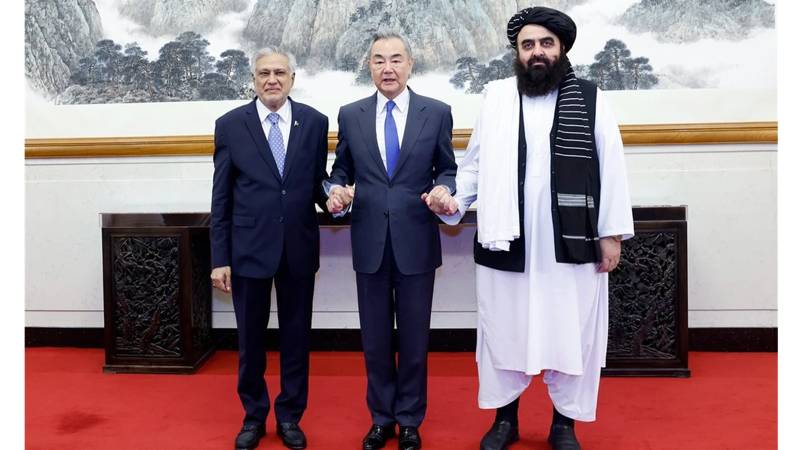
Although the Pakistan–Afghanistan conflict remains rooted in traditional issues such as the Durand Line dispute, the TTP, and historical mistrust, it has increasingly become embedded within the broader China–India strategic rivalry. China's expanding diplomatic, military, and economic involvement alongside Pakistan, combined with India's growing engagement with Afghanistan, has transformed what was once a bilateral conflict into a regional geopolitical competition.
The declining ties between Pakistan and Afghanistan have seen China and India get further involved in the complex geopolitical setting of the conflict. Both nations have significant stakes in the matter, but they have different approaches to the situation. For its part, China has been involved in Afghan affairs through its strategic relationship with Pakistan, as well as through its own interests in regional security, trade, and economic development.
Nevertheless, in the last years, the nature of Chinese involvement has changed; on the one hand, due to the threat that instability in the region poses to the CPEC projects, which are crucial for the economy of China, and on the other, because of the potential threat posed by militant groups, especially the ones that China considers as security threats to Xinjiang. In addition, China now has some economic interests regarding the new leadership in Afghanistan; Beijing now has the opportunity of expanding its regional connectivity through Afghanistan.
On its part, India has managed to gradually restore its ties with Afghanistan after the return of the Taliban to power in the region. These developments do not suggest that Afghanistan has become a formal Indian ally comparable to Pakistan's relationship with China. Nevertheless, China's growing diplomatic involvement and India's renewed engagement with Kabul have added a broader China–India dimension to a conflict historically shaped by Pakistan–Afghanistan tensions and Pakistan–India rivalry.
China’s Strategic and Economic Calculus
China's role is tightly linked to its relations with Pakistan. China is the largest trade partner of Pakistan and is also a key defence partner. Furthermore, the China-Pakistan Economic Corridor is one of the important elements of China's Belt and Road Initiative. According to CFR, the total costs of the highway and energy projects of the corridor amount to about $65 billion. Therefore, China has a direct interest in eradicating terrorism and instability in the region to safeguard its investment and the region overall.
Afghanistan presents both a security challenge and an economic opportunity for China: while militant activity could undermine regional stability and investment, closer cooperation could allow Chinese and Pakistani infrastructure networks to expand there
Another reason why Afghanistan has become significant for China's regional integration plan is that, in May 2025, the three nations agreed to cooperate in expanding the China-Pakistan Economic Corridor (CPEC) to Afghanistan in order to improve trade and connectivity. In addition, they agreed to coordinate counterterrorist efforts, taking into consideration China's worry about militant activities in Afghanistan and the possible implications for China as a result.
In this case, China is particularly worried about the militant organisations in the region, particularly the Turkistan Islamic Party (TIP), which it associates with separatist militancy in its northwestern Xinjiang region. It is worth mentioning that Xinjiang shares a border with Afghanistan via the narrow Wakhan Corridor. This makes the Chinese government worried that the militants in Afghanistan may use their base in Afghanistan as training camps or bases for carrying out attacks in China. China is therefore requesting guarantees from the Taliban in Afghanistan that their territory will not be used by organisations that are a threat to China's security.
Afghanistan consequently presents both a security challenge and an economic opportunity for China: while militant activity could undermine regional stability and investment, closer cooperation could allow Chinese and Pakistani infrastructure networks to expand into Afghanistan and strengthen trade connections across South and Central Asia.
Connection with political issues in China appeared especially visible in 2026 when the scope of fighting between Pakistan and Afghanistan grew. Beijing invited senior officials from Islamabad and Kabul to Urumqi from the 1st to the 7th of April. Participants in discussions included heads of the ministries of foreign affairs, defence, and security. Afghanistan called the consultations "useful," while China claimed that the sides had reached an agreement to look for the possibility of solving the problems in a comprehensive way and avoiding any steps that would increase the tension in the conflict. Pakistan, on the other hand, used the meeting for articulating its core security demands, including official recognition of TTP as a terrorist group and providing evidence of dismantling the TTP infrastructure. Thus, it becomes evident that China became not just an economic and military partner of Pakistan but also a mediator between Islamabad and Kabul.
This shows how China's involvement provides Pakistan with another channel of diplomacy in its quest for solving its security disputes with Afghanistan. For Amina Khan, resolving any security issues between the two nations must involve sustained diplomacy and regional cooperation as well as counterterrorism policies and not military missions alone, since military engagements will not solve the political and economic disputes between the two states.
While Pakistan's main concern is stopping any attacks by the Taliban against its people emanating from Afghanistan, China, on the other hand, has additional concerns like ensuring safety of its citizens and investments, the operations of militant groups that might affect Xinjiang, and future trading routes. Any continuous hostilities between Afghanistan and Pakistan may disrupt cross-border trade and affect any future projects involving the China-Pakistan Economic Corridor into Afghanistan, and also provide an environment for any militant group to operate. All these explain the reason why China facilitated talks between Pakistan and Afghan representatives in April 2026 in Urumqi, where they discussed security issues as well as economic cooperation.
India’s Renewed Engagement and Strategic Interests
India has continually improved its connection with Afghanistan. The relevance of this is noticeable since India's sentiments regarding the Taliban were usually unflattering when the latter was in power for the first time in the years 1996–2001. With the appearance of the Taliban for the second time in 2021, India closed its embassy in Kabul but re-entered Afghanistan with caution before forming its technical mission in the country in 2022.
In January 2025, the Taliban officials described India as a "significant regional and economic partner." In October 2025, India declared itself ready to restart its diplomatic efforts through the establishment of an ordinary embassy in Kabul again after the visit of the Afghan Minister of Foreign Affairs Amir Khan Muttaqi to New Delhi. However, despite all these efforts regarding cooperation, India has not recognised the Taliban government yet.
India relies heavily on its strategic interests in diplomacy and commerce. With the Taliban back in power, India’s investment in Afghanistan has totalled over $3 billion on health, water, and other infrastructure projects. India has continued its humanitarian work and is now discussing more trade through Iran’s strategically important Chabahar Port, which allows India to access the landlocked nation without relying on port facilities provided by Pakistan.
The wider regional implications of the conflict become particularly evident when examining Pakistan's concerns about India's growing relationship with Afghanistan. According to Feryaz Ocakli and Yelena Biberman, writing for the Lowy Institute, Islamabad fears that India could take advantage of deteriorating Pakistan–Afghanistan relations to expand its influence along Pakistan's western border. For India, increased contact with Kabul will help meet two strategic objectives: namely, to limit the influence of Pakistan in the region and reduce the possibility that any militant organisation based in Afghanistan could pose a threat to the Indian security, especially in Kashmir.
It should be noted, however, that these strategic interests do not imply India's efforts to promote the conflict and control the Afghan Taliban. In particular, according to the Council on Foreign Relations, Pakistan accuses India of sponsoring the TTP, and portrays the Afghan Taliban government as a proxy of India. Such claims can be explained by the long-standing fear of the Pakistani authorities about the strategy of strategic encirclement, whereby India's increasing engagement with Afghanistan may pose threats from the country both to its eastern and western borders. Nevertheless, India's growing diplomatic engagement with Kabul does not mean that India is involved in TTP attacks or the Afghan army's operation in Pakistan. It is important to stress here that the rivalry between China and India affects how Pakistan perceives and reacts to the conflict.
Asymmetry and the Broader Trajectory
This evolution of relationships indicates a significant degree of asymmetry between them. The China-Pakistan relationship has been established for some time now and is based on institutionalised strategic partnership, while the India-Afghanistan relationship is still evolving and is quite careful. Thus, it would be a mistake to divide South Asia into two equal alliances: China-Pakistan and India-Afghanistan. The China-Pakistan alliance is much older and more institutionalised than India's relations with Kabul. Additionally, India's relations with the Taliban government are rather new and guarded. Thus, the evidence supports the idea of the regionalisation of the Pakistan-Afghanistan conflict. China and India did not generate this conflict, but they increasingly influence the environment of the conflict and the behaviour of the countries of the region.
These shifts do not mean that the dispute between Pakistan and Afghanistan has turned entirely into a proxy theatre for China-India competition. Rather, a historical bilateral confrontation has gradually fused with this broader strategic friction. Consequently, the trajectory of the crisis hinges not merely on whether Islamabad and Kabul can settle their core grievances, but also on how effectively this overarching regional rivalry is navigated to prevent further escalation. The consequences of this political settlement will reverberate throughout West, Central, and South Asia.