

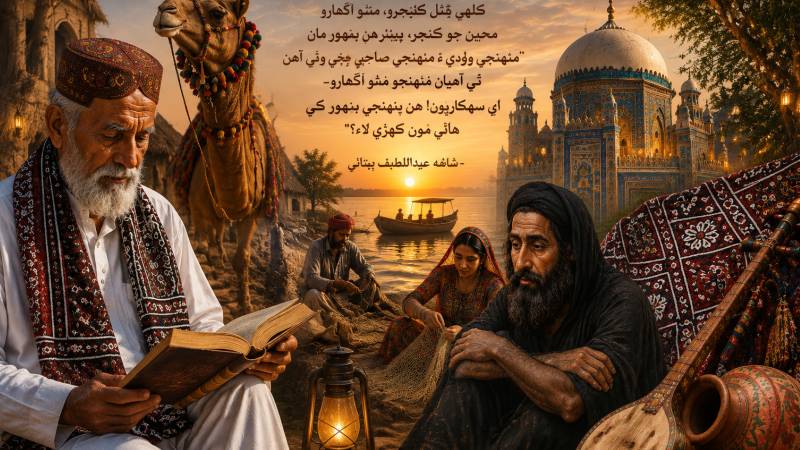
Kulhe Phatal Kunjhero, Matho Ugharo
Muhenjo Kujaro, Bhainar Hin Bhamhor Main
"My gown is at my shoulders torn; alas my head is bare-
O sisters, in your Bhambore fair, what have I now to do?"
The 283rd Urs of Shah Abdul Latif Bhittai, Sindh's immortal mystic poet, visionary scholar and timeless cultural icon, was observed in July with its customary reverence and devotion. As thousands gathered from every corner of the country at Bhit Shah, his enduring message of love, peace, tolerance, fraternity and universal harmony echoed once again through the land he loved so dearly. Yet the greatest tribute to Latif is not confined to annual celebrations. He lives every day in the hearts of millions who recite his verses, seek guidance from his wisdom and draw strength from his vision of humanity.
Few poets have become so inseparable from the soul of their people. Shah Abdul Latif is not merely read; he is lived. His verses run like streams --through quiet villages and restless towns, across sunburnt deserts and whispering jungles,along riverbanks that that remember every word -- natural, unbroken, eternal. Mothers still sing his sweet verses as lullabies to comfort crying children. Farmers humming beneath the blazing sun, shepherds grazing their flocks, fishermen casting their nets into the mighty Indus, sailors confronting turbulent waters and weary travellers crossing the vast sands of Thar all find solace in his soul-stirring poetry. For the poor, the forgotten and the vulnerable, Latif has always been a companion in hardship and a beacon of hope.
Unlike court poets who sought the favour of kings, Latif chose the company of ordinary people. He travelled extensively across Sindh and neighbouring regions, closely observing the lives of peasants, fishermen, artisans, nomads, shepherds, boatmen and labourers. Their joys became his joys; their suffering became his own. He preferred humble huts to royal palaces and celebrated the dignity of honest labour over the splendour of power. His poetry became the voice of those who had no voice.
The beauty of Latif's poetry lies not only in its compassion but also in its extraordinary portrayal of nature. Nothing escaped his observant eye. Every gleaming stretch of roaring Indus, flowing streams, glittering lakes, towering mountains, rolling sand dunes, dense forests, colourful birds, moonlit nights and the vast star-filled sky all found immortal expression in his verses. Every tree, every breeze and every landscape carried a deeper spiritual meaning. Nature, in Latif's world, was not merely scenery but a living reflection of the Creator and an inseparable companion of humanity.
Beyond describing beauty, Latif illuminated the struggles of life. His verses speak of love and separation, courage and sacrifice, poverty and perseverance, oppression and resistance. They carry the wisdom of centuries, celebrate human dignity and remind people that hope survives even in the darkest moments. His words continue to touch hearts because they spring from lived experience rather than imagination alone.
Latif chose the company of ordinary people. He travelled extensively across Sindh and neighbouring regions, closely observing the lives of peasants, fishermen, artisans, nomads, shepherds, boatmen and labourers.
Among Latif's greatest contributions is the honour he bestowed upon women. At a time when women endured exploitation, discrimination and social injustice, he transformed them into the heroines of his poetry. Marui, Sassui, Sohni, Noori and Moomal are not merely romantic figures but enduring symbols of loyalty, courage, sacrifice, resilience and patriotism. Marui, in particular, remains the embodiment of love for one's homeland. She rejected the luxury of King Umar's palace and chose instead the simplicity of her desert huts, her people and her freedom. Through these remarkable women, Latif celebrated moral courage over worldly power.
The circumstances in which Latif lived explain the depth of his message. Between 1689 and 1752, Sindh witnessed political instability, the decline of Mughal authority, the rise of the Kalhora dynasty, foreign invasions, widening class divisions and crushing poverty. Heavy taxation burdened peasants, fishermen and artisans while feudal domination denied ordinary people dignity and justice. Latif stood firmly beside the oppressed, exposing injustices through poetry and inspiring those, crushed by exploitation.
More than two and a half centuries later, his message remains profoundly relevant. Much of what troubled Latif continues to haunt Sindh today. Feudal domination and tribal influence still shape countless lives. Millions remain deprived of quality education, healthcare, clean drinking water and equal opportunities. Poverty, unemployment, crime, injustice, decaying infrastructure and the oppressive thana culture continue to burden ordinary citizens. Women still suffer violence, discrimination and the barbaric practice of Karo Kari, stealing innocent lives, while the weakest sections of society struggle to have their voices heard.
If Shah Abdul Latif were to walk through today's Sindh, he would recognise much of the suffering that inspired his poetry centuries ago. He would see exhausted mothers carrying malnourished children from one public hospital to another in search of absentee doctors and medicines that never arrive, farmers burdened by debt, labourers denied fair wages, villages deprived of basic facilities, and countless young people searching for opportunities that remain beyond their reach. He would surely ask why so little has changed despite the passage of nearly three centuries.
Latif's legacy is therefore, not one of remembrance alone but of responsibility. His poetry calls upon us to stand against oppression, injustices, hatred and inequality, to uphold compassion over cruelty, justice over privilege and humanity over divisions. His message transcends the barriers of time, geography, caste, creed and colour because it speaks to the universal aspirations of the human heart.His message is as urgently needed today as it was in the 18th century. In a world torn apart by hatred, conflicts, and inequality, Latif's poetry is not a relic to be honoured once a year at his Urs,but a call to be answered every day.It is a call to rise,to resist oppression, to stand against injustices.It is time to resuscitate Bhittai's piercing message and let it do the work it was always meant to do: to break the chains of servitude that still bind us,so that people breathe freely determine their own destinies, and step into an era of genuine change and socio-economic justice.
The true celebration of Shah Abdul Latif Bhittai will not be completed with floral tributes, musical gatherings or ceremonial speeches alone. It will be realised only when his ideals become the guiding principles of our society when the poor are treated with dignity, justice is accessible to all, and every individual enjoys the freedom to live with honour. That would be the finest tribute to the great poet, whose voice continues to illuminate hearts long after his earthly journey came to an end.