

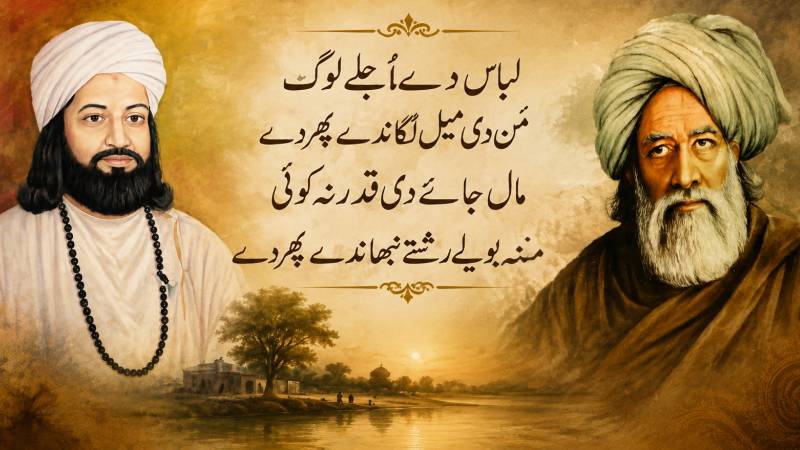
Growing up, I spent my school years at one of Lahore's leading boarding schools. The school regarded English and Urdu as the languages of education, progress, and refinement. Whereas Punjabi, the language spoken in our homes by parents, grandparents, and countless ordinary Pakistanis was discouraged. We were expected to converse in English or Urdu, and for many of us, Punjabi became something we heard more often from our elders than in our classrooms.
Yet somehow, Punjab's greatest voices found a way into our lives. We heard Waris Shah's Heer sung with haunting emotion at family gatherings and on the radio. We knew fragments of Bulleh Shah's immortal verses, especially "Bullah ki jaana main kaun," long before we understood what those words truly meant. Like many Pakistanis, we admired the melodies before we appreciated the philosophy and the message. It was only much later in life, after reading their works in earnest, that I came to understand the extraordinary breadth and depth of their thought. What I had once assumed were simply beautiful Punjabi poems turned out to be profound reflections on identity, love, justice, truth, power, society, and the human condition. They were not merely poets of Punjab, they were philosophers of humanity.
More than two centuries after their deaths, their words continue to resonate across generations. Their verses are sung in villages and cities, quoted in conversations, invoked in moments of joy and sorrow, and rediscovered by each generation searching for meaning. Their poetry has survived the collapse of empires, colonial rule, Partition, military governments, democratic experiments, and the profound social transformations of the modern age.
This enduring relevance raises an important question. Why do two eighteenth century Punjabi poets continue to speak so powerfully to twenty first century audiences? The answer is that neither Bulleh Shah nor Waris Shah was merely writing poetry. Both were engaged in a much larger endeavor, understanding the human condition. They wrote about love, identity, power, hypocrisy, suffering, truth, and the moral responsibilities that human beings owe one another. While their language was Punjabi and their setting was the Punjab of their time, the questions they explored were universal.
In many respects, Bulleh Shah and Waris Shah approached these questions from different directions. Bulleh Shah looked inward, examining the human soul and its search for truth. Waris Shah looked outward, examining society and its many contradictions. Together, they offer a remarkably complete vision of both personal character and public responsibility. Bulleh Shah's poetry is fundamentally concerned with self discovery. One of his most famous verses begins with a question that remains as profound today as it was when he first posed it, "Bulleya, ki jaana main kaun?". "Bulleh, to me, I know not who I am."
At first glance, the line appears deceptively simple. Yet it contains a challenge that cuts to the heart of modern life. Human beings spend much of their existence defining themselves through labels. We identify ourselves through religion, ethnicity, nationality, profession, ideology, social class, and countless other categories. While such identities can provide meaning and belonging, Bulleh Shah understood that they can also become barriers to deeper understanding.
His concern was not with identity itself but with the arrogance that often accompanies it. People become so attached to their labels or identities that they cease to see the humanity of those who belong to different groups. They become convinced of their own righteousness and lose the capacity for self reflection. They seek certainty when they should be seeking wisdom.
For Bulleh Shah, the greatest obstacle to truth was the ego. The spiritual journey was therefore not about defeating others but about overcoming one's own pride, prejudice, and self importance. Genuine faith, in his view, was not measured by outward displays of religiosity but by inner transformation. Compassion, humility, empathy, and love mattered more than ritual without understanding.
This message feels remarkably contemporary. Around the world, societies are becoming increasingly polarized. Political and ideological identities have hardened. Social media rewards outrage and certainty while discouraging nuance and reflection. Public discourse often revolves around emphasizing differences rather than discovering common ground. Bulleh Shah's response to such divisions would not have been to choose one side over another. Rather, he would have challenged the assumptions underlying the conflict itself. His poetry consistently points toward a larger human identity that transcends narrower affiliations. He reminds us that before we are members of competing groups, we are human beings.
Love occupies a central place in his worldview, but it is important to understand what he meant by the term. Bulleh Shah's conception of love extends far beyond romance. Love, for him, is the force that dissolves arrogance and compels individuals to recognize the dignity of others. It is what allows human beings to move beyond narrow self interest and encounter the world with openness and humility. If Bulleh Shah sought to understand the individual, Waris Shah sought to understand society.
The spiritual journey was therefore not about defeating others but about overcoming one's own pride, prejudice, and self-importance.
His masterpiece, Heer Ranjha, is often described as the greatest love story in Punjabi literature. Yet such a description, while accurate, captures only part of its significance. Heer Ranjha is also one of the most penetrating examinations of society ever produced in South Asian literature. Through the story of Heer and Ranjha, Waris Shah explored the tension between individual freedom and social conformity. He examined the role of family, tradition, power, greed, honor, and authority. He exposed the ways in which societies often betray their own stated values and highlighted the gap between moral ideals and actual behavior.
The enduring power of Waris Shah lies in his understanding of human complexity. His characters are not simplistic heroes and villains. They are fully human, capable of both generosity and selfishness, courage and weakness, honesty and deception. This realism gives his work a timeless quality because it reflects life as it is rather than life as we might wish it to be. Perhaps most importantly, Waris Shah possessed an extraordinary ability to expose hypocrisy. He recognized that societies frequently proclaim virtues they fail to practice. People speak of justice while tolerating injustice. They praise honesty while rewarding dishonesty. They invoke morality while pursuing self interest. These observations remain painfully relevant today.
Modern societies continue to struggle with the same contradictions that Waris Shah identified centuries ago. Political leaders speak of public service while seeking power. Institutions claim legitimacy while failing to deliver accountability. Citizens demand standards from others that they are unwilling to apply to themselves. Yet, Waris Shah was not a cynic. His purpose was not to encourage despair but to encourage honesty. He believed that meaningful reform begins with a clear eyed understanding of reality. A society cannot address its shortcomings if it refuses to acknowledge them.
Taken together, Bulleh Shah and Waris Shah offer complementary lessons. Bulleh Shah teaches that social progress begins with personal transformation. Before changing the world, individuals must confront their own prejudices, assumptions, and limitations. Waris Shah teaches that personal virtue alone is insufficient. Human beings live within social structures that shape opportunities, distribute power, and influence outcomes. Justice therefore requires not only good individuals but also fair institutions.
One poet emphasizes character. The other emphasizes society. One examines the soul. The other examines the world. Together they provide a framework for understanding both. Their relevance extends far beyond literature. They speak directly to some of the most pressing challenges facing contemporary Pakistan. The country's problems are often discussed in terms of economics, politics, governance, security, and institutions. These issues are undeniably important. Yet beneath them lies a deeper question about culture and citizenship. What kind of society do Pakistanis wish to build? What values should guide public life? What responsibilities do citizens owe one another? These questions cannot be answered solely through legislation or public policy. They require moral reflection.
Bulleh Shah's message offers a powerful antidote to the divisions that frequently characterize Pakistani society. At a time when sectarian, ethnic, ideological, and political differences often dominate public discourse, he reminds us that humanity must come before labels. His emphasis on humility stands in sharp contrast to the certainty and self righteousness that increasingly define modern politics. Waris Shah's message is equally important. He reminds us that societies should be judged not by their rhetoric but by their realities. His relentless exposure of hypocrisy challenges citizens and leaders alike to close the gap between what they profess and what they practice. In a country where accountability has often been elusive, this lesson remains indispensable.
Perhaps the most important contribution of both poets is their rejection of indifference. Neither accepted the notion that individuals should retreat into private concerns while ignoring the condition of society. Their work encourages engagement rather than apathy, responsibility rather than resignation, and reflection rather than complacency.
Pakistan today possesses enormous potential. It is a country rich in talent, resilience, creativity, and energy. Yet realizing that potential will require more than economic reform or political adjustment. It will require a civic culture rooted in empathy, honesty, accountability, and shared responsibility. This is why Bulleh Shah and Waris Shah continue to matter.
They remind us that nations are built not only through institutions but also through values. They remind us that social progress depends as much on character as on policy. They remind us that no society can achieve lasting success if it loses sight of its humanity. More than two hundred years after they walked the soil of Punjab, their words continue to challenge us. They urge us to examine ourselves before judging others. They encourage us to confront injustice rather than ignore it. They ask us to choose humility over arrogance, truth over hypocrisy, love over hatred, and responsibility over indifference.
Pakistan's future will ultimately depend on many factors, including stronger institutions, economic opportunity, constitutional stability, and the rule of law. Yet beneath all of these lies a more fundamental requirement, that of citizens who possess both the courage to look inward and the determination to improve the society around them. That, ultimately, is the enduring gift of Bulleh Shah and Waris Shah. They remind us that the path to national renewal begins not just merely in parliaments, courts, or ministries, but in the moral imagination of ordinary people. And in that sense, their message may be more relevant today than at any time since they first wrote it.