

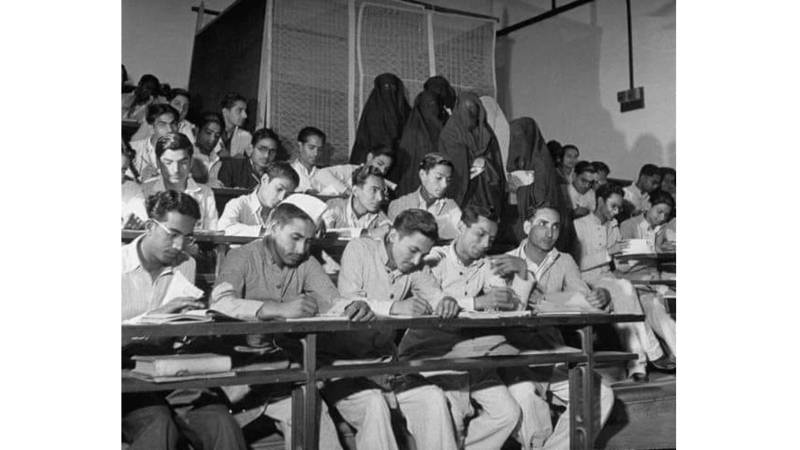
It is often remarked that the famous author Mirza Farhat Ullah Beg played a significant role in highlighting the human face of Deputy Nazir Ahmad through his popular memoir, Deputy Nazir Ahmed Ki kahani, Kuch Unki Kuch Meri Zabaani. Aligarh Muslim University (AMU) was similarly fortunate: the students it produced were imbued with an abiding love and loyalty to their alma mater. The following essay reviews a few books about the Muhammadan Anglo-Oriental College (MAO College, later AMU), written by prominent AMU alumni, that showcase the institution's unique character and traditions.
One of the most prominent alumni who loved MAO College was Professor Rashid Ahmad Siddiqui, who wrote extensively about it, romanticising its traditions and social and academic norms. He came to Aligarh as a wide-eyed, unvarnished undergraduate and never left. In one of his early books, Ashufta Biani Meri, he wrote that whenever he met someone who impressed him, he wondered whether the person had ever been educated at Aligarh. If so, he was pleased; if not, “I am sad that he missed a valuable opportunity.”
Professor Siddiqui, known for his signature subtle, biting humour, highlights in his accounts the unique daily life of MAO College and how it shaped students' character for the rest of their lives. He recalls disembarking at Aligarh railway station, coming from a small town in UP, not knowing anyone or even where he would spend the night—a desperate situation! Some students travelling with him learned of his plight, took him to their hostel room, and one of them gave him his own bed to sleep in. In the morning, total strangers fed him their own breakfast. The way students treated him, a total stranger, is etched in his memory, and even after four decades, he has not forgotten it. That was his first encounter with life at MAO College.
He was assigned a room in the Kutchi Barracks, a primitive hostel with poor living conditions, long since demolished. Often, after torrential monsoon rain, the place came alive. Having survived the storm, students felt a sense of exhilaration, changed clothes, and came out into the courtyard to boisterously celebrate and have fun. The book highlights the beneficial role that the English faculty played in instilling discipline and a sense of duty in the students. Once, while the noisy celebration was in progress, everyone was surprised to see the principal, Mr John Towle (1909–1919), arrive, drenched from head to toe, riding a horse. Satisfied and amused that all was well, he turned back and went away.
Professor Siddiqui’s book presents an authentic cultural history ranging from the status of Muslims after the disintegration of the Mughal Empire to the freedom movement and AMU's role in it
The book records delightful stories about little-known eccentricities and peculiar habits of some of the professors, especially the Englishmen. Among them were the storied English professors David Renell, Auchterlonie, and John Towle. Professor Renell was so punctilious about being on time that once, when he was a few minutes late for class, his students left, accustomed to his punctuality. On his last day at MAO College, as he was preparing to depart, he taught his class as usual and left for the railway station. For the first time, however, his students sensed some emotion as he said goodbye to his class.
Rashid Ahmad Siddiqui was a prolific writer, and in his other book, Gunj haiay Granumaya, he drew intimate pen portraits of MAO College’s most memorable personalities whom he knew personally. Among them were Maulana Mohammed Ali, Jigar Moradabad, Sir Shah Suleiman, and Dr Mukhtar Ahmad Ansari.
Among the more recent authors who wrote about their days at AMU was Zakir Ali Khan, whose book, Riwayat e Aligarh, was very popular. An engineer by training, he had migrated to Pakistan after independence. In simple, humorous prose, he narrated the traditions and mischievous activities that had become hallmarks, such as the Introduction Night and the mock funeral of the opponent defeated in an election for the Students’ Union. Zakir Saheb was very active in establishing the Old Boys Club in Karachi. I recall that some old traditions were revived at their annual dinner, when former students re-enacted their youthful games.
Zakir Ali Khan worked with Z A Nizami Saheb to establish Sir Syed College, now the University of Engineering and Technology in Karachi, which has produced many engineers and technologists to meet the country's needs. Some years ago, when I visited the University, Nizami and Zakir Sahaban warmly greeted me, and the latter affectionately gave me a signed copy of his newly published book.
In the US, Professor David Lelyveld published a scholarly book in English in 1978 documenting the institution’s founding and early history, and its ties to Indian Muslim identity. The book, Aligarh’s First Generation, is an authoritative, seminal study by Lelyveld, supported by a grant from the US Foreign Area Fellowship Programme and the University of Chicago. He travelled extensively and spent most of 1967–1969 interviewing numerous people in India and Pakistan to collect material for the book. The book presents an authentic cultural history ranging from the status of Indian Muslims after the disintegration of the Mughal Empire to the Freedom Movement and AMU's role in it. The book is essential reading for understanding the cultural evolution of 19th-century Indian Muslims. It is distinct from other books since the author is not an alumnus and had no emotional ties to the University.
More recently, Mukhtar Masood's books showcase a highly individualistic, elegant writing style that leaves a lasting impression on his readers. His writing has created a romanticised and endearing image of his alma mater. He migrated to Pakistan with his parents after Partition and successfully competed in the first-ever competition for a position in Pakistan’s Civil Service. He rose quickly through the civil service ranks and served in various prestigious positions. His first book, Awaz e Dost, widely regarded as a masterpiece of Urdu literature, remained on Pakistan’s bestseller list for a long time. It focuses on the author's student life at Aligarh and the remarkable people he met there. The story begins in 1938, when the author, then a school student, was alerted by his father that a famous Muslim Chinese scholar, Mohammad Ibrahim Shakiochinw, would be visiting their house; he should talk to him and get his autograph.
Masood went straight to the Shamshad market, bought a small autograph book, and presented it to his Chinese guest for an autograph. The scholar greeted him affectionately and wrote a message in Chinese script, upside down. From then on, following his father’s advice, he sought autographs only from selected celebrities usually affiliated with the AMU who met his high moral and ethical standards. Those he selected included the renowned poetess Sarojini Naidu, the politician Hasrat Mohani, Maulana Zafar Ali Khan, and the admired English writer E M Forster. The book contains numerous anecdotes told in fascinating language that influenced Mukhtar Masood's life and career.
Masood was serving as Secretary General of Regional Cooperation for Development (RCD) in Tehran when the Islamic Revolution broke out in Iran. In his book, Loh e Ayyam, he documented the day-to-day turmoil that engulfed the country, resulting in the overthrow of the monarchy.
He wrote four books, all of which enriched Urdu literature; the last, Harf e Shouq, was published posthumously. It differs from his other books and reflects the wisdom and insights he accumulated over the years. It is not about anything in particular but comprises the author's musings, rooted in lifelong experience, first as a student at Aligarh and later as a senior civil servant in Pakistan. The book is dedicated to students, and most of its content underscores his enduring love for AMU. He recounts that someone once asked him whether he missed Aligarh; he replied, "No, because I never left Aligarh; I carry it with me in my soul."