

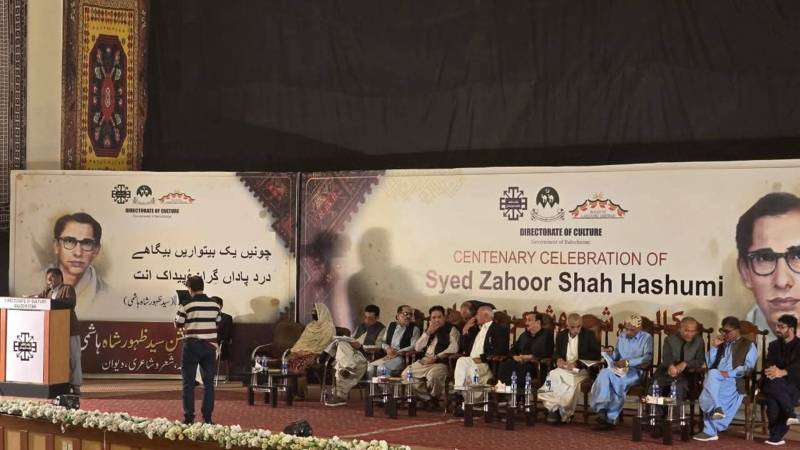
At a quarter to three on the afternoon of the 31st of October 2026, the first whispers of a winter breeze were creeping through the sunlit air of Quetta. At the Noori Naseer Khan Cultural Complex, the birth centenary of the Baloch poet and literary giant, Syed Zahoor Shah Hashmi, was being celebrated. The cultural hall is named after Mir Naseer Khan I, the ninth Khan of Kalat, who ruled the Baloch Confederacy from 1749 to 1794.
Littérateurs, poets, book-lovers, and people from all walks of life had gathered beneath its roof, bringing with them a shared love of words, ideas, and literature.
A Legacy Against a Sombre Backdrop
Syed Hashmi's birth centenary is celebrated at a time when his homeland is passing through one of the darkest periods in its history. A land once celebrated for its rich literary and cultural heritage now finds itself haunted by bloodshed and human suffering. It is a painful irony that Syed Hashmi is being honoured against such a sombre backdrop.
Yet, within the cultural complex, the atmosphere offered a stark contrast to the troubled political climate beyond its walls—a quiet reminder that even in uncertain times, when Balochistan remains shrouded in political turmoil and unrest, literature can bring people together and keep the flame of hope alive.
Determined to document and strengthen the Balochi language, he travelled extensively through Baloch-populated regions, often on camelback, to preserve literary traditions that might otherwise have been lost
The event went beyond a ceremonial tribute; it reaffirmed a legacy that continues to shape the intellectual and cultural contours of Baloch society.
Every literary tradition has its own defining voices. Just as William Shakespeare became a timeless symbol of English literature, Ferdowsi illuminated Persian literature through his immortal Shahnama, and Alexander Sergeyevich Pushkin shaped the modern spirit of Russian literature. Amir Khusrau added great richness to the literary and cultural heritage of the subcontinent. Rabindranath Tagore, too, brought new depth and beauty to Bengali literature. Similarly, Syed Hashmi stands as a pioneer of modern Balochi literature.
A Life Devoted to Literature
Born on the 21st of April 1926, and passing away on the 4th of March 1978, Syed Hashmi devoted his life to the service of the Balochi language and literature. Writing remained his passion until his final days. Even while battling illness, he continued his literary work, reflecting an extraordinary commitment to the language he loved.
Deeply well-versed in Balochi, Syed Hashmi also had a strong command of Urdu, Persian, English, and Arabic. His linguistic versatility reflected the breadth of his intellectual horizons and enabled him to engage with diverse literary traditions while strengthening his own. His work not only enriched Balochi literature and helped standardise its grammar but also laid its intellectual foundations.
In the mid-twentieth century, Balochistan still looked much as it had centuries earlier. Time seemed to have stood still. People travelled on the backs of huge and fearsome animals, carrying on a way of life rooted in the distant past. Modern transportation was scarce, and many remote regions could be reached only after long journeys across rugged terrain.
Yet these challenges did not discourage Syed Hashmi. Determined to document and strengthen the Balochi language, he travelled extensively through Baloch-populated regions, often on camelback. These arduous journeys enabled him to collect linguistic material, study local dialects, and preserve literary traditions that might otherwise have been lost.
Pioneering Lexicography and Fiction
As the first comprehensive lexicon of the Balochi language, his landmark compilation, Sayad Ganj, marked a milestone in Balochi lexicography. The work earned him a prominent place in Baloch literary circles and provided an invaluable foundation for subsequent linguistic research.
His groundbreaking debut novel, Nazuk (1976), is celebrated as the first novel in the Balochi language. Many later Balochi novels fostered its narrative techniques, which influenced subsequent Baloch writers and helped establish the novelistic tradition in the Balochi language.
The impact of this transformation became increasingly visible in the decades that followed. From the mid-twentieth century onward, fiction writing in the Balochi language continued to evolve, with many novels and short stories exploring imaginative storytelling and, in some instances, elements of magical realism and surrealism.
The Layered Symbolism of Hanul
Syed Hashmi's poetry remains equally significant. He often combined romantic lyricism with a powerful sense of collective identity and cultural consciousness. Equally compelling are Syed Hashmi's poetic lines, where a recurring symbol of Hanul occupies a central place in his verse, often seen as a tender name for Hani, a name commonly given to Baloch girls. Hanul in his poetic lines carries several layered meanings. Some critics interpret it as a metaphor for an unseen beloved and personal longing, while others see it as a symbolic expression of love for the Baloch homeland itself. This layered symbolism, however, continues to invite interpretation and admiration.
The Bridge of Cultural Recognition
To understand Syed Zahoor Shah Hashmi is, in many ways, to understand the story of modern Balochi literature. His life reflects a crucial period of transition: from oral tradition to written literature, from scattered expressions to structured prose, and from cultural preservation to literary innovation.
Yet a quiet irony remains. Although Syed Zahoor Shah Hashmi is deeply revered within Baloch literary circles, he is still not as widely known across Pakistan's broader literary landscape as his achievements warrant. His contributions deserve greater national recognition and wider scholarly attention.
As Syed Hashmi's centenary is celebrated this year, we realise that such cultural gatherings serve as a bridge across deep political divides, and act as a 'ladder down' in the intense political conflict and violence. When poets, writers, and scholars come together to celebrate literature, human progress, and the refinement of society, we are reminded that the victories of peace are far more glorious than the victories of war.