

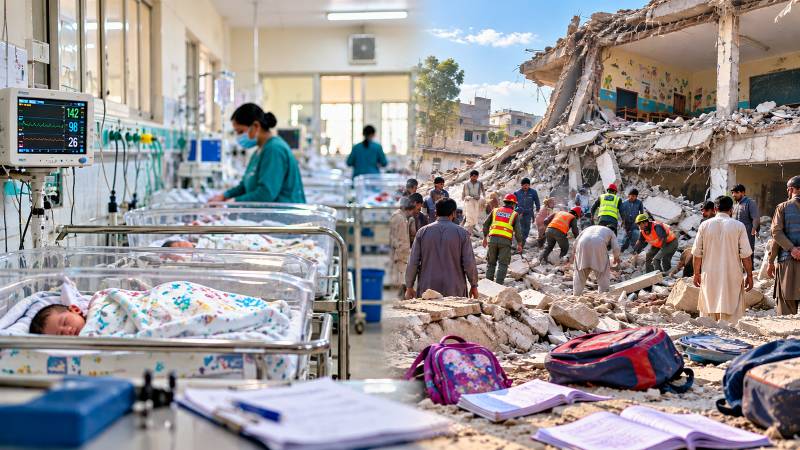
The news about the hospital came the way most bad news comes now: on a small screen, while I was scrolling. I had reached for my phone during an online meeting, the way I do every now and then, thumb moving through the feed out of habit, past a colleague’s conference photo and a recipe someone had saved. Outside my window the sky was doing what it does in the wet season, deciding whether to rain. I read the headline twice, the way you reread a sentence in a language you are still learning, hoping the grammar will come out differently the second time.
Fourteen newborns. Some said fifteen. A ward on the third floor of the Mother and Child Centre at PIMS, a building I have driven past more times than I can count. A little before seven in the morning. Sixteen babies in the room, one carried out by a doctor. An air conditioner, they said. A short circuit. Every door but one was shut. I put the phone face down and went back to my meeting, back into the fog of online meetings. But I remember thinking, with an odd clarity, that some nurse or orderly must have glanced at that air conditioner in the weeks before and noticed it was making a sound. Not a loud sound. Just a sound it had not made before. But she had a hundred other things to do.
Seven weeks later now it is a school in Peshawar. Al-Khair, in Dir Colony, on a lane so narrow the neighbors reached the rubble before the rescuers did and dug with their hands. Eight forty-eight in the morning. An upper roof gave way and took the floor below with it. At least thirty-four children, most of them between six and twelve, and their teacher. Someone had been building on top of a structure that could not carry the weight. The owner was arrested. A committee was formed. A committee was formed. I have read that sentence, or its cousins, in more reports than I care to admit. For most of my working life I have sat in committee rooms where children are spoken of in the plural. Out-of-school children. Neonatal mortality. Facilities meeting minimum standards. The numbers are not wrong. But numbers have a way of standing still while children keep moving.
The point is the tak, the until, by the time: the distance between the thing happening and the thing being known. That interval is where governance lives or dies.
Here is something I have come to believe, though it took me longer than I am proud of. Buildings do not collapse for lack of concrete. They collapse in the gap between a rule and the person paid to enforce it. A fire or safety audit that exists only on paper. A maintenance budget that is always the first line cut, because no minister has ever cut a ribbon on a rewired ward. A low-fee private school that opens because the government school is too far, too full, or simply a ghost, a name on a register with no building behind it, and a regulator with no inspector, or one inspector without transportation, or one inspector with a price. A third storey added to a two-storey frame because the rent is good and the demand never ends.
Each of these is a rational decision. That is the frightening part. The system is not broken. It is doing exactly what its incentives ask of it. I keep thinking of a novel I once read, in which a man who finds an old stone pit hidden in the woods behind his house. Something had been sealed down there for a very long time, waiting, and once the pit was opened it climbed out. My country has a pit like that beneath its ministries and press briefings. Everything left undone drops into it without a sound: the postponed inspection, the flagged wiring, the petition a parent-teacher committee wrote about the crack in the classroom ceiling. No one hears anything land. And then one morning, at seven, or at eight forty-eight, the pit gives something back.
There is a couplet by Ghalib I keep returning to these weeks.
ہم نے مانا کہ تغافل نہ کرو گے لیکن
خاک ہو جائیں گے ہم تم کو خبر ہونے تک
I grant that you will not be negligent. But
we will have turned to dust by the time word reaches you.
He wrote it to a beloved, as Urdu poets do. Read now, it sounds like a petition that was never forwarded. I do not think the state is indifferent. The Prime Minister orders an inquiry. The President calls it heartbreaking. Nobody sets out to commit taghaful. But intention is not the point. The point is the tak, the until, the by the time: the distance between the thing happening and the thing being known. That interval is where governance lives or dies. A working smoke alarm shortens it. An inspector who actually climbs onto the roof shortens it. A maintenance line that survives the third budget revision (if it ever made it into the first) shortens it. Every institution we build is, in the end, a machine for making the news arrive sooner.
In Pakistan, the news arrives after the dust. The rain came down hard that night. I sat by the window and thought about the one baby the doctor carried out of the ward. That child is two months old now, perhaps sleeping in a room with a fan turning slowly overhead, knowing nothing. In four or five years, someone will walk that child into a school on a narrow lane. I would like, before then, for word to reach someone. Not of what happened. Of what is about to.