

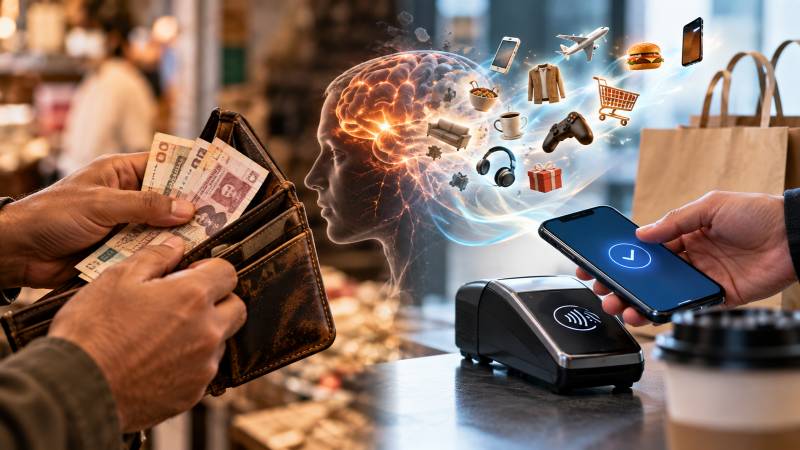
For centuries, money in its pure, intrinsic and tangible form was confined to people’s pockets and wallets. With the advent of banks in the 17th century, aristocrats began relying on financial institutions for safety and security, a trend that later rippled down to the lower classes of society. This trend, however, began to create a shift in psychological behaviour in the 1950s following the evolution of financial technology.
In earlier times, spending money was tied to a direct, physical exchange of goods or services for money. People could feel their money in their hands, count it, tuck it away in envelopes, and watch it disappear from their wallets with every transaction. Watching their money diminish, they experienced a tangible sense of guilt and anxiety.
Today, however, this experience is changing. Money is no longer available in its conventional form — it has left our pockets and become represented by numbers across multiple mobile banking and microfinance applications, while being carried with us 24/7 through smartphones and smartwatches. A tap of a phone can pay for a meal. A swipe can purchase clothes. A QR code can transfer thousands of rupees within seconds. Subscriptions renew automatically, food arrives at the door, and online purchases are completed without a single banknote changing hands.
Nonetheless, financial technology (fintech) has made payments faster, easier and increasingly invisible. This has accelerated economic activity and contributed to overall economic well-being, but it may also come at a psychological cost. The transformation from cash to cashless payments is not merely a matter of technological advancement; rather, it has diminished the psychological weight of spending.
Paying Rs. 5,000 in cash requires a person to count the notes and hand them over in exchange for a purchase. By contrast, paying Rs. 5,000 digitally may require nothing more than a fingerprint or facial recognition. The amount leaving a person’s possession is the same, but the psychological experience can be different. This emotional discomfort associated with spending is commonly referred to as the “pain of paying”, while the tendency for this discomfort to diminish with cashless transactions is often discussed as the “cashless effect”.
There is a growing body of scholarly literature examining this relationship. The idea was first explored by Zellermayer (1996), who described the departure of money as generating negative emotions when it is exchanged for goods or services. Similarly, Kamakura et al. (2014) describe humans as loss-averse, associating the departure of money with a loss they seek to avoid. In contrast to physical cash, money leaving an account electronically may reduce this perceived sense of loss, which can contribute to more mindless spending through cashless transactions (Reshadi & Fitzgerald, 2023).
The way people remember their spending is also relevant. Money spent in the form of cash may have a stronger emotional connection and remain in memory longer than money spent through cashless payments. With cashless payments, this reduced memorability may ultimately lessen the pain of paying and increase overall spending (Soman, 2001).
To provide empirical evidence, Agarwal et al. (2024) used India’s 2016 demonetisation as a natural experiment. The researchers examined transaction-level data from a large supermarket chain and exploited differences in consumers’ exposure to the sudden reduction in cash availability. They found that a forced increase in digital payment use was associated with higher spending. Their estimates indicate that a one-percentage-point increase in the digital-payment share led to approximately a 0.81 per cent increase in total spending among affected consumers. The authors argue that the evidence is consistent with digital payments weakening consumers’ psychological attachment to their money, which they describe as a subdued endowment effect.
Moreover, cashless payments may also contribute to mindless spending and overconsumption. Data collected from 498 e-commerce shoppers suggested a strong positive relationship between impulsive spending and cashless payment methods, raising concerns about responsible production and consumption under Sustainable Development Goal 12 (SDG 12) (Doan et al., 2025). In essence, money may have become psychologically lighter as digital payments have stripped away some of the negative emotions traditionally associated with spending. When we can no longer see money leaving us, we may not always feel what it costs. And perhaps that is the most important question fintech should now ask — not simply, “How easily can we make people pay?” but, “How can we make paying easy without making mindless overspending inevitable?”
References
Agarwal, S., Ghosh, P., Li, J., & Ruan, T. (2024). "Digital payments and consumption: Evidence from the 2016 demonetization in India". The Review of Financial Studies, 37(8), 2550–2585. https://doi.org/10.1093/rfs/hhae005
Doan, Linh T. M., Mizan Rahman, and Xuan Vinh Vo. 2025. “Mitigating Overconsumption through Mindfulness: The Role of Cashless Payments in Impulsive Buying and Sustainable Consumer Behaviour.” Journal of Chinese Economic and Business Studies, 23(2):209–32. doi:10.1080/14765284.2024.2415728.
Kamakura, Wagner, Praveen K. Kopalle, and Donald R. Lehmann. 2014. “Empirical Generalizations in Retailing.” Journal of Retailing, 90(2):121–24.
Soman, Dilip. 2001. “Effects of Payment Mechanism on Spending Behavior: The Role of Rehearsal and Immediacy of Payments.” Journal of Consumer Research, 27(4):460–74.
Lee, J. N., Morduch, J., Ravindran, S., & Shonchoy, A. S. (2024). "The social meaning of mobile money: Earmarking reduces the willingness to spend in migrant households". Journal of Economic Behavior & Organization, 221, 675–688. https://doi.org/10.1016/j.jebo.2024.04.023
Schomburgk, L., Belli, A., & Hoffmann, A. O. I. (2024). "Less cash, more splash? A meta-analysis on the cashless effect". Journal of Retailing, 100(3), 382–403. https://doi.org/10.1016/j.jretai.2024.05.003
Zellermayer, O. (1996). The pain of paying. Carnegie Mellon University.