

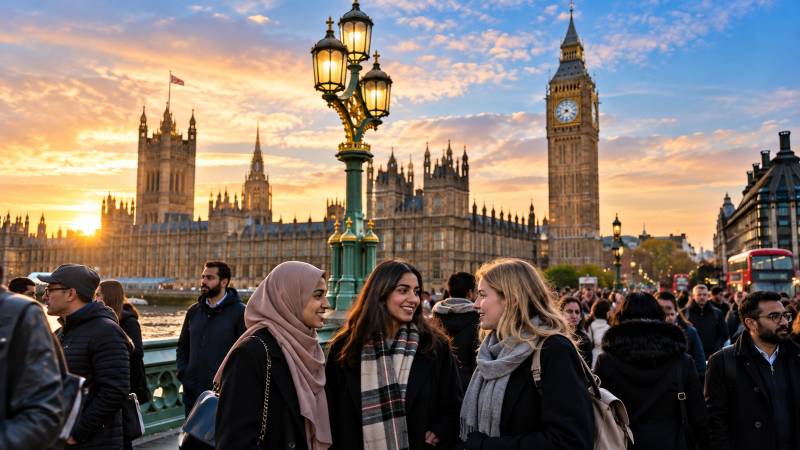
There is growing unease in the United Kingdom over rapid demographic change, much of it driven by mass migration. Nobody with a sensible head on his shoulders would suggest that illegal migration should be treated lightly, yet a legitimate debate about borders has, perhaps, acquired a more troubling question, who is really British, and will the “native Briton” one day find himself a stranger in his own country? It was this anxiety that Sir Jacob Rees-Mogg challenged at the Oxford Union earlier this year, reminding Britain, in that unmistakably Etonian cadence of his, that a country ought to have some faith in the institutions it has spent centuries building. His argument was rather simple, if Britain truly trusts its Parliament, laws and democratic traditions, why should peaceful difference be treated as an existential threat?
In his speech, Rees-Mogg reminded Britain of something it is not often reminded of, not merely what is wrong with the country, but what it has managed to build. He spoke of a system which, rather than fearing change, was strong enough to absorb it, a system capable not only of preserving what is distinctly British, but of protecting the communities and faiths that have made Britain their home. That system, of course, was democracy and the British constitution, in which Rees-Mogg appeared to place an almost Victorian degree of confidence. His argument was that Britain ought to trust its institutions enough to withstand changes in its identity without losing the very character those institutions were built to protect. What followed was perhaps the more striking point, Britain, he argued, could accommodate an increase in a particular demographic and still welcome those people as part of the country. After all, what happens in Tehran does not, by some peculiar constitutional magic, happen in Westminster.
If Britain truly trusts its Parliament, laws and democratic traditions, peaceful demographic and religious difference need not be treated as an existential threat to the country’s identity.
Within the very constitution of which he spoke so highly, Rees-Mogg pointed to a rather important freedom which is sometimes curiously absent from conversations about “British values”, freedom of religion. His reminder was simple enough. If Britain’s values are liberty, expression and democratic freedom, then those freedoms must extend to the communities who call the country home. Rather than treating religious difference as a threat to be managed, he presented it as something from which Britain might benefit. His wider point was that the modern West was not shaped by one tradition alone, but by ideas that travelled between civilisations and faiths, often leaving Britain rather better off for the journey.
Perhaps, then, the question ought not merely to be what Britain has to fear from those who are different, but what it might gain by allowing them the freedom to contribute. For a country so fond of calling itself the birthplace of modern liberty, that seems a proposition worth considering. The speaker went further, offering Muhammad ibn Musa al-Khwarizmi as a rather practical reminder of what different communities have contributed to the world Britain now inhabits. The Muslim scholar’s work in mathematics helped lay the foundations for the numerical systems upon which modern commerce depends. One need only imagine capitalism without numbers to appreciate the difficulty. His wider point was that civilisation has never been the exclusive property of one faith or people.
When challenged with examples of terrorism and violence committed by those from particular communities, his answer was equally simple, Joseph Stalin was an atheist, but no one would seriously suggest that atheists should answer for his crimes. Christians, he added, have hardly kept their hands entirely clean throughout history either, yet one Christian does not become the representative of all Christianity. The argument was ultimately against collective guilt, Britain’s security should be judged by genuine threats, according to him, including states such as China and Russia, rather than by turning entire communities into suspects for the actions of a few. A rather obvious principle, perhaps, but one politics has an impressive talent for forgetting.
He ended by embracing his Christianity with unmistakable pride, seeing in it not a rejection of modern Britain but one of the traditions through which its freedoms had been formed. Freedom of speech, expression and religion were, in his telling, not concessions to a changing society but among the very principles that allowed Britain to remain itself. There was something rather striking about that coming from an Eton-educated, Oxford graduate Tory who had spent his career in finance and Parliament yet remained so deeply rooted in Britain’s history and culture. At a time when many young people encounter both through the rather unreliable tutelage of social-media algorithms, perhaps the value of listening to someone who has actually studied the past is that he reminds us that a country can be confident in what it inherited without being frightened by what it becomes. That, ultimately, was the spirit of his argument, Britain need not abandon its identity to accommodate others, nor close itself off to preserve it. It need only have enough confidence in itself to do both.