

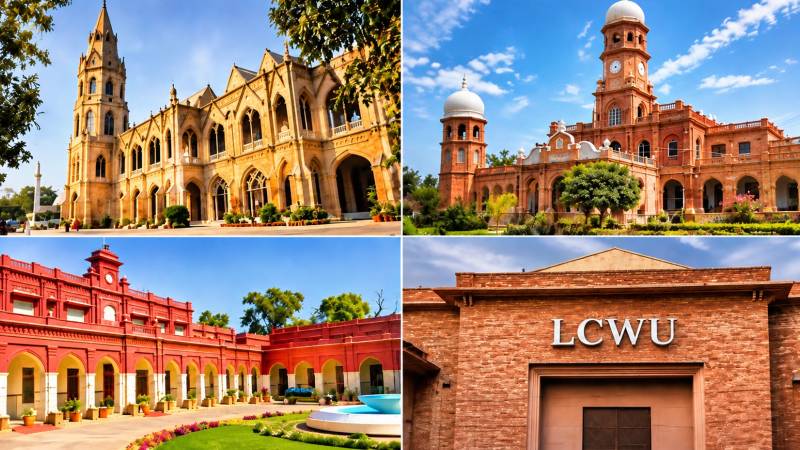
Punjab’s Higher Education Department has written to the vice-chancellors of six public universities, directing them to drop the word “University” from their names. The directive comes under the Public Sector Universities (Amendment) Act, 2026. The six are Government College University Lahore, Lahore College for Women University, Government College University Faisalabad, and the women’s universities in Faisalabad, Sialkot and Bahawalpur. They will continue to award degrees, run PhD programmes and compete for research grants. They just won’t be allowed to say what they are in their own names.
The irony is that twenty-four years ago, these institutions were told to add “University” to their names. Now, twenty-four years later, the Punjab government has decided that was a mistake. So, the names have been changed again, and the universities are back to being called colleges. A name tells us something about an institution’s identity and standing. When an institution calls itself a university, it tells students, employers, regulators and research partners what kind of institution it is, what degrees it awards and what sort of academic work goes on there. An amendment that appears to change only a name deserves a serious debate for precisely that reason.
In 2002, legislators took an approach to naming that had no precedent in Pakistan. They kept “Government” and “College” and added “University”. The idea was to carry the institution’s history forward. It was a sensible way of preserving its heritage. Former students who still fondly call their alma mater “GC” had lost nothing. The old name lived on within the new one. The supporters of the new Act ought to answer a simple question. What part of the institution’s heritage was missing from “Government College University” that “Government College, Lahore” now restores?
Supporters of the Act point to King’s College London, Imperial College London, Trinity College Dublin and Dartmouth College. All are universities with “College” in their names. But those examples point to something else. The names make sense within education systems where people already know the standing of these institutions. In Pakistan, “college” has a clear and widely understood meaning. It generally refers to a teaching institution affiliated with a university, which conducts the examinations and awards the degrees. An admissions officer or a credential evaluator abroad who sees “Government College” on a Pakistani academic record will read it in that context. A Dartmouth graduate doesn’t have to explain the status of their alma mater. Why should ours have to?
In the two decades since 2002, the institutions that went from colleges to universities have built a reputation under their current names. Those names appear in Scopus and Web of Science alongside the research papers of their faculty, identifying their institutional affiliations. The universities are registered in the Research Organization Registry, or ROR, which supplies information to systems such as ORCID and Crossref. Credential evaluation bodies such as WES and ECCTIS list them as recognised degree-awarding institutions. Agreements with foreign universities have been signed under those same names.
Turning back the hands of the clock cannot bring back the past, but it can damage the present and jeopardise the future, leaving a generation of students to pay the price for a decision in which they had no say.
Names can be updated in these systems, but the process can be far from simple. Research records often end up split between the old and new names until someone takes the trouble to bring them together. Citation-based indices can be affected in the meantime. Public universities already struggling financially will have to bear this additional expense without gaining anything academically. Then there is the cost to the individual. Suppose someone who graduated in 2015 now lives in Toronto and holds a degree from Government College University Faisalabad. When an employer or immigration official goes to verify that degree, the institution that issued it will be operating under a different name. The discrepancy will eventually be cleared up, but only after correspondence, supporting documents and delays. And the graduate will have to pay for it. Now think of the graduates of all six institutions over thirty years and imagine the scale of that burden.
I understand the feeling among former students that lies behind this amendment. For years, many old students of Government College Lahore have said that the old name is, in the words of one Ravian, “a name that carries our identity and heritage”. I understand that sentiment. Names hold memories, and those memories matter. But memories are a poor basis for policy. The desire to bring back the old names is largely born of nostalgia. It comes mainly from people who studied there before the institution became a university. Many of them are now retired. For them, “GC” is an entire period of their lives. It means their youth, their teachers and the Lahore they knew. The old name carries with it the hope that some of that time might return. But the Oval Ground and the clock tower will still be where they have always been. Removing a word from the nameplate won’t bring back the seventies.
We should also think about the stakeholders this decision overlooks. For nearly a quarter of a century in Lahore and Faisalabad, and for more than a decade at the newer women’s universities, each incoming class has known its institution as a university. That is the name on their admission letters, degrees, academic records, theses and research publications. To them, “University” is hardly a new label stuck onto an old college. It is part of the only name they have ever known their alma mater by. Small wonder that those who have studied and graduated since these institutions became universities are uneasy about the decision.
When we make laws on matters of public concern, we have to weigh the benefits against the costs. Here, the benefits go to one group and the costs fall on another. The benefit is largely sentimental, and it goes mainly to those who graduated before their institution became a university. The costs will be borne by current students, faculty and those who graduated after it became a university. Many of them are still at the beginning of their careers. The present names are on their degrees, in their appointment records and in their immigration files. Turning back the hands of the clock cannot bring back the past, but it can damage the present and jeopardise the future. The Punjab Assembly still has time to reverse its decision. If it allows the change to stand, the price of restoring an old name may be paid by a generation of students who had no say in the decision.