

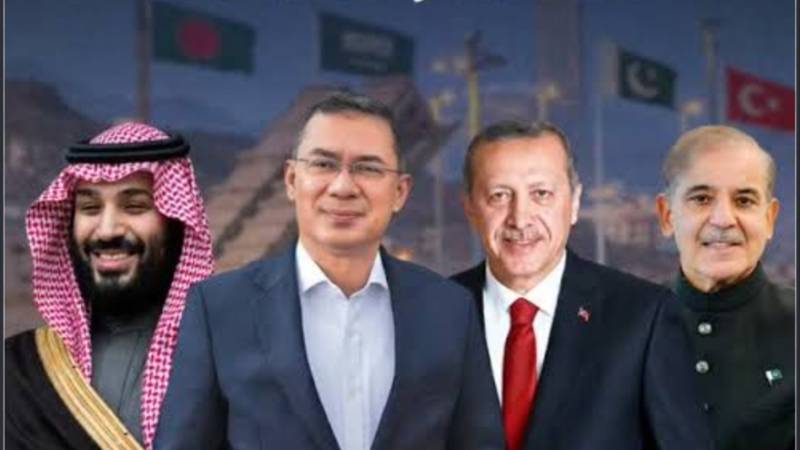
For fifty years, Bangladesh’s foreign policy carried forward a single, unwritten rule: India first policy, and Pakistan was kept at arm’s length due to 1971 established narrative. Sheikh Hasina’s Awami League flourished her politics and political identity on that memory. Her sudden fall in August 2024, and the rise of Muhammad Yunus’s interim government followed this year by Tarique Rahman’s Bangladesh Nationalist Party (BNP), has done more than change faces in Dhaka. The assumption that New Delhi was sine qua non for Bangladesh defence fell apart. A sudden shift in foreign policy towards Pakistan concerned New Deldhi as relationship propper up so quickly , it became indigestible for Modi government. Direct flights with Pakistan resumed, visa procedures eased, and military delegations began crossing a border that had barely seen them in decades . Now that recalibration has acquired a sharper edge: Dhaka says it is open to joining the Mecca Joint Defence Agreement, the mutual-defence pact binding Saudi Arabia, Turkey and Pakistan.
Bangladesh’s state minister for foreign affairs, Humayun Kobir, has been careful with his words but clear in his direction, calling the possibility. For him it’s not unnatural for a Muslim-majority nation (Bangladesh) to view such developments positively althoguh a formal proposal is yet to be tabled. Signed in Mecca on 7 August 2026 by Saudi Crown Prince Mohammed bin Salman, Turkish President Recep Tayyip Erdogan and Pakistani Prime Minister Shehbaz Sharif, the agreement declares that an attack on any one signatory is an attack on all three which is similar to an Article 5 of NATO commitment. That has been based on the bilateral Saudi-Pakistan defence pact signed the previous September 2025. Egypt has also signalled interest, and Turkish officials have said the pact’s vision was never meant to stop at three members.It means the new members like Bangladesh, Indonesia are likely to join as memebers. For Rahman’s government, courting under a self-described Bangladesh First doctrine, the calculus is straightforward: Mecca carries religious weight at home, Riyadh and Ankara offer capital and defence technology, and Islamabad offers a partner unburdened by the emotional debts India still expects Dhaka to honour.
This is where the story stops being a South Asian centric and becomes a China question. Beijing has spent the past two years quietly doing to Bangladesh what it long ago did to Pakistan: “building a community of shared future.” Rahman's first overseas trip as prime minister was not to New Delhi, breaking six decades of convention, but to Kuala Lumpur and then Beijing, where his June 2026 visit produced fifteen memorandums of understanding, roughly $300 million in Chinese grants, and an agreement to explore a joint diplomatic-and-defence “2+2” dialogue mechanism. Xi Jinping revived Beijing’s old proposal for a China-Myanmar-Bangladesh economic corridor and pledged interest in modernising Chattogram and Mongla ports, the latter sitting a mere 80 kilometres from the Indian border and is significant in terms of strategic significance. Bangladesh is now only the second South Asian country, after Pakistan, to be granted this “shared future” designation, a label China reserves for its closest strategic partners.
Dhaka is building stronger relationships with other countries to reduce its dependence on New Delhi; China, without directly involving itself in the Mecca pact, stands to benefit from a Bangladesh that is becoming closer to Pakistan and more open to Beijing.
So, what happens if the country Beijing has just strengthened ties with joins a Muslim collective-defence pact led by a country that China has already developed close relations with? For China, the cost is relatively low. Chinese reactions to the Mecca pact have been largly relaxed. Rather than seeing it as a threat to China, Chinese analysts have presented it as another sign of declining American influence in West Asia. Some commentators on Chinese social media have even described it as a Sunni NATO, mainly directed at Iran and Israel rather than China.
A Bangladesh-Pakistan-Saudi-Turkey grouping, loosely connected by shared religious identity and doubts about the long-term commitment of the United States, does not directly challenge Chinese interests. In fact, it fits Beijing’s preference for a multipolar security order that reduces American dominance without requiring China to take on additional security responsibilities.
But the second-order effects matter more to Beijing than the pact’s text. A Dhaka drawing closer to Islamabad on defence, even loosely, sits inside a wider pattern China has been actively cultivating: two increasingly aligned South Asian capitals, both hosting Chinese port and connectivity investments, both explicitly hedging away from India, and both willing to entertain a defence-and-diplomacy dialogue with Beijing on near-identical 2+2 terms. That is not an alliance China envisioned, but it has potential to undermine Indian policy of Bangladh using an ally or a buffer with China. Indian analysts have already viewed the handover of Mongla Port and the proposed Myanmar corridor as a direct strategic challenge to India. They are particularly concerned because these developments could put additional pressure on the Siliguri Corridor, the narrow land route that connects India’s northeastern states with the rest of the country. This corridor is often seen as a major strategic vulnerability for India because of its limited width and proximity to Bangladesh, Bhutan, Nepal and China.
There are some technicalities to the Mecca Pact that still are under discussion in scholarly circles. Analysts in Beijing, Riyadh and Ankara have cautioned against describing the Mecca pact as a full military alliance. Its three founding members have different strategic priorities and threat perceptions, and Pakistan’s nuclear umbrella is unlikely to extend to its new partners. Rahman also argues that Bangladesh’s growing ties with China and the Gulf states are mainly about diversifying its foreign relations, rather than completely moving away from India. Bangladesh still depends on India for fuel, electricity and other essential supplies and breaking with India is not the option for Bangladesh. However, regardless of these intentions, the broader trend is clear. Dhaka is building stronger relationships with other countries to reduce its dependence on New Delhi. China, without directly involving itself in the Mecca pact, stands to benefit from a Bangladesh that is becoming closer to Pakistan and more open to Beijing. For China, therefore, this is not a problem to manage. It is a strategic advantage that is already beginning to pay off.