

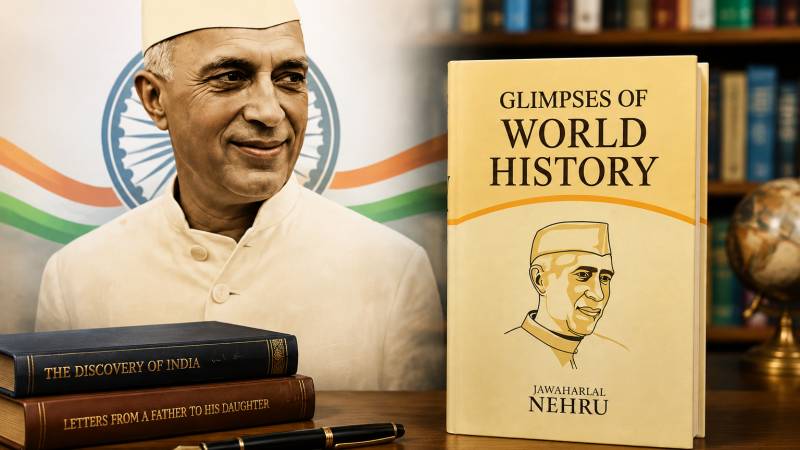
The book did not begin as a book at all. In 1928, Jawaharlal Nehru, deeply involved in India’s freedom movement, sat down to write his ten-year-old daughter, Indira, a series of letters about the early history of the world. It was nothing grander than a father trying to give his child a sense of where she stood in time. Those letters received what Nehru later described as a generous reception and were published in 1929 as Letters from a Father to His Daughter. Then life intervened. Political activity consumed him, and the idea of continuing the letters remained in his mind without becoming urgent enough to pursue.
It took prison to finish what a busy life kept postponing. Nehru was jailed repeatedly through these years for his part in the Civil Disobedience Movement against British rule, and from 1930 to 1933, writing from Naini, Bareilly and Dehra Dun, with two letters written aboard the SS Cracovia in the Arabian Sea during a brief period of freedom, Nehru resumed writing to Indira and this time did not stop.
What had begun as an occasional correspondence grew, letter by letter, prison by prison, into 196 letters, carrying the reader from the earliest civilizations through the nineteenth century and into the turbulent political world of Nehru’s own time. A private habit of fatherly letter-writing had, almost without anyone intending it, become one of the more unusual works of historical writing of the twentieth century.
The sheer range of what Nehru attempts is worth pausing over. This is not a history confined to India and Britain, the two poles of his political life. He moves through the Hellenic city-states and Roman Republic, the Mauryan and Gupta empires, the Mughal Empire, the Ch’in and Han dynasties, the Abbasid caliphate under Harun-al-Rashid, the Mongol conquests from the Yellow River to Eastern Europe, and Shogunate Japan.
He takes detours into the Maya civilization, the Malay empires of Madjapahit and Malacca, the temple kingdoms of Angkor, and the trading networks of Sri Vijaya, while also exploring the French Revolution, the Irish struggle for independence, religion, scientific discoveries, poetry, literature, creation stories and philosophy.
The book’s real subject, in the end, may not be world history at all. It may be what happens when a mind refuses to go idle simply because it has been locked away.
Few writers working from a prison cell, without access to a library or reference collection, would attempt a canvas this wide, let alone move across it with such ease, treating Tokugawa Japan and ancient Athens as parts of a single connected human story. Nehru himself is candid about the limitations of the project. In his preface, he admits that his outlook on history changed as the letters progressed, so that he would have written many of them differently by the time they were gathered for publication. Yet by then it was too late to begin again.
He also acknowledges the restrictions imposed by prison. There were no libraries or reference books at the prisoner’s command, and he relied largely on memory, notebooks containing notes from earlier reading, and whatever books temporarily reached him. Rather than concealing these limitations, he places them before the reader.
This is, in other words, a history written in full knowledge of its own incompleteness. That honesty gives the book much of its distinctive texture. Nehru does not claim the authority of a professional historian. He is thinking on the page, working from memory and old notes, aware of where a scholar might qualify his claims, yet choosing to write nevertheless. The letters move with the pace of someone reconstructing a picture rather than simply reciting settled facts. That quality is part of why the book still feels alive rather than embalmed, nearly a century after it was written.
The intimacy of the address matters too. These are letters to “Indu,” filled with birthday greetings, private asides and a father’s hope that his daughter will grow up brave and unafraid. More importantly, Nehru does not ask her to accept his views unquestioningly. “But that is my opinion,” he tells her. “Some people differ from this. You need not take anything for granted, and, when the time comes, you can draw your conclusions.” It captures the essence of the book: Nehru is not merely teaching Indira what to think about history, but how to think about it.
He is trying to give his daughter, and eventually young readers everywhere, a way of understanding the sweep of human civilization as something continuous and comprehensible. He does so in a voice that trusts its reader enough to reveal its own uncertainties and limitations.
Written over roughly thirty months, the letters are held together by the plainness of the prose. Nehru writes conversationally, addressing Indira directly and explaining complex subjects without drowning them in scholarly detail. The mechanics of empire, the economics of trade and the philosophical foundations of religious movements arrive in the same unhurried voice a father might use while explaining the world to his child. That accessibility is likely one reason the book has remained readable and continues to find new readers nearly a century later.
Read today, in a country whose relationship with its past is often more asserted than examined, there is something instructive in that trust. Glimpses of World History was never intended to be a definitive reference history, and Nehru himself acknowledged its limitations. Near the end of the letters, he tells Indira that history is no magic show, but insists that there is “plenty of magic in it for those who have eyes to see.” It is that insistence, more than any claim to absolute accuracy, that the book ultimately delivers on. As a demonstration of what sustained intellectual labour can produce without institutional support, a library, or research staff, it remains a remarkable act of will.