

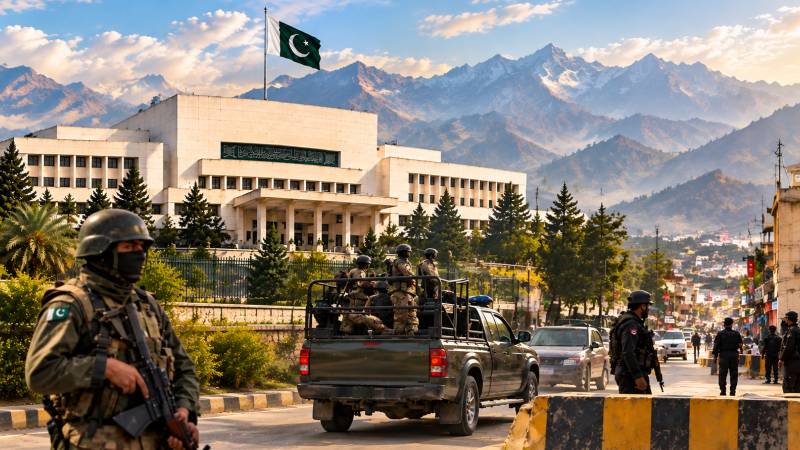
The emergency imposed in Khyber Pakhtunkhwa raises a fundamental question: can political disagreement and a province's alleged failure to cooperate justify extraordinary constitutional intervention? On 11 October 2026, President Asif Ali Zardari approved an emergency proclamation for Khyber Pakhtunkhwa under Article 232, alongside a separate proclamation under Article 234. Parliament subsequently approved both proclamations. Read closely, the proclamation resembles a chargesheet, accusing the provincial government of failing to show "the ownership, will and intent to adequately deal with the menace of terrorism." But political unwillingness is not, in itself, proof of constitutional incapacity. The question is whether the grounds for each intervention were independently established.
The contextual understanding of Articles 148 and 149, and its distinction with Article 232, is central to understanding the constitutional issue. These provisions belong to different constitutional frameworks and should not be treated as interchangeable. Chapter 2 of Part V, "Administrative Relations between Federation and Provinces," establishes the framework for the continuing relationship between the Federation and the provinces. Article 148(2) requires the Federation, when exercising its executive authority within a province, to have regard to that province's interests. Article 148(3) places a duty on the Federation to protect every province against external aggression and internal disturbances and to ensure that its government is carried on in accordance with the Constitution.
Article 149(4) must be understood in this context. It empowers the Federation to direct how provincial executive authority is exercised to prevent a grave menace to the peace, tranquillity or economic life of Pakistan or any part of it. It provides a constitutional mechanism for addressing serious threats within the continuing federal-provincial relationship. Its existence does not, by itself, authorise the takeover of provincial government functions.
Article 232 belongs to Part X, "Emergency Provisions," and addresses a different situation. An emergency on the ground of internal disturbance requires a grave emergency threatening the security of Pakistan, or a part of it, arising from a disturbance beyond the power of the provincial government to control. This is an exceptional constitutional threshold, not merely an extension of the ordinary framework of administrative relations. The distinction matters. Chapter 2 provides a framework for federal and provincial authorities to discharge their respective responsibilities, including through federal directions where the constitutional conditions are met. Article 232, by contrast, permits extraordinary measures when its specific threshold is satisfied. A dispute over cooperation or the adequacy of provincial policy cannot, by itself, transform the former situation into the latter.
The central question is not simply whether terrorism has increased or whether the federal government considers the provincial response inadequate. It is whether the internal disturbance threatens security in circumstances beyond the provincial government's power to control. A serious threat and a province's inability to control it are different things, and the gravity of terrorism alone does not establish the second. Nor can political disagreement, a breakdown in negotiations or alleged non-cooperation automatically satisfy that requirement.
The legitimacy of institutional power and political action derives from the Constitution, which defines both their authority and their limits. When politics exceeds those boundaries, constitutional balance gives way to the assertion of power, undermining the very framework that legitimises it.
The federal government's assessment must therefore be tested against the threshold in Article 232, not treated as proof of it. The implications are particularly significant for the twelve districts placed under a separate administrative arrangement, including the merged tribal districts. The Twenty-Fifth Amendment integrated the former FATA into Khyber Pakhtunkhwa and ended its separate constitutional status. It is worth asking, then, whether emergency powers are being used to bring about a practical reversion of that integration without formally reversing the amendment.
Article 232 contains important procedural safeguards. Its first proviso requires a resolution of the relevant Provincial Assembly for an emergency based on internal disturbance beyond the provincial government's power to control. A further proviso deals with a proclamation issued by the President acting on his own and requires approval by each House of Parliament within ten days. In this case, the Provincial Assembly of Khyber Pakhtunkhwa never passed such a resolution.
That makes the relationship between these provisions more than a theoretical puzzle. It is, at bottom, a question of interpretation: can the President routinely circumvent the first proviso by relying on the power to act on his own? It seems difficult to say yes. If the answer were yes, the requirement of a Provincial Assembly resolution would become redundant in practice, and the very purpose for which the Eighteenth Amendment inserted it into Article 232 would be defeated. Parliamentary approval is a separate constitutional requirement. Whether the procedure followed satisfies the Constitution, including the role expressly assigned to the Provincial Assembly, remains a distinct question.
Article 234 raises a different question: what constitutes a situation in which provincial government cannot be carried on in accordance with the Constitution? The Supreme Court's decision in Pir Sabir Shah v. Federation of Pakistan, which arose from the 1994 proclamation in the then North-West Frontier Province, offers a relevant comparison. There, obstruction of Assembly proceedings prevented a vote of confidence and created a constitutional deadlock over whether the Chief Minister commanded majority support. The present proclamation, however, merely invokes the language of Article 234 without adequately establishing the factual circumstances that constituted a breakdown of constitutional machinery in Khyber Pakhtunkhwa. What specific events or institutional failures led the Federation to conclude that the provincial government could not be carried on in accordance with the Constitution?
Allegations of inadequate counterterrorism efforts or insufficient political cooperation do not, without more, answer that question. In Pir Sabir Shah case, the proclamation arose from an identifiable institutional deadlock that obstructed the determination of the Chief Minister's majority. No comparable deadlock has been demonstrated in the present case. The proclamation must therefore be scrutinised not merely for its stated conclusion, but for whether the facts relied upon satisfy Article 234's constitutional threshold. Otherwise, an exceptional constitutional power risks becoming an instrument for resolving political disagreement.
The emergency and the separate intervention under Article 234 must each stand on their own constitutional grounds. The transfer of provincial executive functions to federal administration illustrates the seriousness of these measures, but their consequences cannot determine whether the legal conditions for intervention existed. The Federation has a constitutional responsibility to address security threats. Yet Chapter 2 provides the framework within which federal and provincial authorities must discharge their responsibilities, while Article 232 prescribes the conditions for exceptional intervention. The latter cannot be justified merely by pointing to difficulties within the former.
The decisive question in Khyber Pakhtunkhwa is therefore not whether the federal and provincial governments were at odds. It is whether the distinct constitutional conditions for the measures adopted were established and the safeguards prescribed by the Constitution respected. The legitimacy of institutional power and political action derives from the Constitution, which defines both their authority and their limits. When politics exceeds those boundaries, constitutional balance gives way to the assertion of power, undermining the very framework that legitimises it.