

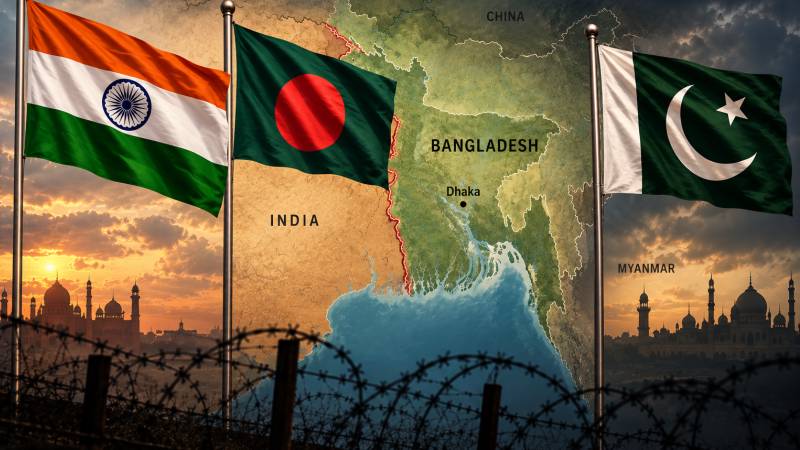
India, Pakistan, and Bangladesh inherited the same administrative bloodstream; the colonial-era Indian Civil Service, split at Partition and split again in 1971. Three states, one institutional ancestor. What has happened since is the real diagnostic, because if the DNA is identical and the outcomes are not, the difference is not the system. It is what each country's political leadership chose to do with it.
India kept the elite, cadre-based structure of the old ICS largely intact, distributed it across its states through the IAS, and critically subordinated it to elected political authority early and durably. Bangladesh went the opposite structural route, flattening its service into a single unitary grade system and leaning on NGOs and development partners to fill administrative gaps the state could not staff on its own. Neither model is without flaws. Both countries have spent the last two decades growing steadily, attracting foreign investment, and building digital government capacity that Pakistan has not matched. Pakistan carried forward the same colonial cadre model as India, added heavy centralization on top of it, and layered a third variable neither neighbour shares at the same scale: a bureaucracy that has spent much of its history operating in tandem with, or subordinated to, the military establishment rather than to elected civilians. That third variable is not a footnote. It is arguably the single largest structural difference separating Pakistan's trajectory from India's and Bangladesh's, and it deserves far more scrutiny than it receives in the domestic political conversation.
Now put Pakistan next to a different comparison set entirely. The UAE has run an aggressive "Zero Bureaucracy" program specifically designed to strip out redundant paperwork and cut transaction times across federal services, and it now ranks 11th globally on the UN's e-government index. Singapore, ranked 3rd, and Norway, ranked 15th, are both built on the same underlying principle: government effectiveness measured not by the size of the civil service but by how little friction a citizen or investor encounters when dealing with it. None of these three states inherited anything resembling Pakistan's colonial administrative structure. What they share instead is something structural choices alone cannot fully explain, a political class that made bureaucratic efficiency a measurable target rather than a rhetorical one.
That comparison is the uncomfortable part for Pakistan's current political leadership, because it exposes what "blaming the bureaucracy" actually is: a diagnosis that stops one level too early. A civil servant does not independently decide to award a contract without competitive bidding, or to sit on a file for eighteen months, or to look away from an irregularity. Those actions happen inside a chain of command that ends, ultimately, with elected officials who set the incentives the bureaucracy operates under. Where political leadership has been genuinely, consistently committed to transparency, corruption in the civil service becomes structurally difficult to sustain not because bureaucrats become more virtuous, but because the cover they would need from above simply is not available. Where that commitment is absent, the bureaucracy does not act alone; it does what it has learned, over decades, that the political leadership tolerates or quietly rewards.
Where that commitment is absent, the bureaucracy does not act alone; it does what it has learned, over decades, that the political leadership tolerates or quietly rewards.
This is the nexus worth naming plainly: Pakistani politicians have historically preferred bureaucrats willing to execute questionable instructions over ones who would resist them, and have shaped laws, rules, and postings to make that preference pay. Postings and transfers at the top of Pakistan's bureaucracy are decided in Islamabad, by Pakistan's own prime minister and cabinet not in New Delhi, and not by India's prime minister. When a Pakistani official's conduct raises concern, the responsibility for who put that official there, and kept them there, sits entirely on this side of the border.
The tragic saga of Federal Minister for Establishment, Mr Ahad Khan Cheema, entrusted with the transfer of bureaucrats too, encapsulates the bitter dilemma of Pakistan’s statecraft: a public administrator whose massive assets and questionable past are a matter of open knowledge to every citizen with a smartphone, yet who now holds absolute sway over the nation's entire bureaucratic apparatus. The tragedy lies not just in one man’s rise, but in the complete moral collapse of an institutional hierarchy. Across every digital screen, the public watches a record of alleged excesses laid bare, yet the state elevates the same individual to dictate the postings, transfers, and destinies of civil servants. This stark reality casts a permanent stigma over Pakistan’s bureaucracy, signalling to every honest officer that integrity is irrelevant, accountability is a charade, and political patronage reigns supreme.
Pakistan finds itself trapped in an agonising dilemma: a state so institutionally hollowed out that it must entrust its administrative steering wheel to those whose integrity remains deeply compromised in the court of public opinion. When the custodians of governance are widely perceived as its chief exploiters, public trust dies—leaving a nation to watch helplessly as the very machinery meant to serve it cements its own systemic decay.
That is what makes it hollow when senior figures who have themselves been part of this system for decades including ministers now publicly lecturing the bureaucracy on its failures, decline to resign or step back from the very structures they helped build, while treating public criticism of "the bureaucracy" as sufficient distance from responsibility for it. Roughly 117 million Pakistanis are online today, carrying phones connected to some 194 million active mobile connections, watching this contradiction in real time. A public with that much visibility into government conduct is not persuaded by a minister denouncing a system he spent a career inside of.
None of this is an argument that systems don't matter. It is an argument that Pakistan's system is not meaningfully different from India's or Bangladesh's at the structural level, the DNA really is the same which means the outcome gap is explained by choices, not chromosomes. India, Bangladesh, and Pakistan share an identical institutional inheritance, and their diverging outcomes over the past two decades establish, again, that it is not the system but the people who run it that ultimately matter. Corruption channelled through unchecked procurement and patronage does not stay contained to a ledger; it starves the state of the resources and legitimacy that development, service delivery, and security all depend on, and it is not a coincidence that Pakistan's weakest-governed peripheries are also its most conflict-affected. We say plainly to the Prime Minister: sack the corrupt today, and confidence in this government will return. That confidence is what currently stands missing in Balochistan, Khyber Pakhtunkhwa, and Azad Jammu and Kashmir, where corruption in procurement, land allotment, and provincial development spending has for years diverted resources away from exactly the districts where grievance and insurgency have taken deepest root, and where every recruiter's most effective argument is that Islamabad only ever protects its own. Remove that argument, and the ground beneath it shifts.
This is also why the Prime Minister's own repeated invocation of Hazrat Omar's standard of accountability rings hollow unless it is matched by practice. Citing that standard rhetorically, while the postings and patronage decisions that actually determine who is protected and who is punished remain unchanged, asks the public to accept the reference in place of the result. The nation is not asking the Prime Minister to quote that standard again. It is asking him to apply it, starting with his own cabinet.
That gap between rhetoric and practice is precisely what has worn out the public's patience with ministers who publicly denounce "the bureaucracy" for failures the same political class enabled, and then decline to step back from office themselves. Treating repeated public criticism as a substitute for resignation, or for any real consequence, signals to the public that its judgment does not matter to those making these statements, a costly miscalculation in a country where a labourer in Gwadar can follow, on a smartphone, exactly what is being said and done in Islamabad in near real time. The credibility gap this creates is not a minor communications problem. It is corrosive on its own terms, independent of whatever the underlying facts of any single case turn out to be.
It should also be said plainly to both ministers: the country is watching this contradiction closely, and treating that scrutiny as noise to be managed rather than judgment to be answered is a serious misreading of where the public now stands. This scrutiny will only intensify. Artificial intelligence and data analytics are already being used, in Pakistan and elsewhere, to cross-reference procurement records, asset declarations, and tender awards in ways that used to take investigators months and now take analysts minutes. A political class that has operated for decades on the assumption that most irregularities would go unnoticed or unproven is about to find that assumption considerably less reliable than it once was.
Systemic corruption is the true engine driving insurgency and terrorism across Balochistan, Khyber Pakhtunkhwa, Azad Jammu & Kashmir, and the former FATA. We humbly urge the Prime Minister to recognize that national security cannot be restored without first dismantling internal rot. By decisively purging corrupt ministers and bureaucrats from office, the state can instantly starve these regional unrests of their core grievances. We respectfully appeal to the Prime Minister to shatter the iron curtain erected by self-serving officials and paid voices, step outside this echo chamber, and confront the ground reality before time runs out. True national strength begins with uncompromising integrity at the top.