

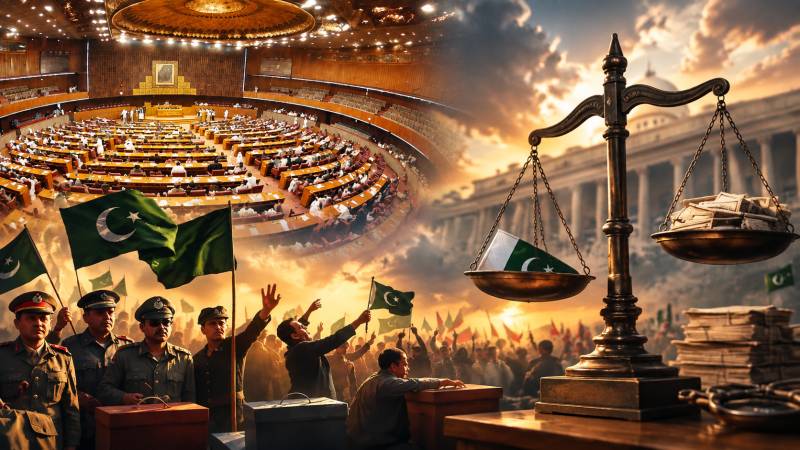
A familiar refrain echoes through our drawing rooms, our television panels, and our social media timelines: that Pakistan has been looted and distorted by its politicians, and that the legislature is the theatre in which the national tragedy unfolds. This is a seductive narrative, and like all seductive narratives, it is only half true. The politician is visible, audible, and electorally accountable; he can be voted out, humiliated, imprisoned, or exiled. There is, however, another estate in this country that is neither elected nor ejected, that survives every coup, every charter, every national reconciliation ordinance, and every regime change. That estate is the bureaucracy and it is past time that the national discourse confronted the true architecture of power in Pakistan.
Consider, first, the constitutional theory. Under Article 97 of the Constitution, the executive authority of the Federation is exercised in the name of the President by the Federal Government, which consists of the Prime Minister and the Federal Ministers. At the provincial level, Article 128 mirrors this arrangement. On paper, the minister is the political master; the civil servant is the adviser, the implementer, the subordinate. In practice, the relationship has been inverted with such completeness that ministers today often discover that files do not move, postings are not affected, and policies are not implemented unless the departmental secretary, the permanent incumbent deigns to oblige. Chief Ministers and Prime Minister, for all the pomp of their offices, routinely find themselves helpless before a cartel of generalists who control the files, the precedents, the notifications, and above all the institutional memory of the state. A minister may command the press conference; the bureaucrat commands the system.
It is often said that the military establishment shapes governments at the macro level that it decides who rules and who falls. There is substance in this observation, and no honest analyst would deny it. But even this account obscures the deeper reality. The establishment may rearrange the chessboard, but it is the bureaucracy that plays the game, square by square, file by file, every hour of every day. Between the macro decision in Rawalpindi or Islamabad and the citizen standing at a tehsil office counter lies an entire micro-level state run by the civil bureaucracy; the deputy commissioner, the assistant commissioner, the patwari, the superintendent of police, the excise inspector. It is here that Pakistan is actually governed, and it is here that Pakistan is actually failing.
The record of that governance is writ large in the misery of the ordinary citizen. Institutions and departments under bureaucratic stewardship function in a manner that can only be described as pathetic. Files gather dust for years; no office runs smoothly; merit is the exception rather than the rule, and those rare officers who insist on it are marginalised, transferred, or buried in 'punishment postings'. A professional military can, in a crisis, impose order upon this chaos but it cannot cure it, because the disease is not indiscipline; it is the bureaucratic ethic itself. The soldier's code demands service before self; the prevailing bureaucratic code, regrettably, demands self before service, and the state has been progressively weakened as a consequence.
Then there is the question that no admirably self-effacing salaried official should be afraid to answer: how does a government servant, on a fixed and modest official salary, come to live like a monarch? The mansions in the choicest sectors, the imported vehicles, the private schooling in foreign curricula, and the landholdings that multiply with each transfer, none of this is reconcilable with the emoluments recorded in the official pay scales. Corruption in the bureaucracy is no longer an allegation to be whispered; it is a mass, systemic, and institutionalized phenomenon, lubricated by the discretionary powers that the colonial state bequeathed to its successor and that successive regimes have zealously preserved. Every posting in the transfer-posting industry carries a price; every tender, a commission; every file, a toll. The bureaucracy has converted public office into private patrimony.
The politician is visible, audible, and electorally accountable; he can be voted out, humiliated, imprisoned, or exiled. There is, however, another estate in this country that is neither elected nor ejected, that survives every coup, every charter, every national reconciliation ordinance, and every regime change: the bureaucracy.
It is therefore a profound error to lay the totality of Pakistan's economic collapse — the mounting national debt, the inflation that has devoured the purchasing power of the middle class, the relentless price hiking of essentials, the unemployment that has disillusioned an entire generation, solely at the door of politicians or the legislature. Politicians legislate; bureaucrats implement, administer, and enforce. When implementation is corrupt, administration is predatory, and enforcement is selective, no law, however brilliantly drafted, can save the republic. The collapse of public education, public health, municipal services, tax collection, and land administration is, in each instance, a bureaucratic failure before it is anything else. The politician signs; the bureaucrat delivers or, in our case, deliberately fails to deliver.
The political class, to be sure, is not innocent, and an honest opinion must concede what the evidence shows. Our political system has degenerated into dynastic aristocracy. Every politician who grows old anoints a child to the provincial or national assembly seat; marriages are contracted between political houses so that party, constituency, and patronage remain within a single pedigree — scions of a kingdom masquerading as representatives of the people. This hereditary capture of representation is a genuine affliction. Yet dynasts, for all their sins, must periodically face the electorate. The bureaucrat faces no one. He is transferred, perhaps; rarely is he dismissed. He retires on full pension, his record intact, his accountability a legal fiction.
Other democracies solved this problem generations ago. The United Kingdom professionalised its civil service through the Northcote–Trevelyan reforms of 1854; the Americans built a merit-protected federal service after the Pendleton Act of 1883. The object of those reforms was precisely to prevent the emergence of a permanent governing caste insulated from political accountability and also, it must be said, to ensure that a professional, permanent administration did not itself become a predatory estate. Pakistan inherited the outward forms of the British system but perverted its spirit, fusing colonial discretionary powers with post-colonial patrimonialism.
The romanticised division of blame in this country; soldiers and politicians as villains, bureaucrats as humble clerks is a misconception that the permanent establishment has every interest in preserving. The truth is less comfortable. Politicians come and go on the tide of public votes, often dynastic, often compromised, but always, in the end, removable. The bureaucracy stays. It has stayed through martial law and democracy, through parliamentary and presidential systems, through every constitutional amendment and every regime change. Until this republic musters the political will to make its permanent servants genuinely accountable to its temporary masters; the people, through their elected representatives, Pakistan will continue to be governed not by its constitution, but by a quiet, permanent, and unaccountable state within the state. And no election, however free, will change that.