

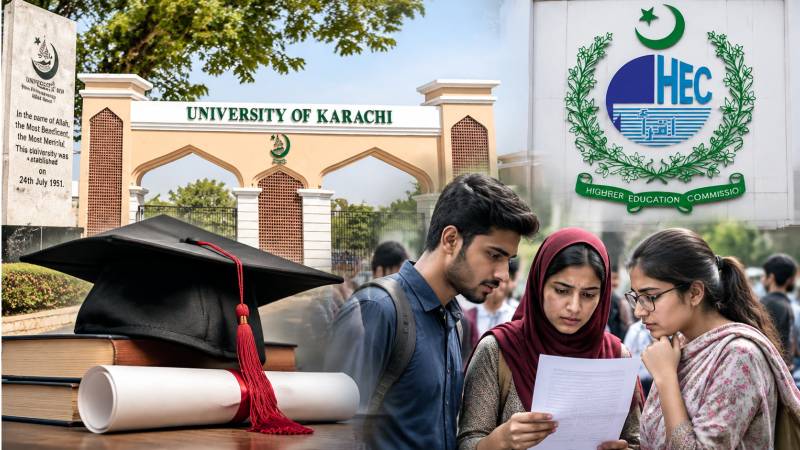
Education is an investment in the future, yet thousands of students enrolled in Associate Degree Programs (ADPs) at colleges affiliated with the University of Karachi face uncertainty over their examinations and academic prospects. Despite completing their coursework, students remain unsure about examination schedules and the system under which they will be assessed. What began as an administrative disagreement has become a serious concern involving educational policy, degree recognition and institutional accountability. The consequences extend beyond classrooms, threatening students' academic progress, employment opportunities, family finances and confidence in Pakistan's higher education system.
Pakistan's Associate Degree Program was introduced to replace traditional two-year BA, BSc and BCom qualifications with a more structured undergraduate system. Under the Higher Education Commission's Undergraduate Education Policy 2023, the program comprises four semesters and 60–72 credit hours, combining general education with specialized subjects. Students may obtain a recognized two-year qualification or seek admission to the fifth semester of a relevant four-year bachelor's program, subject to university requirements. Although designed to improve educational quality and accessibility, its implementation has exposed serious coordination problems among the HEC, universities and affiliated colleges.
Understanding the confusion requires distinguishing annual, biannual and semester examinations. Annual examinations generally cover an entire year's syllabus, while biannual examinations simply occur twice a year. A semester system, however, requires structured courses, credit hours, continuous assessment, academic calendars and appropriate administrative arrangements. Holding examinations twice annually does not automatically fulfil HEC requirements. The real challenge at Karachi lies in inadequate preparation, unclear implementation procedures and uncertainty over institutional responsibilities.
The chronology of decisions is revealing. In December 2024, the University of Karachi's Academic Council approved semester-based examinations for affiliated colleges offering Associate Degrees in Arts, Commerce and Science. Examinations were expected approximately every five or six months, replacing the conventional annual arrangement. However, concerns emerged about syllabus preparation, examination arrangements and institutional readiness. The Regional Directorate of Colleges recommended postponing the biannual system for another year because further preparation was required. Examinations expected in July had not taken place, while examination forms, centres and dates remained undecided.
In September 2026, the University of Karachi's Academic Council deferred the biannual examination system for another year, and a committee comprising university and college representatives was tasked with preparing recommendations within three months. Having served as a member of this committee before my retirement in early October 2026, I can recall that our discussions focused primarily on courses, curriculum and related academic requirements rather than examination arrangements. The committee was subsequently reconstituted in October, following my retirement. Although the postponement acknowledged practical difficulties, it did little to resolve the underlying uncertainty. Students still needed to know which examination system applied to their admission sessions and how the eventual transition would affect them. A temporary extension may provide administrative relief, but it cannot substitute for a clear and permanent policy.
As November 2026 began, questions about examination forms, schedules and future arrangements persisted. The University of Karachi's official examination webpages continued to describe annual examinations for Associate Degrees in Arts, Science and Commerce. Such information may remain applicable to existing students, but its relationship with the proposed semester transition requires clarification. Students admitted under one system should know whether the same rules will apply throughout their studies. Teachers and colleges likewise need sufficient notice to organize courses, practical work and assessments. Uncertainty should not become a permanent feature of academic administration.
An even more serious concern involves degree recognition and attestation. Reports of an HEC circular warning against annual-system Associate Degrees have circulated among educational stakeholders. The HEC's undergraduate policy does prescribe a semester-based framework, while degree attestation requires institutional verification and compliance with applicable regulations. However, this does not automatically establish that every student previously admitted under an annual arrangement will be denied attestation. The position depends upon admission dates, program recognition and any formally approved transitional arrangements. A verified HEC notification establishing a blanket refusal to attest all such degrees has not been identified in the public documents examined for this article. The HEC must therefore issue a clear written statement explaining the status of existing students and the conditions governing recognition.
Examination delays present another serious difficulty. The University of Karachi's official results page lists Associate Degree in Commerce annual examinations for 2025, conducted in April 2026, with results appearing in October 2026. This represents an interval of approximately six months. For graduating students, such delays may mean missing university admissions, scholarship deadlines or employment opportunities. Those seeking admission to the fifth semester of a bachelor's program may find that the relevant admissions process has closed before their results become available. Consequently, an administrative delay can cost a student an academic term or even an entire year.
The consequences are particularly severe for students from modest-income families. Parents often calculate educational expenses according to the expected duration of a program. Delayed examinations and results increase financial pressure, postpone employment and complicate plans for further education. Female students whose continuation in education depends upon family circumstances may face additional obstacles, as may students balancing employment with studies. An unpredictable academic calendar effectively transfers the costs of administrative inefficiency to those least able to bear them. Timely examinations and results should therefore be considered essential components of educational accessibility rather than matters of departmental convenience.
Regulatory approval alone cannot ensure success. Effective reform requires resources, consultation, trained personnel and coordination between those who formulate policies and those responsible for delivering education.
The controversy also exposes weaknesses in coordination among the University of Karachi, its affiliated colleges, the Directorate of Colleges and the HEC. The university determines academic and examination arrangements through its competent authorities, while affiliated colleges must provide the teaching environment and facilities necessary for implementation. Provincial authorities oversee important administrative and staffing matters, and the HEC establishes national academic standards. Problems arise when decisions are made without adequate consultation or when responsibility remains unclear. A university may approve a semester system before colleges possess the resources to implement it, while a directorate may request postponement without presenting a sufficiently detailed readiness plan. Effective reform requires clearly assigned responsibilities, realistic timelines and cooperation among all concerned institutions.
The opportunity to continue into a four-year bachelor's program also requires careful coordination. Admission to the fifth semester depends upon relevant academic requirements, previous coursework, credit hours, performance and available seats. Students changing disciplines may face additional conditions. They should therefore receive accurate guidance well before graduation. Universities should coordinate admission calendars with the examination schedules of affiliated colleges. Where results are delayed for reasons beyond students' control, legally permissible arrangements such as conditional admission or provisional verification should be considered. Administrative timing should not defeat the educational flexibility that the Associate Degree Program was intended to provide.
Digital reform could help address several persistent problems. Examination forms should be accessible through a reliable online system, with clear deadlines and confirmation of submission. Students should be able to track their eligibility, admit cards, results, certificates and verification requests without repeated visits to university offices. Automated record management may improve efficiency and reduce errors, provided the underlying procedures are reliable. Universities should also publish realistic service standards specifying when examinations will take place, how quickly results will be announced and how grievances will be resolved. Once approved, these timelines should become institutional commitments rather than optional targets.
The immediate priority, however, is a clear and authoritative policy statement. The University of Karachi, HEC, Directorate of Colleges Karachi Region and Sindh College Education Department should jointly clarify which examination system applies to each admission cohort. The statement must identify when the semester system will begin, how existing students will be accommodated and whether qualifications awarded during the transition will receive recognition and attestation. A comprehensive examination calendar should specify deadlines for forms, fees, examinations, practical assessments and results. The information must be communicated consistently through the university and affiliated colleges, with clearly identified officials responsible for answering questions and resolving complaints.
An independent monitoring arrangement could strengthen accountability. Representatives of the university, colleges, provincial authorities and HEC should periodically assess progress through measurable indicators: examinations conducted on schedule, time taken to declare results, unresolved verification cases and students' progression to further education. Public reporting would help distinguish genuine resource limitations from avoidable administrative failures. Where colleges require additional staff or facilities, provincial authorities should address those needs. Where delays originate within the university's examination machinery, responsibility must be clearly established. Reform cannot succeed if every institution identifies problems while assuming another will solve them.
The Associate Degree controversy illustrates a broader weakness in Pakistan's higher education system: ambitious policies are frequently introduced without adequate preparation for implementation. Regulatory approval alone cannot ensure success. Effective reform requires resources, consultation, trained personnel and coordination between those who formulate policies and those responsible for delivering education. Existing students must be protected through legitimate transitional arrangements, but temporary extensions should not become a permanent substitute for necessary change.
Universities understandably take pride in their distinguished faculty, research achievements and contributions to society. Yet institutional credibility also depends upon the experiences of ordinary students. The University of Karachi and its affiliated colleges must address uncertainty over examinations, results and degree recognition through a sustainable policy rather than repeated postponements. The fundamental question is not whether annual examinations are easier or semester examinations more fashionable, but which arrangement meets national standards, can be implemented effectively and protects students' academic interests.
Ultimately, students should not suffer because of administrative indecision. They deserve predictable examination schedules, timely results and assurance that their qualifications will be recognised. Every delayed examination disrupts academic plans, while delayed results may deprive students of admission and employment opportunities. Educational reform must create opportunities rather than obstacles. Pakistan cannot afford a system in which students fulfil their academic obligations while institutions fail to honour theirs. The real examination is now for the authorities responsible for education, and their results are long overdue.
Author’s note: This article is written in my personal capacity and reflects my independent views. It does not represent the official position, recommendations, or subsequent deliberations of the committee of which I was a member prior to my retirement.