

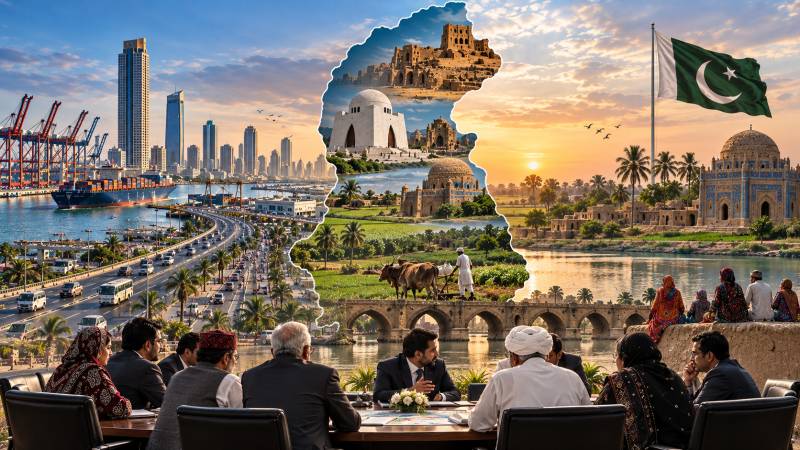
Sindh is a major province of Pakistan, with a long history and an important role in the country’s economic, political and cultural life. It is home to ancient civilisations, a major seaport, a vast agricultural sector and the country’s largest city, Karachi. Yet behind this wealth of history and potential, lies a province divided by political, linguistic, economic and social differences. These divisions have shaped Sindh for decades and continue to influence how people live, work and share opportunities. Understanding these differences is needed to understand both the challenges Sindh faces today and the future it can build.
Over the years, many attempts have been made to address these differences, but negotiations between different political parties and social groups have often failed to produce lasting solutions. Instead of bringing people closer, political disagreements have increased mistrust and created new divisions. One of the most important sources of division in Sindh is the difference between the urban and rural areas. Karachi, Hyderabad and other major cities have developed into important centres of business, industry, education and employment.
Rural Sindh remains heavily dependent on agriculture and continues to face serious problems related to poverty, education, healthcare and employment. The economic gap between the two sides has created different priorities and political interests. People living in rural districts often complain about a lack of basic services, while residents of major cities argue that their contribution to the provincial economy is not properly recognised.
Karachi is at the centre of many of these tensions. The city is the country’s largest economic hub and contributes significantly to the national economy. It is home to people from almost every part of the country and has a complex ethnic and linguistic identity. Sindhi, Urdu, Pashto, Punjabi, Balochi and other languages are spoken in the city. This diversity has made Karachi a vibrant place, but it has also contributed to political competition over representation, resources and authority.
The language question has historically been one of the most sensitive issues in Sindh. Sindhi is the native language of a large part of the province and has a strong cultural and historical identity, while Urdu is widely spoken in urban areas, particularly Karachi and Hyderabad. The migration that followed the creation of Pakistan changed the demographic structure of Sindh, especially its cities. Over time, political movements developed around these linguistic and cultural identities. Instead of treating diversity as a strength, political actors have at times used language and identity to strengthen their political positions.
The Muttahida Qaumi Movement, or MQM, has been a major force in the politics of urban Sindh for decades. Its supporters have traditionally argued that Urdu-speaking communities in Karachi and other urban areas have faced political and administrative discrimination. The party has also demanded greater political representation and stronger local government institutions. These concerns cannot simply be dismissed, because questions of representation, municipal services and the distribution of resources are genuine political issues. However, MQM has also faced criticism for the way it has approached politics and negotiations.
When opposition becomes an objective in itself, negotiations become difficult because political parties begin to measure success by how strongly they can resist their opponents rather than by what they can achieve for the public.
Critics have often accused the party of adopting an attitude of opposition for the sake of opposition, particularly when dealing with the provincial governments or political opponents. From this perspective, every disagreement can become a political confrontation, even when there is room for compromise. When opposition becomes an objective in itself, negotiations become difficult because political parties begin to measure success by how strongly they can resist their opponents rather than by what they can achieve for the public.
However, this criticism should not be applied only to the MQM. Politics in Sindh has frequently been dominated by confrontation, accusations and mistrust. Different parties have often opposed one another simply because they belong to different political camps. The problem goes beyond one party. When political leaders refuse to accept even reasonable proposals because they come from their rivals, the people ultimately pay the price. The challenge becomes serious when political parties move between government and opposition. A party may support a policy when it is in power but oppose the similar policy when it moves into opposition. Likewise, an opposition party may reject government proposals without fully considering their merits. Such politics weakens public confidence and makes long-term planning almost impossible.
In Sindh, this pattern has contributed to a culture in which political disagreements are often treated as battles that one side must win. However, negotiation is not about winning or losing, it is about finding a solution that different sides can accept. Karachi’s problems cannot be solved by the provincial government alone, nor can they be solved by an urban political party acting independently. The federal government, provincial government, local authorities and political parties all have a role to play.
Another major issue is the usage of resources. Sindh produces a considerable share of Pakistan’s agricultural and industrial output and has important natural resources. Yet many communities within the province continue to lack clean drinking water, reliable electricity, quality schools and proper healthcare. This creates frustration among the citizens who believe that the wealth produced by their province is not being used fairly.
Karachi faces its own challenges. The city struggles with traffic congestion, inadequate public transport, poor waste management, water shortages and housing pressure. Its rapidly growing population has placed enormous demands on infrastructure. Many residents believe that the city needs stronger and more effective local government. Others argue that Karachi’s problems cannot be solved without cooperation between federal, provincial and local authorities.
This is where meaningful negotiation becomes mandatory. Sindh needs dialogue among the federal government, provincial government, local authorities, political parties, business groups, civil society and ordinary citizens. Such negotiations must go beyond political slogans. They should focus on practical questions such as how resources are distributed, how local governments are empowered, how public services are improved and how employment opportunities are created.
A successful discussion also requires both sides to recognise each other’s concerns. Rural Sindh should not be treated only as a political vote bank, while urban Sindh should not be viewed as a source of revenue. Both are part of the same province and depend on each other. Agriculture in the rural areas supports the wider economy, while cities provide markets, industries, financial services and employment. Political parties have a particular responsibility in this process. MQM and other urban political groups have legitimate reasons to demand better services and greater local representation. At the same time, they need to recognise that constant opposition does not automatically produce better governance. If a proposal is beneficial to citizens, it should not be rejected only because it comes from a political rival.
The same principle applies to the Pakistan Peoples’ Party and other parties that have governed Sindh. They should not treat criticism from urban parties as an attack on the province or the government itself. Genuine concerns about Karachi, Hyderabad and other cities should be heard seriously. A provincial government that listens to its critics can strengthen its own position by addressing legitimate complaints instead of dismissing them. The people of Sindh have little to gain from permanent political confrontation. They need functioning schools, hospitals, roads, public transport, clean water, employment and security. They do not benefit when political parties spend years blaming one another while basic problems remain unresolved.
Education can also play an important role in reducing the divide. Schools should teach children about the history and cultures of different communities living in Sindh. Students should learn that speaking different languages or belonging to different ethnic groups does not make one community more important than another. Better education can also reduce economic inequality by giving young people from rural areas greater access to professional opportunities.
There is also a need to strengthen local government system. Many problems faced by the citizens are local in nature. People need effective systems for water supply, sanitation, roads, transport, parks and other municipal services. Local representatives who are given powers and financial resources can respond more effectively to these needs. Strong local institutions could also reduce political competition between provincial and urban interests by giving communities a greater voice in decisions that directly affect them. Sindh does not need uniformity. It needs equality. Its people do not have to speak the same language, support the same political party or live in the same type of community to work towards common goals. What they need is a political system in which every citizen feels respected and has a fair chance to improve their life.
The future of Sindh depends on whether its political leadership can replace confrontation with negotiation. Opposition is a major part of democracy, and political parties must have the right to question governments. But opposition becomes harmful when it exists only to block every initiative of a rival. The purpose of political disagreement should ultimately be to improve government, not to make government impossible.
MQM's critics have a legitimate point when they argue that opposition for the sake of opposition can damage the interests of Karachi. But the larger lesson applies to every political party in Sindh. No party should make confrontation its permanent political strategy. If the interests of citizens are placed above party rivalry, there will be greater space for compromise. Sindh has enormous potential, with a major port, a large industrial base, fertile agricultural land, valuable natural resources, historic sites and a young population. With better governance, investment and cooperation, it can become one of the strongest and most prosperous parts of Pakistan. But this will require political maturity and a willingness to negotiate honestly.
The divide in Sindh is not impossible to overcome. Different communities have lived and worked together in the province for generations. The challenge is to build political relationships and institutions that turn this diversity into an advantage rather than a source of conflict. Negotiation should not be seen as a sign of weakness. It is a democratic tool through which differences can be managed. Sindh's future should not be defined by the divisions of its past. It should be shaped by a shared commitment to development, justice and equality. Political parties must learn that compromise is not surrender and opposition is not an end in itself. Whether in government or opposition, their first responsibility should be to serve the people.
If Sindh's leaders can sit together, listen to one another and accept that no single party owns the province, there is a possibility of reducing its political and social divide. What Sindh needs is not another permanent battle between urban and rural interests, or between one political party and another. It needs a new culture of dialogue in which disagreement is respected, reasonable criticism is accepted and negotiation is used to find solutions rather than create further division.