

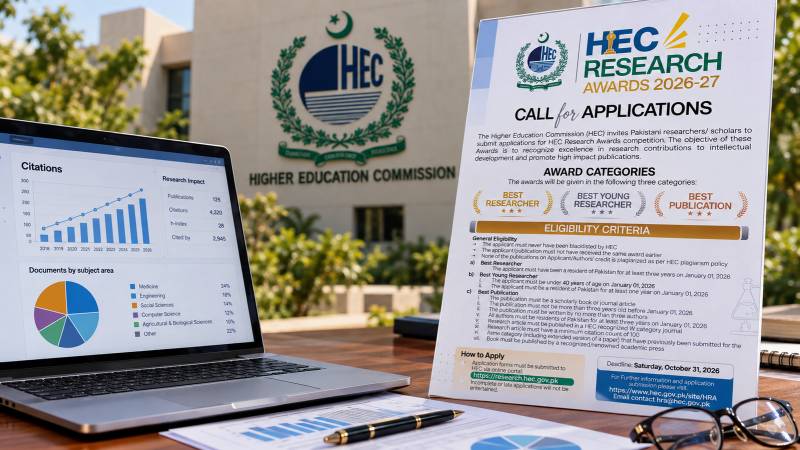
The Higher Education Commission (HEC) deserves appreciation for announcing its call for Best Publication Awards (In October 2026), an initiative that recognises scholarly contributions and encourages research excellence in Pakistan. Such recognition can motivate researchers, promote a culture of quality scholarship, and highlight the contributions of Pakistani academics to national and international knowledge. To maximise the impact of this initiative, however, it may be useful to consider several aspects of publication evaluation.
One important question concerns the definition of the subject area in which a publication is assessed. For instance, the Scopus classification system recognises 26 major subject areas, including Medicine, Engineering, Chemistry, Computer Science, Social Sciences, Arts and Humanities, and others. These broad areas are further divided into more than 320 subcategories. Medicine alone includes 49 subcategories, while Social Sciences and Nursing each have 23, Engineering has 17, and Biochemistry, Genetics and Molecular Biology has 16 categories.
This diversity presents a practical challenge for any award based substantially on citation counts. A paper in Cardiology, for example, may operate within a different citation environment from one in Mathematics, Linguistics, or a specialised area of Chemistry. The size of the research community, annual publication output, referencing practices, and pace of scientific development can vary considerably. Consequently, the same number of citations may represent different levels of relative influence across disciplines. Even within a single major subject area, citation patterns may differ between subcategories. A comparison based exclusively on total citations could therefore favour fields in which researchers publish and cite more frequently. Publication accessibility is another consideration. Two papers addressing similar questions within the same specialty might receive 200 and 250 citations, respectively. The second paper has accumulated more citations, but this difference alone does not establish that it is necessarily the better contribution. Accessibility, dissemination, research quality, relevance, and the time available to accumulate citations may all influence the outcome.
In other words, open-access publications are freely available to readers, whereas subscription-based articles may require institutional access or individual payment. Open access can expand readership and create additional opportunities for research to be discovered and cited. However, it does not automatically produce more citations or indicate superior quality. Some open-access journals charge substantial article processing charges (APCs), potentially amounting to several thousand US dollars, while others publish without such fees. Subscription-based journals can also publish highly influential research. Accordingly, publication access and dissemination deserve consideration, without assuming that either publishing model is inherently superior. The selection of citation databases also matters. Scopus, Web of Science, and Google Scholar do not cover precisely the same journals, conference proceedings, books, and other scholarly materials. Their citation counts for the same publication can consequently differ, sometimes substantially. An assessment based on one database may produce a different ranking from one using another.
Citations provide valuable evidence of scholarly attention, but they do not independently establish originality, methodological soundness, practical relevance, or lasting contribution.
For transparency, HEC could specify the database to be used, the date on which citation information will be retrieved, and the document types included in the assessment. If applicants are permitted to submit citation figures from different platforms, a consistent verification procedure would be essential. Otherwise, researchers may be compared using figures generated through different coverage criteria, making the resulting rankings less straightforward to interpret. The sources of citations may also provide useful context. Citations from established, peer-reviewed journals can indicate engagement by the research community, although the significance of a citation depends on its purpose and context. Similarly, the quartile ranking of a citing journal may offer supplementary information, but it should not be treated as a direct measure of the quality of the paper being cited.
The type of publication is equally relevant. Original research articles, systematic reviews, and meta-analyses may attract different citation patterns. Reviews, for instance, often bring together findings from numerous studies and may become widely cited because they provide an overview of a developing field. This does not diminish their scholarly value, but it does suggest that different publication types may require careful interpretation when compared directly. Research originality, methodological rigour, relevance, and potential scientific or societal contribution should complement citation-based indicators.
The size of the research field is another factor that may merit consideration in the evaluation of the Best Publication Awards. Research areas differ considerably in the number of researchers working within them, the volume of publications they produce, and the potential audience for their findings. The subject-area figures provided for consideration illustrate these differences. For example, Medicine reports (as per Scopus data retrieved in October 2026, covering years from 2024 to 2026) 55,990 authors, compared with 33,557 in Engineering, 25,488 in Agricultural and Biological Sciences, 24,375 in Biochemistry, Genetics and Molecular Biology, 22,895 in Computer Science, 20,292 in Chemistry, 18,746 in Physics and Astronomy, 14,683 in Social Sciences, 13,243 in Mathematics, 11,292 in Energy, 8,652 in Business, Management and Accounting, and 2,694 in Arts and Humanities. Differences are also evident within individual disciplines: the reported figures include 10,099 authors in Artificial Intelligence, 11,855 in Public Health, Environmental and Occupational Health, 8,849 in Plant Science, 9,288 in Condensed Matter Physics, 6,707 in Physical and Theoretical Chemistry, 3,516 in Applied Mathematics, 1,838 in Linguistics and Language, and 126 in Literature and Literary Theory.
These figures prompt an important question for HEC: could a paper published in a field with a larger research community have more opportunities to attract citations than an equally valuable paper in a smaller or highly specialised field? A larger pool of researchers and a higher volume of related publications may provide more opportunities for a paper to be discovered, discussed, and cited. Conversely, a strong contribution in a specialised area may address a narrower audience and accumulate fewer citations despite its scholarly merit. This does not mean that every paper in a larger field will receive more citations, nor do author counts alone establish the size of the active citing community. Nevertheless, the possibility deserves consideration when comparing publications across disciplines.
Ultimately, the objective of a Best Publication Award should extend beyond identifying the paper with the highest citation count. Citations provide valuable evidence of scholarly attention, but they do not independently establish originality, methodological soundness, practical relevance, or lasting contribution. A transparent framework combining citation impact with disciplinary context, research quality, and appropriate publication-type considerations could offer a more comprehensive basis for recognition. HEC may therefore wish to publish clear evaluation criteria, including the indicators and their relative weighting, eligible publication types, the citation database and retrieval date, and procedures for classifying multidisciplinary research etc. These suggestions are offered in the spirit of constructive academic engagement and with appreciation for HEC's efforts to promote research excellence in Pakistan.