

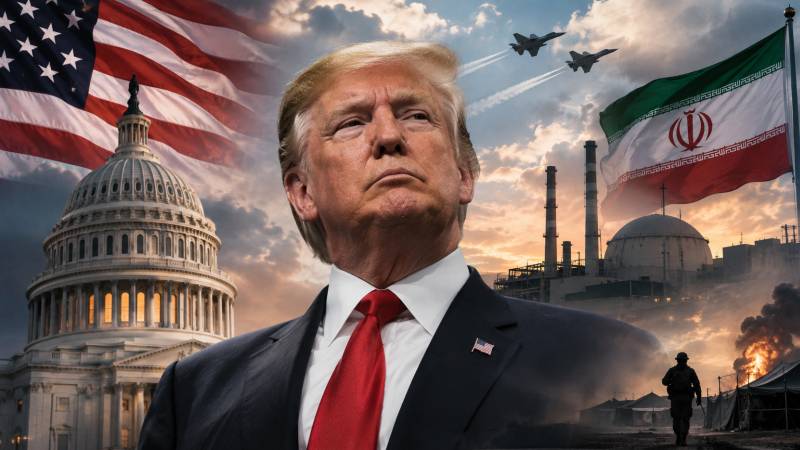
An important contradiction has repeatedly emerged throughout the political history of the United States. On the one hand, the US government has presented itself as a defender of democracy, human rights, and international peace. On the other hand, it has pursued policies of military intervention, warfare, and political pressure in various countries to protect its global economic and imperialist interests. From the Cold War to Afghanistan, Iraq, Libya, and the Middle East, the record of US foreign policy reflects this contradiction. Donald Trump’s military policy towards Iran must also be understood within this broader historical and political context. It is not sufficient to view any war merely as a military confrontation between two countries. Economic interests, energy resources, the global distribution of power, the arms industry, and the interests of the capitalist system also play a role in shaping the forces behind such conflicts. At the same time, the consequences of war are not confined to the countries directly involved. They also affect the population, economy, and political system of the very country that initiates the war.
The results of the midterm elections held in the United States on 3 November 2026 have emerged as a significant political setback for Donald Trump’s administration. The Democratic Party succeeded in securing a majority in both chambers of Congress, while the Republican Party suffered losses even in states where it had traditionally enjoyed a strong political position. Rising inflation, the increasing cost of living, public distrust of government policies, and public opposition to the war with Iran are being identified as major factors behind this electoral outcome. Rather than viewing this result simply as a victory for the Democratic Party or a defeat for the Republican Party, it should be understood as an expression of growing political and economic discontent within American society. Midterm elections are an important part of the US presidential system because they allow voters to express their views on the policies pursued by the president during the first two years of his administration. Although the president's name does not appear on the ballot, the election results often serve as an indication of public opinion regarding the performance of his administration.
This time, the war with Iran emerged as a major issue in the political debate. According to exit polls released after the elections, a large proportion of American voters considered military action against Iran to be a wrong decision. Nearly six out of every ten voters opposed the war, while for many voters; the war was an important factor in deciding how to vote in the congressional elections. A survey conducted by the Pew Research Center in October 2026 also found that 65 per cent of Americans disapproved of the way Trump was handling the war with Iran, while only 33 per cent supported his approach. These figures indicate that opposition to the war with Iran was not limited to supporters of the Democratic Party. A section of Republican voters also expressed concerns about the prolongation of the war and its consequences. Nevertheless, it would not be historically or politically accurate to claim that the war with Iran was the sole reason for Trump's electoral defeat. Inflation, energy prices, government performance, and other domestic issues also played an important role in shaping the election results. The central point is that the war further intensified the economic and political contradictions that already existed within American society.
It would not be appropriate to interpret the Democratic Party’s victory in the midterm elections as the end of American imperialism or as a fundamental ideological shift in US foreign policy. The election results have changed the institutional balance of power, potentially increasing congressional oversight of the Trump administration’s legislative agenda, budget, and military policies.
One of the major contradictions in the Trump administration’s military policy towards Iran is that the very war justified in the name of US national security and global stability imposed economic costs on the American people themselves. The consequences of war are not limited to an increase in military spending or the use of weapons. They also affect global energy markets, oil prices, trade, transportation, food supplies, and the everyday lives of ordinary people.Iran is located in a strategically important geographical and energy-producing region of the Middle East. The Strait of Hormuz is particularly important for the global supply of oil. Any war or military tension in this region creates uncertainty in international energy markets. As a result, the risk of rising oil and gas prices increases, and the burden ultimately falls on ordinary consumers, workers, and the middle class. According to a Pew Research Center survey, 73 per cent of Americans expressed extreme or serious concern about rising petrol and fuel prices as a result of the war with Iran, while 71 per cent were concerned about American military personnel being wounded or killed. This shows that public opposition to the war was not based solely on moral concerns or humanitarian sympathy; it also reflected economic and social anxieties.This raises an important economic question: if the benefits of a war go to institutions and groups with limited economic and political interests, while its costs are borne by ordinary people, how can such a policy be described as serving the public interest?
Following the outcome of the midterm elections, an important question arises: will the Democratic Party’s victory bring fundamental changes to US foreign policy? This question requires a cautious answer. In the United States, the Democratic and Republican parties differ on many political and economic issues. However, there are also significant continuities in their policies towards the global capitalist system; US military dominance, and strategic alliances. For example, military interventions in Iraq and Afghanistan, the US military presence in the Middle East, support for the arms industry, and economic sanctions against various countries have not been limited to the governments of any one political party. Democratic administrations have also pursued US military and strategic interests. Therefore, it would not be appropriate to interpret the Democratic Party’s victory in the midterm elections as the end of American imperialism or as a fundamental ideological shift in US foreign policy. The election results have changed the institutional balance of power, potentially increasing congressional oversight of the Trump administration’s legislative agenda, budget, and military policies. However, the real significance of this change will depend on the decisions and actions taken by the new Congress in practice.