

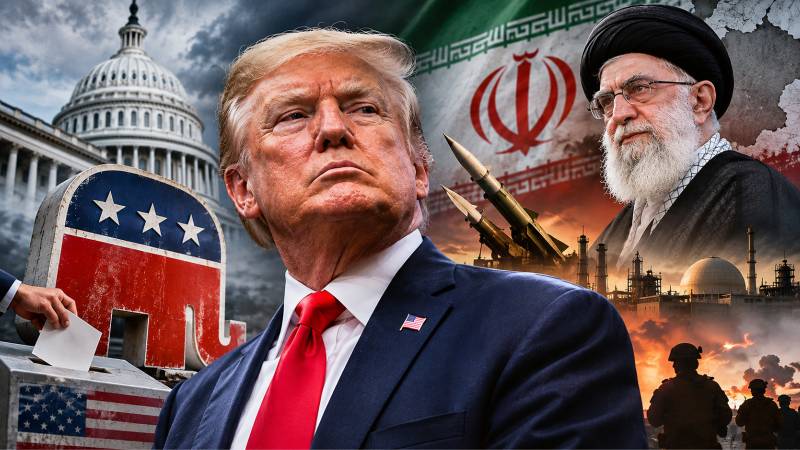
Every election cycle produces a temptation to find one decisive explanation. If Republicans perform worse than expected, commentators search for a single mistake: a controversial foreign policy decision, an unpopular candidate, a bad debate, or a damaging news story. Yet voters rarely make decisions based on only one issue. The debate over whether Republican electoral setbacks were caused primarily by tensions with Iran or by Donald Trump's personal approach to world leadership illustrates this problem.
The argument for the "Iran war" explanation is straightforward. When military conflicts expand or appear likely to expand, voters often become anxious about costs, casualties, instability, and uncertainty. Many Americans who support a strong foreign policy still become skeptical when they believe the United States is drifting toward another prolonged Middle Eastern conflict. If voters viewed Republican leaders as increasing the likelihood of confrontation with Iran, that perception could have hurt the party among independents and moderate voters.
However, one does not believe Iran alone can explain significant Republican losses. Foreign policy rarely dominates American elections unless Americans are directly experiencing major consequences. Most voters spend more time thinking about inflation, housing costs, healthcare, wages, crime, education, and immigration than they do about regional geopolitical disputes. Foreign policy can reinforce a broader impression of leadership, but it is seldom the sole determinant of electoral outcomes. This brings us to Trump's role. One of Trump's greatest political strengths has been his ability to project confidence and challenge established political norms. His supporters view him as a leader who refuses to be constrained by diplomatic etiquette and who prioritizes American interests over international approval. That image helped build a highly loyal political movement.
In modern American politics, Trump is not merely a Republican politician. He is the central figure around whom much of the Republican Party has organised itself, making it difficult to separate his fortunes from those of the party.
Yet the same traits can become liabilities with other voters. International relations are not merely about policies; they are also about perceptions and relationships. Critics argue that Trump's confrontational approach toward allies, his unpredictable communication style, and his tendency to personalize political disagreements can create uncertainty both domestically and internationally. Voters who are comfortable with strong leadership may nevertheless become uncomfortable if they perceive unnecessary friction with allied governments or excessive political drama. In that sense, attitudes toward world leaders may matter more than the Iran issue itself. A military confrontation can be viewed as an isolated event. A leadership style is perceived as permanent. Voters often ask themselves not only, "Do I support this specific decision?" but also, "Do I trust this person to handle the next crisis?" The second question typically has greater electoral significance. That leads to the final question: Was it Trump's defeat or the Republican Party's defeat? It appears to be both, but in different ways.
In modern American politics, Trump is not merely a Republican politician. He is the central figure around whom much of the Republican Party has organized itself. When candidates embrace Trump, benefit from his endorsements, and campaign using his message, it becomes difficult to separate their fortunes from his. If voters are reacting negatively to Trump, Republicans often pay the price. If voters are reacting positively to him, Republicans usually benefit as well. Nevertheless, elections are ultimately won and lost by parties, not individuals. Republican candidates make their own arguments, choose their own priorities, and run their own campaigns. Structural weaknesses within the party cannot always be blamed on Trump. Likewise, strong Republican performances cannot be attributed solely to him.
Therefore, I would describe any significant Republican setback as primarily a Republican defeat politically, but a Trump defeat symbolically. The party loses seats, offices, and influence. Trump loses something different: the claim that his personal brand and political instincts are an automatic electoral advantage. The more interesting question may not be whether Iran or Trump's personality mattered more. It is whether voters were expressing dissatisfaction with a specific policy decision or with a broader style of leadership. Historically, the latter tends to have longer-lasting political consequences.