

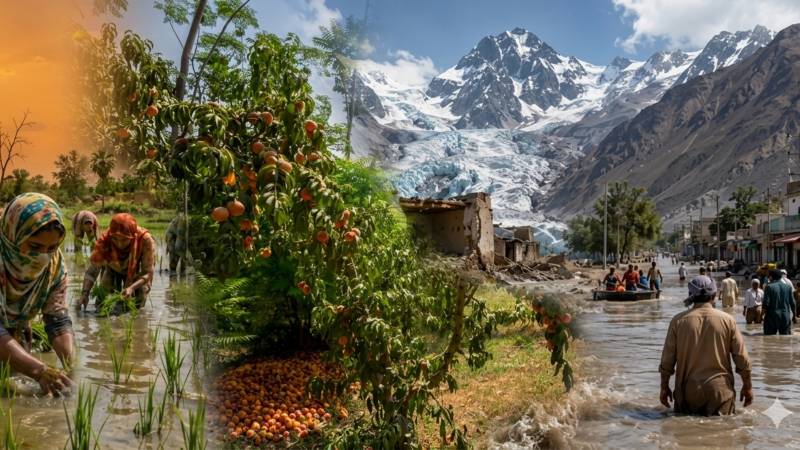
The other day, I visited the central fruit market in Mingora, Swat, to buy a few cartons of peaches for friends in the down districts, as I do every year. But no matter where I looked, I could not find fruit worthy of being gifted. My mind drifted back to earlier years, when August meant markets overflowing with peaches, apples, and other seasonal harvests.
Swat cultivates eight to ten distinct varieties of peaches, including a late-season variety that ripens around mid-August and is renowned for its size, vibrant colour, sweetness, and long shelf life. Friends from the plains would routinely request them, and I would happily dispatch a carton or two, joking with them on WhatsApp that I was the owner of miles-long orchards. It was a cherished annual ritual. In return, a friend from Sheikhupura would send a bag of fine Basmati rice, while another from Sukkur would send mangoes. Yani, sauda mehnga nahin—not a bad trade at all.
This year, however, the market left me deeply troubled. The peaches were small, discoloured, and bruised. The one I tasted was dry, hard, and flavourless. The very fruit we once proudly gifted across the country was now barely fit for our own table.
Later that afternoon, I met Sadiq Ahmad, a farmer from the village of Kokarai, working in his field. When I asked why the yield and quality were so poor, he said nothing at first. He simply pointed a finger towards the sky. Unseasonal rains and hailstorms had struck during the early flowering stage, followed by extreme heatwaves during fruit development. Together, they had devastated Swat’s agricultural economy.
This silent disaster extends far beyond peach orchards. Excessive heat and erratic weather patterns have triggered acute shortages of animal feed, reduced milk yields, dried up mountain streams, driven away pollinators, and depleted groundwater reserves. With no crop insurance or meaningful institutional safety net, and with mainstream media focused elsewhere, the mountain farmer watches helplessly, largely without a voice or even moral support.
Climate change is not defined only by raging waters and catastrophic floods, but also by failing crops, dying orchards, shrinking harvests, and bankrupt households.
Out of Swat’s 250,000 acres of arable land, nearly 100,000 acres are planted with fruit orchards, including apples, apricots, pears, peaches, and persimmons. Swat alone accounts for more than 70 per cent of Pakistan’s total peach production, alongside 5,000 acres of persimmon orchards yielding up to 20,000 metric tonnes annually. In good years, a farmer could earn roughly Rs300,000 per acre enough to sustain a household, plan for the future, and invest in a child’s education.
Today, however, severe weather, hailstorms, fruit flies, and bat swarms have damaged both the quality and yield of fruit crops. Market prices barely cover the costs of picking, packaging, and transport, while the prices of fertiliser, seed, and diesel have tripled. Overall fruit production in Swat has declined by up to 40 per cent, a decade-long deterioration that, in aggregate, may prove far more damaging than any single flash flood.
When floods, earthquakes, or storms strike, the destruction is visible. Collapsed homes, uprooted trees, and washed-out bridges prompt immediate attention and relief. But when we see shrivelled fruit on a market stall, few recognise it as part of the same climate crisis. It does not roar like a flood; it creeps in silently, consuming farm livelihoods year after year.
It is time for agricultural scientists, farmer associations, civil society, and local administrations to move beyond rhetoric. Policymakers must realise that climate change is not defined only by raging waters and catastrophic floods, but also by failing crops, dying orchards, shrinking harvests, and bankrupt households.
To save the rural economy, both short- and long-term interventions are urgently needed. These should include low-interest or interest-free credit schemes with flexible repayment schedules; access to heat- and drought-resistant crop varieties; subsidised water-saving technologies such as drip and sprinkler irrigation systems; and practical, plain-language weather alert systems that tell farmers exactly when to plant, protect, or harvest their crops. If we do not act, the mountain farmer faces not only economic hardship but the gradual loss of an identity that Swat has built over centuries, an identity tied to its land, its orchards, its beauty, and its pride.