

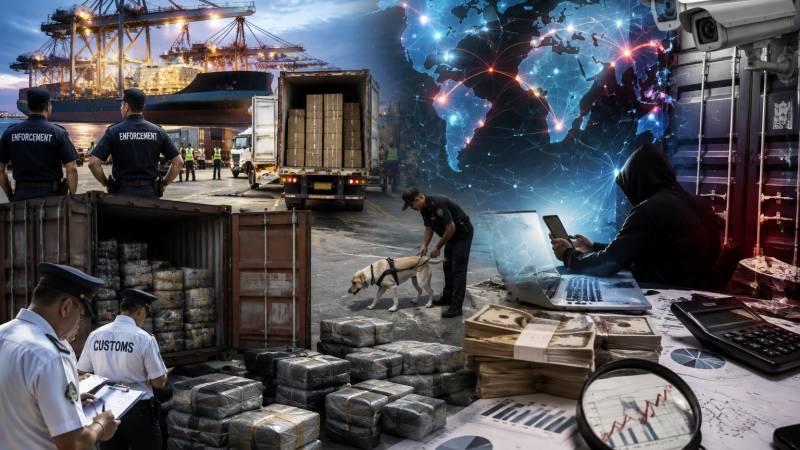
Every budget season, Pakistan does the same thing. It widens the withholding tax net, squeezes another slab out of salaried workers, raises the sales tax on some category of goods already carrying one, and calls it reform. Every year, the shortfall shows up anyway. The instinct is to conclude that the country simply doesn't tax enough. The more uncomfortable possibility is that it taxes the wrong economy; the one that already shows up, files returns, and can be found. The rest operates untouched, and every year it gets a little bigger.
That is the real story behind TRACIT's 2025 Illicit Trade Index, released jointly with the Policy Research Institute of Market Economy. Pakistan comes in at 101st out of 158 countries, behind India at 52nd, Malaysia at 72nd, Sri Lanka at 73rd, and Bangladesh at 95th—four economies that share most of Pakistan's structural headaches and several of its enforcement agencies' bad habits. Even Bangladesh, which nobody mistakes for a customs success story, does better. The gap isn't about resources. Pakistan has a functioning tax bureaucracy, a customs service, a drug regulator, and an IP office. What it doesn't have is any of them acting as though smuggled cigarettes, adulterated fuel, and counterfeit medicine are the state's problem rather than background noise. The index points to weaknesses in enforcement, governance, customs controls, and intellectual property protection—a combination that makes illicit trade easier to run and harder to catch. It leaves legitimate businesses with less confidence that the rules will actually be applied to everyone.
Five sectors alone account for an estimated Rs 751 billion in forgone tax revenue every year, a figure that would cover a meaningful share of the annual PSDP. Tobacco leads at Rs 300 billion, followed by petrol and diesel smuggling at Rs 270 billion, tyres and lubricants at Rs 106 billion, pharmaceuticals at roughly Rs 60–65 billion, and tea at Rs 10 billion. Tobacco and fuel together account for nearly three-quarters of the total, and it's worth asking why those two keep winning. Both are heavily taxed, both move through porous western borders in enormous volumes, and both have retail networks—thousands of small outlets—that no enforcement regime has ever seriously attempted to police from the demand side. The Federal Board of Revenue (FBR) raises the tax; the smuggled version undercuts it at the till; the compliant manufacturer loses volume and lobbies for a tax cut instead of enforcement because enforcement has never actually arrived. The tax authority ends up negotiating with itself. The Drug Regulatory Authority of Pakistan (DRAP) has the legal mandate to police this; what it has lacked is the track-and-trace infrastructure to make policing possible at scale.
Every budget season, Pakistan does the same thing. It widens the withholding tax net, squeezes another slab out of salaried workers, raises the sales tax on some category of goods already carrying one, and calls it reform.
None of this is really a story about missing laws. Pakistan has an IP regime, a Drugs Act, a Customs Act, and provincial market-inspection powers. What it lacks is coordination between the agencies that hold these mandates and, more fundamentally, a sense that any of them will face consequences for treating enforcement as optional. The Intellectual Property Organization of Pakistan, DRAP, Customs, and the provincial governments each control one piece of a supply chain that criminals treat as a single, continuous system. Fixing that means three things happening together rather than separately: inspections that target production and distribution instead of merely seizing goods at the point of sale; digital verification tools, such as QR codes and serialisation, that allow consumers or retailers to check whether a medicine or a spare part is genuine; and dedicated IP courts that resolve counterfeiting cases quickly enough to make the penalty a real deterrent. None of these three works in isolation. A track-and-trace system that nobody enforces is just an app; enforcement without a way to verify products is guesswork; and courts that take years to rule protect no one.
Pakistan's fiscal problem has never really been a shortage of tax rates. It has a shortage of consequences for the people avoiding them. Raising taxes on an economy that already complies while leaving the other one alone is not revenue policy; it's a tax on honesty. Until enforcement catches up with legislation, Pakistan will keep passing budgets that look tougher on paper and change nothing on the ground.