

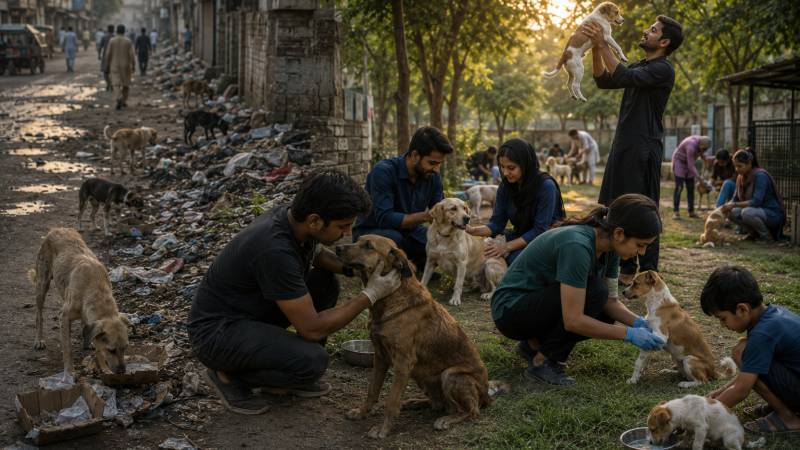
''The greatness of a nation and its moral progress can be judged by the way its animals are treated." Mahatma Gandhi.
Every morning, while travelling or walking through the streets of my city, I encounter a scene that has become so common that many people no longer notice it. A dog sleeps under a roadside cart, unaffected by the constant noise of traffic because exhaustion has become stronger than fear. A kitten cautiously approaches a restaurant, hoping that leftovers might be enough to get through another night. Their eyes follow every passerby with a silent expectation that perhaps someone, somewhere, might stop. Most people do not. Over time, we have become remarkably skilled at looking away.
As a veterinary student, these encounters often leave me with an uncomfortable question: How did we reach a point where buying a pet has become cooler than adopting one? In recent years, pet ownership has gained enormous popularity. Social media is filled with pictures of exotic cats, imported breeds and expensive puppies wearing designer collars. Many families spend considerable amounts of money searching for specific breeds, often believing that a pedigree guarantees companionship, intelligence, or loyalty. Yet, outside those same homes, countless healthy and affectionate animals spend their lives waiting for something far simpler: a safe place to sleep, proper care and someone willing to call them family. This contradiction should make us think about the way we view animals and the choices we make when bringing them into our lives.
The phrase "Adopt, Don't Shop" is often considered just a simple slogan used by animal welfare organizations, but I do believe that its meaning goes far beyond that. It is not only a request to be kind; it is a reminder of our ethical responsibility toward animals and definitely a challenge to reconsider our relationship with them. It encourages us to question, not only how we acquire pets but also how we define their worth. In essence, adoption raises a fundamental question: If thousands of animals already need loving homes, why create demand for more before caring for those that already exist? This does not mean that all breeders are irresponsible or that purchasing a pet is always wrong. Responsible breeders who prioritize health, welfare and ethical practices have an important role in maintaining animal standards. However, before searching for the "perfect" breed, perhaps we should first consider the animals that are already waiting for a chance. The stray dog whose tail still wags whenever someone approaches, or the rescued cat that has survived despite neglect and hardship, may not have pedigree certificates, but they often possess something far more valuable: the ability to form a deep and meaningful bond with the person who gives them a second chance.
One of the biggest misconceptions about adoption is that it is an act of charity, as though the adopted animal should remain permanently grateful for being rescued. I see adoption differently. It is not about pity; it is about partnership. Anyone who has lived with a rescued animal understands this relationship. Many adopted animals arrive frightened, malnourished, or uncertain about human intentions because of previous experiences. Yet with patience, consistency and care, they often regain their ability to trust. In return, the adopter receives something that cannot be purchased from a pet store: genuine companionship, unconditional affection and the privilege of witnessing an animal overcome its past. As Roger Caras, an American wildlife photographer, once wrote, "Dogs are not our whole life, but they make our lives whole." Rescued animals often add another dimension to this idea. They remind us that compassion has the power to repair what neglect has damaged.
Scientific studies have shown that companion animals can improve mental health, reduce stress, encourage physical activity and help people overcome loneliness.
Scientific studies have shown that companion animals can improve mental health, reduce stress, encourage physical activity and help people overcome loneliness. However, the true value of adoption cannot always be measured through research findings. Ask someone who adopted a stray after a difficult period in their life or a family whose children learnt empathy through caring for a rescued kitten. They will rarely begin their stories with statistics. Instead, they will remember moments: the first hesitant movement of a fearful animal approaching them, the first time a nervous cat relaxed enough to purr, or the quiet comfort of knowing that another living being completely trusts them. These experiences represent a form of connection that cannot be measured financially.
Adoption is also due to a problem that societies often prefer to ignore. Pakistan, like many other developing countries, is facing an issue of growing population of stray animals. These animals are exposed to hunger, dehydration, untreated injuries, infectious diseases, road accidents, and unfortunately, human cruelty. Their suffering is visible, but because it has become a familiar part of our surroundings, it is often accepted as unavoidable. It should not be.
Every stray animal on our streets represents a larger human failure. These animals did not choose a life of uncertainty and suffering themselves. Their circumstances are often the result of abandonment, uncontrolled breeding, irresponsible ownership, limited public awareness, and inadequacy of animal welfare systems. Therefore, the stray animal crisis is a reflection of human accountability. This is exactly why adoption matters.
Every adopted animal reduces pressure on shelters and rescue organizations that often operate with limited resources. Future stray populations can be decreased with the help of every conscientious owner who offers nutrition, vaccinations, and appropriate veterinary care. Adoption is still a crucial component of a larger solution that includes public education, population control initiatives, and easily accessible veterinary care, but it cannot solve the issue on its own. Our duties as aspiring veterinarians go well beyond treating illnesses and wounds. A veterinarian's role begins long before an animal reaches the examination table.
However, promoting adoption should never mean romanticizing it.
Too often, people adopt animals based only on emotion. A photograph on social media captures their attention, but they fail to consider the years of responsibility that follow. When excitement fades and challenges appear, the animal may once again experience abandonment. This defeats the very purpose of adoption. Therefore, I believe society should promote responsible adoption, not simply adoption.
Before bringing an animal home, every potential owner should ask themselves important questions. Do I have enough time to provide daily care? Can I afford regular veterinary visits, vaccinations, parasite control, proper nutrition and emergency treatment when required? Am I prepared to care for this animal throughout its entire life, even when my personal circumstances change? If the answer is yes, adoption can become one of the most rewarding decisions a person makes. If the answer is no, waiting is far kinder than making a commitment that cannot be fulfilled. Animals do not understand temporary affection. They understand consistency, security and trust. They remember kindness, but they also suffer when that kindness disappears.
Perhaps the greatest challenge facing adoption is not the shortage of shelters or rescue organizations; it is the way a society senses value. We have made a strong belief that price determines quality, that pedigree represents superiority and that stray animals are somehow less deserving. However, the qualities that make an animal a true companion cannot be measured through certificates or breeding records. Loyalty cannot be purchased, intelligence cannot always be predicted and love does not come with a receipt.
As Anatole France wisely observed, "Until one has loved an animal, a part of one's soul remains unawakened." I believe that love has little to no interest in pedigrees. It only requires an opportunity to exist. Eventually, the conversation surrounding adoption is not only about dogs and cats. It is about the kind of society we want to build. A society is not defined only by economic progress, technological advancement, or impressive infrastructure. It is also reflected in how it treats those who cannot speak for themselves. Our humanity is measured not only by how we care for human beings but also by how we respond to vulnerable lives that depend entirely upon our choices. The next time you decide that your family is ready to welcome a pet, I hope your first question is not, "How costly of a pet should I buy?" Instead, ask yourself, "Which life can I change?" Visit a shelter. Speak with rescue volunteers. Meet the animals who have spent days, months, or even years waiting for someone to choose them.
You may discover that what you are rescuing is not merely an abandoned animal. You are creating an opportunity to practice compassion every single day. Because the most extraordinary friendships are rarely the ones that money can purchase. They are the ones built through trust, patience, and a second chance. After all, not every best friend is bought. Some simply spend their lives waiting for us to become the kind of people they already believe we are.