

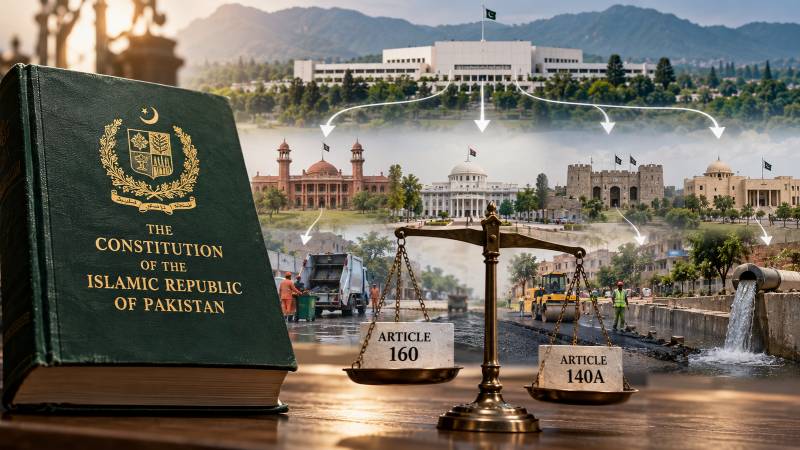
Pakistan’s Constitution tells two different stories about devolution. The first concerns the relationship between the Federation and the Provinces. Here, the Constitution is detailed, institutional and protective. Article 160 establishes the National Finance Commission, defines its composition, requires its constitution at intervals not exceeding five years, specifies its mandate, provides for implementation, and requires its recommendations and action taken upon them to be laid before Parliament and the Provincial Assemblies. The Eighteenth Amendment went further by protecting the provincial share from falling below that of the previous Award and by requiring monitoring of implementation.
The second story concerns the Provinces and Local Governments. Article 140A requires each Province to establish a local-government system and devolve political, administrative and financial responsibility and authority to elected local representatives. Local-government elections are to be held by the Election Commission of Pakistan. The constitutional command is clear. But compared with Article 160, the machinery behind Article 140A is conspicuously sparse.
The contrast is striking because the Eighteenth Amendment dealt with both provisions: it strengthened Article 160 while placing Article 140A in its present form. That difference goes to the heart of Pakistan’s unfinished devolution. Article 160 does not merely instruct the Federation to share resources with the Provinces. It creates a commission, ensures provincial representation, establishes a recurring process, defines its mandate, provides for implementation and protects the provincial share.
Article 140A, by contrast, does not prescribe the essential functions of local government, the minimum fiscal entitlement of local bodies, the periodicity or architecture of Provincial Finance Commissions, or an automatic mechanism for transferring an objectively determined local share. In one case, devolution is surrounded by constitutional machinery. In the other, much of its substance is left to provincial law. This is the central asymmetry.
The case for provincial autonomy is well understood. Pakistan’s history of centralisation produced legitimate demands for greater provincial legislative, administrative and fiscal space, and the Eighteenth Amendment strengthened the federal compact. But devolution cannot logically stop halfway. If the Provinces required protection from excessive federal discretion, why should elected local governments remain substantially more dependent upon provincial discretion? The same logic that supports transfer of authority from Islamabad to the Provinces also supports its further transfer to cities, districts, towns and neighbourhoods.
Power that leaves Islamabad but remains concentrated with chief ministers in Lahore, Karachi, Peshawar or Quetta has been decentralised only halfway. This is not an argument for weakening the Provinces. It is an argument for completing the constitutional logic of devolution. Citizens experience government most directly through water, sanitation, waste disposal, local roads, transport, land use and neighbourhood infrastructure. If elected local governments lack authority over the functions, personnel and finances needed to deliver these services, accountability becomes blurred. Responsibility without authority produces frustration. Responsibility without money produces fiction.
A more balanced approach may be to retain the existing sequence: Federation through the NFC to the Provinces; Provinces through constitutionally protected PFCs to Local Governments. The difference would be that the second transfer could no longer remain substantially discretionary.
Article 140A does use strong language, and the courts have treated it as a mandatory constitutional obligation rather than an invitation to create symbolic local bodies. The difficulty lies in what the Constitution leaves unsaid. Who determines the minimum functions that must remain with local government? What financial share is protected? How regularly must a Provincial Finance Commission be constituted? What happens if an award is delayed? Once a local share is determined, can its release still depend upon provincial executive discretion? What protects local institutions against repeated restructuring or weakening? These questions determine whether devolution exists as an enforceable constitutional arrangement or as a broad principle whose practical content varies with provincial legislation and political circumstance.
The contrast with Article 160 is instructive. The Constitution did not assume that a declaration of provincial entitlement would be sufficient. It built a process around that entitlement: institutions, participation, periodicity, implementation and safeguards. Provinces were protected from the Federation with greater precision than local governments were protected from the Provinces. That is the constitutional gap. A stronger framework need not turn Islamabad into the administrator of local government or impose an identical structure upon Karachi, Lahore, Peshawar, Quetta and smaller districts. Local-government requirements differ according to geography, population and urbanisation.
But that flexibility should operate above a constitutional floor. Such a floor could protect timely elections and elected tenure, a minimum sphere of local functions, administrative authority over the personnel required to perform them, constitutionally mandated Provincial Finance Commissions, regular fiscal awards and an enforceable mechanism for transferring the local share. The Constitution would establish the minimum. Provinces would retain freedom to design everything above it. Constitutional protection need not mean constitutional micromanagement. This is where the proposal for a new Article 160A becomes relevant.
A private Constitution Amendment Bill introduced in the National Assembly on 12 August 2025 proposed expanding Article 140A and inserting a new Article 160A devoted to Provincial Finance Commissions. It proposed formula-based fiscal distribution, periodic PFC Awards, a defined local share, direct payment into local-government funds and additional protection for local functions and institutional continuity. The bill remains a proposal; its precise formulae open to debate.
The constitutional route need not be doctrinaire. Depending on political feasibility and drafting considerations, the safeguards embodied in Article 160 could either be incorporated into a strengthened Article 140A or placed in a separate Article 160A. What matters is whether local devolution acquires institutional machinery, periodicity, fiscal discipline and enforceable protections comparable in spirit to those Article 160 provides in the Federation–Province relationship. One option would permit direct federal-to-local fiscal transfer, reducing provincial discretion. Its attraction is understandable where incomplete fiscal devolution has generated distrust, but it raises a federal question: would local government become less dependent upon the Province only to become more dependent upon Islamabad?
A more balanced approach may be to retain the existing sequence: Federation through the NFC to the Provinces; Provinces through constitutionally protected PFCs to Local Governments. The difference would be that the second transfer could no longer remain substantially discretionary. The constitution, broad mandate and periodicity of PFCs could be guaranteed; objective distribution criteria could be required; and once the local share had been determined, payment into local-government funds could become automatic and legally enforceable. That would preserve provincial autonomy without allowing it to become provincial centralisation.
Devolution, however, is not simply the movement of money. It requires functions, funds and functionaries to move together. If a local government is assigned sanitation but does not control the workforce, or is responsible for roads without command over development resources, devolution remains incomplete. The lesson from Article 160 is not that it should be copied mechanically. Federation–Province and Province–Local Government relations are not identical. The lesson is that important transfers of authority and resources require institutions, procedures, periodicity and safeguards if they are to survive changes in governments and personalities.
Pakistan’s first devolution from the Federation to the Provinces was progressively made more rule-bound. Its second from the Provinces to Local Governments remains comparatively contingent. The future of Article 140A should not be framed as a contest between strong Provinces and strong local governments. A functioning federation should be capable of both. The constitutional objective is straightforward: authority should rest at the level best suited to exercise it; resources should follow responsibility; and each tier should possess sufficient institutional security without depending entirely upon the political goodwill of the tier above it. Article 160 and Article 140A are, in that sense, a tale of two devolutions. One was given machinery. The other was given a mandate. Completing Pakistan’s constitutional architecture requires bringing the security of the second closer to that of the first.