

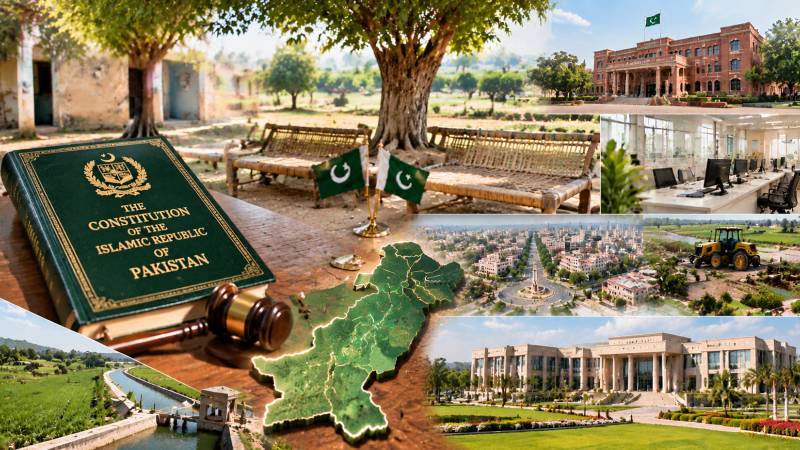
Pakistan has governments at the federal and provincial levels, but the tier closest to citizens remains the weakest. Water, sanitation, schools, healthcare, local roads, land records and policing are essentially local responsibilities, yet remain largely controlled by provincial bureaucracies unaccountable to the communities they serve.
Article 140-A of the Constitution requires provinces to establish elected Local Governments with political, administrative and financial authority. Yet elections are delayed, councils dissolved and powers withheld. Pakistan has never established a permanent, genuinely autonomous third tier of government. Local self-government is not foreign to our history. For centuries, villages managed their affairs through panchayats and other community institutions. Colonial administration progressively transferred their authority to appointed officials. Pakistan inherited this centralized structure and has largely retained it.
The Pakistan Plan (pakistanplan.org) proposes four fundamental reforms.
First, one uniform, constitutionally protected Local Government system across all provinces and districts. Provinces should not repeatedly redesign the electoral structure, administrative responsibilities and institutional arrangements. The same democratic framework must apply throughout Pakistan, irrespective of changing provincial political priorities.
Second, one territorial framework for the census, elections and Local Government. Currently, different authorities draw boundaries under different rules, complicating planning and repeatedly delaying elections. We propose geo-referenced census blocks as the common foundation for electoral and administrative boundaries, maintained through a single national register.
Third, representation built from households upward, rather than provincial governments downward. Approximately fifty households would directly elect a Block Representative. Ten representatives would form a Village Council and elect a Village Councilor. Eight villages would form a Union Council, whose Councilors elect a UC Nazim. Fifteen Union Councils would form a tehsil, electing a Tehsil Nazim. At district level, citizens would directly elect a mayor, while UC Nazims would constitute the District Assembly. Citizens would cast just two direct ballots: one for their Block Representative and another for their District Mayor. The village council would revive the traditional panchayat in a democratic form, with women and landless haaris participating by right rather than concession.
My conviction comes partly from experience. In 2010, while helping establish a new planned village at Shahgarh, Muzaffargarh, we organized households into small blocks and elected representatives. I witnessed a resident, who had originally regarded his home as temporary, begin taking responsibility for his community after his neighbors elected him as their representative. The lesson was unmistakable: people do not develop ownership of their communities merely because the government provides services. They develop ownership when they have a meaningful voice in the decisions affecting their lives.
Pakistan has governments at the federal and provincial levels, but the tier closest to citizens remains the weakest. Water, sanitation, schools, healthcare, local roads and policing are essentially local responsibilities, yet remain largely controlled by provincial bureaucracies unaccountable to the communities they serve.
Fourth, elected political leadership combined with professional district administration. The district would become the principal unit of Local Government, led by a directly elected Mayor and professionally administered by a District Manager. The District Assembly would approve budgets, taxes and local laws. A District Board comprising elected members and five independent experts would appoint and oversee the District Manager through a performance-based contract.
The five experts and corresponding departments would align with The Pakistan Plan's five clusters: Education; Health and Social Safety; Governmental Affairs; Agriculture, Water, Energy and Environment; and Economic Development, harmonizing administration across government tiers.
The existing office of the Deputy Commissioner would cease to function. Provincial administrative control would give way to locally accountable political leadership and competitively recruited professional management. Public appointments would be based on relevance and competence, with opportunities also open to qualified overseas Pakistanis. Elected representatives and professional officials would undergo mandatory training, with further devolution linked to demonstrated institutional capacity.
Districts must be able to raise and retain meaningful local revenues, particularly property taxes, while receiving a constitutionally guaranteed and automatically released share of provincial resources. Independent performance monitoring, published results, audits and separate mechanisms for administrative accountability and public complaints would allow citizens and provincial authorities to assess how effectively districts perform.
In the current system, the absence of empowered Local Governments draws national and provincial legislators into local development spending, distracting them from their primary responsibilities of legislation and oversight. Constituency development funds for MNAs and MPAs shall therefore be discontinued, with local development expenditure entrusted to elected Local Governments.
Constitutional protection is indispensable. A suitable amendment to Article 140-A should establish the uniform national framework, guarantee four-year terms and timely elections, protect elected Local Governments against arbitrary dissolution, define their responsibilities and secure their finances. The Local Government Ordinance 2001 was a significant step towards devolution and could provide a useful starting point for this effort.
The transition need not occur overnight. Functions, personnel and resources should initially move to empowered districts, with further authority devolved to tehsils, Union Councils and villages as their capacity develops. Urban centers and major metropolitan areas would retain arrangements suited to their distinct service requirements within the same national framework. The Eighteenth Amendment transferred substantial authority from Islamabad to the provinces. But devolution cannot end in Lahore, Karachi, Peshawar and Quetta. Authority must reach the communities whose lives it governs.
Pakistan needs a permanent Local Government system built on a uniform national framework, common territorial boundaries, representation originating with citizens, and professionally managed districts possessing real authority, resources and accountability. The objective is not simply to bring government closer to the people. It is to return government to the people.