

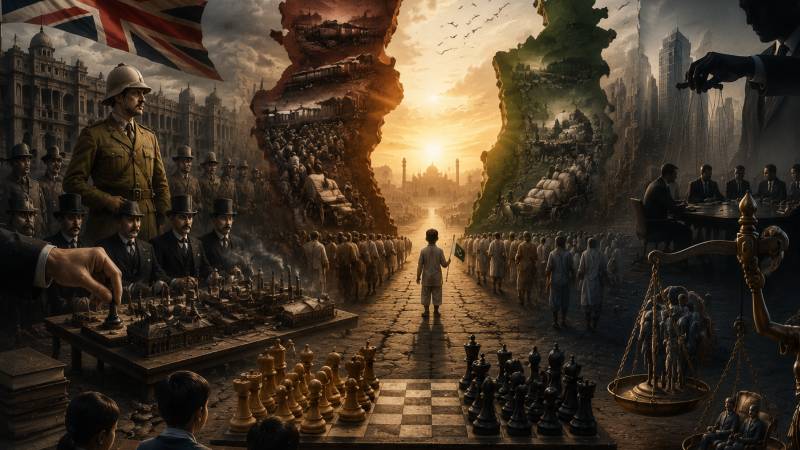
As Pakistan's 79th Independence Day approaches, celebrations are already being scheduled in every setting, with speeches recounting the sacrifices our forefathers made for the country's freedom. What often goes unheeded, however, is our growing tendency to treat Partition Day as the culmination of independence itself. The real contours of what freedom should look like in practice — and the founders' vision for it — remain, quite literally, out of the syllabus. This piece is an attempt to ask whether partition alone amounts to independence, and whether we still live by the ideals of the founders.
Pakistan came into being on 14th August through the dreams and indispensable struggle of its people. The real heroes of that struggle sacrificed their own lives for independence. Yet for the new generation, independence itself remains a question mark. Why?
Independence means choosing what is right without being forced, controlled, or manipulated. It widens the scope of human dignity and freedom, uplifting the standard of living without external interference. A day like 14th August should remind us of that individual sphere of liberty — essential not just symbolically but for socioeconomic survival. It should also remind us of the value, respect, and status of women, which have diminished under sustained pressure and a weak socioeconomic system. That day was, undeniably, a huge triumph against the British Raj — proof of people's power standing against the monopoly of illegitimate authority. For that reason alone, it remains important: for the freedom of the land, its people, and their dignity.
But the real meaning of independence goes further. It is meant to give people a sphere in which to exercise their fundamental rights, secure their sociopolitical standing, and live according to their own framework of values. When rights are still exploited and dignity still violated, hope dies — and no one is quite sure what the real meaning of freedom is. In that gap, ignorance takes root and hides the truth.
Whenever that license of independence exceeds its limits, it creates a cage of suffocation.
Being a woman, I measure freedom by how genuinely my fundamental rights are exercised. The right to life, voice, and expression demands legal support and security. Without that support, people instead take up their own beam balance of justice, weighing a girl's freedom against "honor" and "dignity" — a dignity that is meant to be inviolable, yet is so often used to suppress her dreams and silence her voice. If this is freedom, I don't know what freedom is.
In the political sphere, ordinary people remain largely unaware of the real game — one run by networks of relatives extending outward to the people they claim to represent. The vote becomes a tool to protect narrow interests, pushing common people to the margins while their struggle for rights is managed through patronage and dynastic politics. Under this arrangement, good governance, democracy, and justice all hide in the shelter of relatives' politics. If this is the freedom so often invoked to control people, then we clearly remain unaware of what freedom actually means.
There is a further silence to reckon with. When a crime, an act of abuse, or an act of violence occurs and people around it stay quiet, that silence reflects a society either blind to injustice or quietly protecting its own interests. Such silence gives criminals and abusers room to continue. It reveals an ignorance of rights and duties, or worse, complicity — and it ultimately becomes a failure the government must answer for. If people call this independence, they are ignorant of what freedom actually means.
In the end, the word "independence", a synonym for freedom is routinely misinterpreted. Treated as license to do anything, it becomes something people themselves hand over to those with the power and status to abuse it. Whenever that license exceeds its proper limits, it creates a cage of suffocation for everyone: it diminishes education, manufactures compliance, and curtails freedom itself. And so people stay silent — because on some level they know that this freedom, this independence, was never truly theirs. And the game of crime and criminality carries on, undisturbed, as an accepted part of society.