

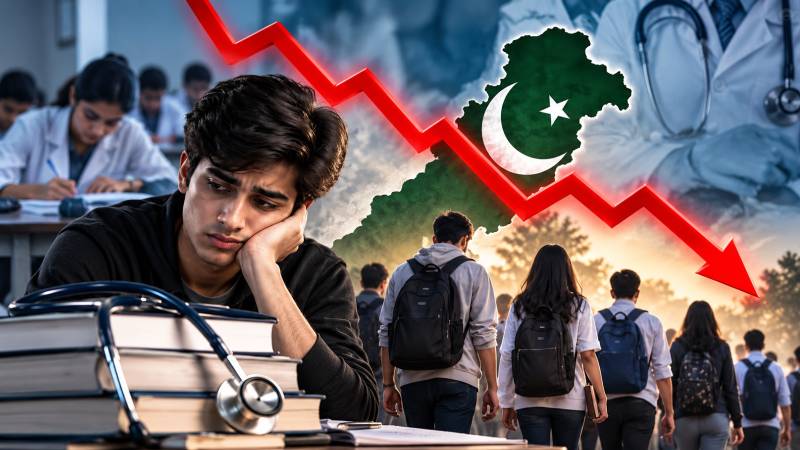
For generations in Pakistan, medicine has occupied a place unlike almost any other profession. To become a doctor was not merely to choose a career; it was to acquire social prestige, family pride, professional respect and, in the imagination of many households, a measure of economic security. Children who performed exceptionally well in school were routinely encouraged towards medicine, sometimes before they were old enough to understand what medical life actually demanded. The annual Medical and Dental College Admission Test therefore became more than an examination. It became one of the most fiercely contested gateways in Pakistani education. That is why the continuing fall in the number of MDCAT candidates deserves attention far beyond the examination halls themselves. In 2022, 204,253 candidates appeared in MDCAT. In 2023, the number fell to 180,534. PMDC data for 2024 recorded 167,744 registered candidates, while 140,071 registered for 2025. For MDCAT 2026, scheduled for September 20, the figure stands at 138,158. The categories are not perfectly identical across all years—some figures refer to candidates who appeared and others to finalized registrations so comparisons must be made carefully. Even with that qualification, however, the broad direction is unmistakable: the pool has contracted sharply, with the 2026 figure roughly one-third lower than the 2022 level.
Before converting those numbers into alarmist conclusions, we should ask what exactly they mean. A smaller applicant pool does not automatically prove that Pakistani youth have suddenly lost interest in medicine, nor does it by itself establish that the country faces an imminent shortage of doctors. It is also important to acknowledge discrepancies in publicly circulated figures. For example, the Pakistan Medical Association recently cited around 182,000 candidates for 2024, whereas PMDC's own pre-examination registration data gave 167,744. Such differences may arise because one dataset counts applications received, another finalized registrations, and another candidates actually appearing. This is precisely why the first requirement is methodological discipline. PMDC and the Ministry of National Health Services should publish a consistent longitudinal series clearly separating applications, approved registrations, actual attendance, pass rates, admissions and final enrolments. Without that, public discussion risks becoming a contest of numbers. Nevertheless, when 204,253 candidates appeared in 2022 and only 138,158 are registered four years later, the decline is too substantial to dismiss as statistical noise. PMA has described the trend as evidence of growing disillusionment and has pointed to high educational costs and poor remuneration among possible causes. That interpretation should be investigated rather than simply accepted, because there may be several overlapping explanations: affordability, confidence in the admission process, employment prospects, changing aspirations, overseas migration, alternative careers and the changing expectations of a new generation.
The most obvious place to begin is cost. Medicine has always required an enormous investment of time, but increasingly it also requires an investment of money that many middle-class families may find difficult to sustain. In August 2026, the National Assembly was informed that Pakistan has around 22,000 medical college seats and that approximately 65 per cent of them are in the private sector, compared with only 35 per cent in public institutions. That ratio matters enormously. Public-sector medical colleges remain highly competitive partly because they offer education at a fraction of the cost of private institutions. In March 2025, a federal committee on medical education reforms set an annual tuition cap of Rs1.8 million for private medical and dental colleges, with inflation-linked increases contemplated within the framework. By August 2026, the health minister told parliament that around 35 institutions had been permitted to charge up to Rs2.1 million annually, while maintaining that private colleges could not raise fees unilaterally beyond approved limits. Even at Rs1.8 million, five years of tuition alone approaches Rs9 million, before accommodation, transport, textbooks, examination charges, equipment and ordinary living expenses are added. At Rs2.1 million, tuition by itself can exceed Rs10 million across the program. For affluent families this may be manageable; for the salaried middle class, particularly households with several children, it can alter the entire career calculation.
This produces a question that previous generations may not have asked with the same urgency. A student no longer thinks only, “Can I qualify for medical college?” The family may now have to ask, “What happens if I do not secure a subsidized public-sector seat?” The distinction is crucial. Medicine can retain extraordinary prestige and still become financially inaccessible. A student from a modest household may perform brilliantly in intermediate examinations and prepare seriously for MDCAT, yet know that failure to secure one of the relatively limited public seats leaves only a private route that the family cannot reasonably afford. That knowledge can influence behaviour before the examination is even attempted. Some students may decide that it is more rational to apply to computer science, engineering, pharmacy, biotechnology, business or another field where the cost-to-training-time ratio appears more manageable. Others may seek admission abroad in countries perceived to offer cheaper medical education, though that route carries its own regulatory and quality risks. The significant policy question is therefore not merely whether fees are “capped,” but whether medical education remains accessible to talented students across income groups. A cap can restrain escalation while still leaving the resulting amount beyond the reach of a large section of the population. If the decline in applicants is concentrated among lower- and middle-income households, that would suggest a serious equity problem. At present, however, we do not have sufficiently granular national data to say so confidently which is exactly why research is needed.
The fall from more than 204,000 MDCAT candidates in 2022 to 138,158 registrations in 2026 cannot be dismissed; Pakistan needs evidence-based research to determine whether young people are abandoning medicine because of cost, uncertainty, changing aspirations or declining confidence in the profession.
The calculation at the other end of medical education has also changed. A young person considering medicine in 2026 can see more clearly than previous generations what lies ahead after admission: five demanding years of undergraduate study, a house job, postgraduate entrance examinations, residency or fellowship training, long working hours and often several further years before reaching professional stability. None of this is inherently a reason to avoid medicine; serious professions require serious preparation. The issue is whether the eventual rewards—financial, professional and personal—are perceived as proportionate to the sacrifices. Medical associations have repeatedly raised concerns about remuneration, working conditions, workplace security and limited training opportunities. Reports of Pakistani doctors seeking employment abroad have also become part of the wider conversation. One medical association estimated that thousands of doctors left Pakistan during 2025, citing low pay and difficult professional conditions; such estimates should be treated as organizational claims rather than a complete workforce census, but the broader concern about doctor migration is well established enough to require systematic tracking. A young person making a career decision is not studying labour-market statistics in isolation; he or she is also watching older siblings, cousins, junior doctors and residents. If those role models appear exhausted, underpaid, insecure or preoccupied with leaving the country, medicine's traditional aura of guaranteed professional security naturally weakens.
At the same time, we must avoid the opposite mistake of concluding that fewer MDCAT candidates necessarily mean Pakistan is about to run out of doctors. Around 138,000 candidates are still competing for roughly 22,000 medical seats, which means medicine remains extraordinarily competitive. The health workforce problem is also much more complex than the simple number of graduates. Pakistan can simultaneously produce many doctors and still experience severe shortages in rural areas, primary care, anaesthesia, emergency medicine, psychiatry or other underserved specialties. It can have unemployed or underemployed graduates in one city while a district hospital elsewhere struggles to recruit a medical officer. It can train doctors at public expense and then lose them to migration because working conditions, specialist training pathways or remuneration are more attractive abroad. Medical workforce planning must therefore examine geographical distribution, specialty distribution, gender patterns in labour-force participation, migration, retirement, postgraduate training capacity and retention. The decline in MDCAT participation should thus be understood not as proof of an impending numerical shortage, but as a possible early indicator that confidence in the profession's future may be changing. That distinction matters because policy responses should be based on diagnosis rather than panic.
The second major issue is trust in the admission process. A difficult examination can be accepted if candidates believe it is fair. What destroys confidence is the perception that effort may not be rewarded equally. MDCAT has faced repeated controversies over the years, and Sindh provides a particularly serious example. In 2023, the caretaker Sindh chief minister ordered the MDCAT to be reconducted after an inquiry found that the examination paper had been leaked several hours before the test; the matter was referred to the Federal Investigation Agency. In 2024, controversy again surrounded the examination in Sindh. The Sindh High Court ultimately ordered a fresh test after a probe committee concluded that the entire procedure had been compromised, and the court directed that the retake be conducted through IBA Karachi and Sukkur IBA. These are not minor administrative complaints. For a student who has spent a year preparing for one high-stakes examination, uncertainty over paper security, retakes and litigation can be psychologically exhausting and financially costly. It is important, however, not to generalise from these cases to claim that the entire MDCAT system is corrupt. What can be said factually is that repeated controversies created sufficient concern for courts, governments and regulators to intervene. That alone is enough to make institutional trust a legitimate part of any inquiry into changing candidate behaviour.
PMDC has itself recognized the need for reform. Its MDCAT Reform Committee identified three broad areas—content, conduct and policy—and proposed work on a unified syllabus, a stronger and sustainable question bank, secure digital infrastructure and possible e-assessment mechanisms. PMDC has also repeatedly directed conducting universities to ensure transparency, standardization and strict monitoring, including for the 2026 examination. These are positive institutional responses, but public confidence is restored not merely by announcing reforms; it is restored when candidates can see that the same standards are consistently applied across provinces and years. A national entrance examination must minimize variations in difficulty, prevent breaches of confidentiality, provide credible mechanisms for appeals and ensure that students are not punished for administrative failures beyond their control. If an examination has to be reconducted, the financial and emotional burden should not fall on candidates. The essential principle is simple: merit cannot exist without trust. Students can accept a seat going to someone who scored higher. They will find it far more difficult to accept a system in which they suspect that someone had prior access to questions, benefited from uneven standards or was advantaged by flaws in administration.
A third issue that deserves more serious attention is the large preparation economy surrounding MDCAT. The official examination fee is only one component of what many families actually spend. There are private academies, crash courses, mock examinations, online subscriptions, printed question banks, travelling expenses and, in some cases, repeated attempts. In large cities, the preparation culture can become almost a parallel education system. Students from well-resourced schools and families may have access to experienced teachers, commercial coaching and repeated testing, while a student in a smaller town may be preparing largely through textbooks and freely available material. This does not mean coaching automatically determines success, nor is there yet sufficient national evidence to quantify its effect. But if admission to subsidised public medical education increasingly depends on participation in an expensive private coaching ecosystem, then merit becomes entangled with purchasing power. A serious national study should therefore calculate the true household cost of competing for a medical seat, not merely the official college tuition. That study should include preparation expenditure, travel, application charges, opportunity costs and repeated examination attempts. The relevant question is not simply “How much does MDCAT cost?” but “How much does it cost a family to compete seriously and repeatedly for medical admission?”
Research should also follow students after they enter medical college. A healthy medical education system is not measured only by how many candidates sit MDCAT. We should know how many students drop out, how many complete the degree on time, how many enter house jobs, how many proceed to postgraduate training, how many practise clinically five or ten years later and how many migrate. We also need to understand why graduates leave clinical medicine altogether. Some may move into research, administration, pharmaceuticals or public health, which can still represent productive use of medical education. Others may leave because of burnout, inadequate remuneration or the difficulty of combining medical careers with family responsibilities. Workforce planning based only on admission numbers is therefore inadequate. If the goal is to strengthen health services, Pakistan must follow the entire professional pipeline from the aspiring MDCAT candidate to the consultant, general practitioner, researcher or emigrant doctor years later.
The issue is ultimately larger than MDCAT. These numbers offer a glimpse into how young Pakistanis are reassessing the relationship between education, cost, sacrifice and opportunity. A generation connected to global information evaluates professions differently. Prestige still matters, but so do quality of life, training duration, earnings, mobility, flexibility and the possibility of working internationally. The medical profession cannot rely indefinitely on inherited social status to attract the country's strongest students. It must also offer a credible pathway in which talent is selected fairly, education is accessible, training is rigorous, employment is dignified and professional advancement is reasonably predictable. Medicine remains highly respected in Pakistan, and the 138,158 MDCAT registrations in 2026 show that interest is still substantial. Yet the fall from more than 204,000 candidates in 2022 cannot be ignored. The deeper issue is what medicine now represents to young Pakistanis: a respected path of service and professional security, or an increasingly costly, uncertain and exhausting career. Rather than assuming the reason, Pakistan needs serious research to understand why so many fewer students are choosing to enter the race.