

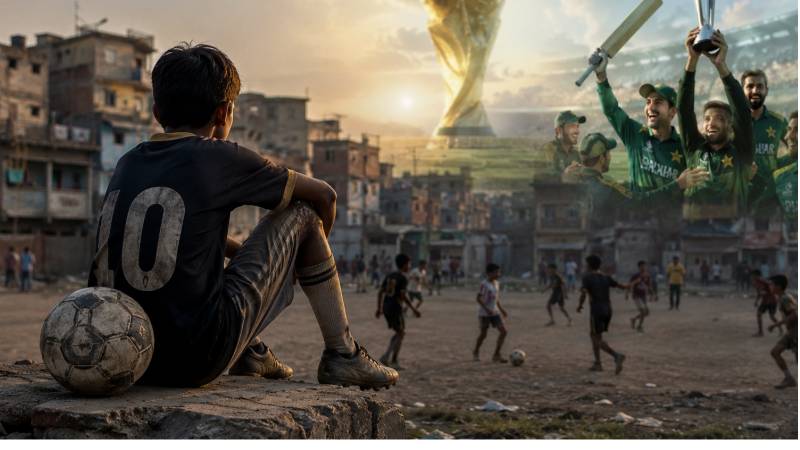
As Spain celebrated lifting the FIFA World Cup after defeating Argentina in a dramatic final in New Jersey, billions of people around the world were once again reminded why football remains the planet's most popular sport. The 2026 World Cup, expanded to 48 teams, was designed to make the tournament more inclusive and give more nations an opportunity to compete on the biggest stage.
Yet one country remained conspicuous by its absence: Pakistan.
For a nation of more than 250 million people—the world's fifth most populous country—that absence should be a source of national embarrassment. Population, of course, does not automatically translate into sporting success. But it certainly provides a vast pool of potential talent. Countries with populations a fraction of Pakistan's regularly qualify for the World Cup. Iceland, with fewer than 400,000 people, qualified in 2018. Croatia, home to under four million people, reached the final in 2018 and the semi-finals in 2022. Morocco, with about 38 million people, became the first African nation to reach a World Cup semi-final.
Pakistan, meanwhile, cannot even get close. This is not because Pakistanis lack athletic ability. Nor is it because football is unpopular. Quite the opposite. Every World Cup transforms Pakistani cities into seas of Argentine, Brazilian, German and now Spanish jerseys. Cafes remain packed until the early hours of the morning. Children play football in streets, parks and empty plots of land across Karachi, Lahore, Quetta, Peshawar and countless smaller towns.
Pakistan has football lovers in abundance. What it does not have is a football system. The reasons are depressingly familiar. Years of administrative infighting within the Pakistan Football Federation resulted in FIFA suspensions, international isolation and the loss of precious development time. While neighbouring countries invested in academies, youth leagues, coaching education and infrastructure, Pakistan was trapped in boardroom battles and courtrooms. Generations of young footballers paid the price for disputes they had no role in creating.
Success is not accidental; it is carefully engineered over decades. Pakistan still relies largely on chance.
Even after FIFA restored normalisation, the damage had already been done. The problem extends well beyond governance. Pakistan has never treated football as a serious national project. Schools rarely have structured football programmes. Universities offer limited pathways. Professional clubs operate on shoestring budgets. Domestic competitions receive almost no television coverage, little sponsorship and negligible public attention. Talented players often abandon the sport because there is simply no viable career waiting for them.
Contrast this with countries that consistently produce elite footballers. Their systems identify talent early, provide quality coaching, expose players to competitive environments and ensure they continue developing through adolescence. Success is not accidental; it is carefully engineered over decades.
Pakistan still relies largely on chance. There is another uncomfortable reality. Cricket dominates almost every conversation about sport in Pakistan. While cricket deserves its popularity and has delivered remarkable moments of national pride, its overwhelming influence has unintentionally crowded out nearly every other sport. Corporate sponsorship, media attention, government funding and public imagination revolve around one game.
The result is predictable. When football competes against cricket for resources, football almost always loses. Yet this is a false choice. Many countries excel in multiple sports simultaneously. Australia is competitive in cricket, football, rugby and swimming. England balances football with cricket, rugby and tennis. Even India, where cricket enjoys near-religious status, has begun investing seriously in football through professional leagues and youth development. The objective is not to diminish cricket but to recognise that a country of Pakistan's size should never depend on a single sport for international recognition.
The irony is that Pakistan already possesses one critical advantage many nations would envy: passion. Football requires no expensive equipment. A ball and an open space are often enough to inspire dreams. Across Lyari in Karachi, Chaman in Balochistan and numerous communities in Khyber Pakhtunkhwa, football has deep cultural roots. These areas have produced gifted players despite receiving little institutional support. Imagine what they could achieve with proper coaching, nutrition, facilities and regular competition.
Talent exists. Opportunity does not. The expansion of the World Cup to 48 teams should have increased Pakistan's sense of urgency. More qualification places mean more realistic pathways for emerging football nations. Countries once considered outsiders now genuinely believe they can qualify. Pakistan, however, remains so far behind that even an expanded tournament offers little hope without structural reform. There are no shortcuts.
Pakistan needs a long-term national football strategy that survives changes in governments and sports administrators. Grassroots academies must become a priority. Qualified coaches should be developed nationwide. Domestic leagues need stable financing and professional standards. Schools and universities must become genuine talent pipelines rather than afterthoughts. The Pakistani diaspora, which includes players competing abroad, should also be integrated into national planning instead of being viewed as occasional solutions.
Most importantly, football administration must remain free from the political interference that has repeatedly crippled progress. No one should expect Pakistan to become world champions overnight. Even qualifying for the World Cup would require years of sustained effort. But qualifying itself would be transformative. It would inspire millions of children, attract investment into the sport and reshape Pakistan's international sporting identity.
As the football world applauds Spain's latest triumph and looks ahead to future tournaments, Pakistan should resist the temptation merely to celebrate other nations' victories. Admiring Lionel Messi, Lamine Yamal or Ferran Torres is easy. Building the next generation of Pakistani footballers is much harder. A country of 250 million people should not spend every World Cup waving someone else's flag. It is time for Pakistan to give its own children the chance to dream of wearing the green shirt on football's biggest stage.