

Cruella de Vil is hardly the character anyone would cite as a source of wisdom. The flamboyant villain of 101 Dalmatians, obsessed with fur and infamous for her pursuit of Dalmatian puppies, is hardly a feminist icon. Yet one of her lines in the 1996 film contains an uncomfortable truth:
“More good women have been lost to marriage than to war, famine, disease and disaster. You have talent, darling. Don’t squander it.”
Strip away the irony, and the question it raises is worth asking in Pakistan: How much female talent do we lose; not because women lack ability or ambition, but because marriage, motherhood, and social expectations push many of them out of education, employment, leadership, and public life?
Despite all odds, Pakistan educates millions of girls every year. Families proudly celebrate daughters who become doctors, engineers, lawyers, teachers, and graduates. Yet for too many women, marriage marks the beginning of a gradual withdrawal from professional life. Education, once celebrated as an achievement, becomes secondary to domestic responsibilities, while the country loses much of the economic and social return on its investment.
Pakistan’s overall literacy rate is 63 percent among the population aged 10 and above, according to the 2024–2025 Pakistan Social and Living Standards Measurement survey. The gender gap is stark: 73 percent of men are literate, compared with just 54 percent of women. But the challenge is not only getting girls into schools, colleges, and universities; it is ensuring that educated women can turn their qualifications into careers, businesses, economic independence, and leadership.
If a woman becomes a doctor, engineer, economist, lawyer, scientist, teacher, journalist, or entrepreneur and then leaves the labour market during her most productive years, the country loses the return on a considerable investment in her education and skills.
Women’s representation in Pakistan’s political institutions remains limited, particularly in executive positions. The current National Assembly has 73 female members out of 336 total members, including those elected on reserved seats, accounting for 21.72 percent of the House. In the Senate, only 18 of the 96 members are women, including 17 on reserved seats, representing 18.75 percent of the Upper House.
The gap becomes even more pronounced in the executive branch. Of the 31 federal ministers, only one is a woman, while only two of the 11 ministers of state are women. In Khyber Pakhtunkhwa, despite women serving in the provincial assembly, there is currently not a single woman in the provincial cabinet. Representation, therefore, is not simply about occupying legislative seats; it is also about having a voice where executive decisions are made, resources are allocated, and policies are implemented.
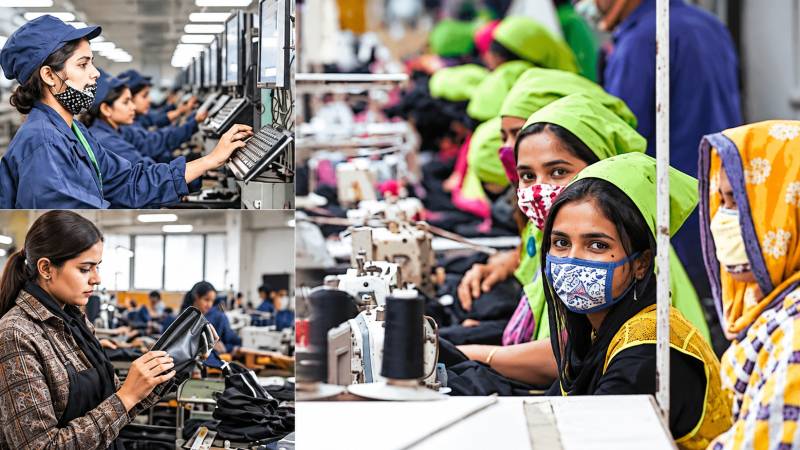
The economic picture is equally stark. The latest Pakistan Labour Force Survey puts female labour-force participation at only 22.7 percent in 2024–2025, compared with 68.7 percent for men. The female unemployment rate was also higher, at 10.5 percent compared with 6 percent for men. These figures do not mean Pakistani women are absent from the economy. Millions work, particularly in agriculture, informal employment, and unpaid family work. But much of this work offers limited income, security, or opportunities for advancement.
This wider women exclusion is reflected in Pakistan’s position in global gender comparisons. According to the World Economic Forum's Global Gender Gap Report 2026, Pakistan ranked 143rd out of 145 countries, with an overall gender-parity score of 59.5 percent. Its Economic Participation and Opportunity score was only 36.4 percent, placing Pakistan 144th globally on that sub-index. In a country that produced Shaheed Benazir Bhutto, the first woman to serve as prime minister of a Muslim-majority country, the question is worth asking: Where do many educated Pakistani women go?
A significant part of the answer lies inside the household. Marriage is not itself the problem. The problem is the unequal distribution of responsibility that often accompanies it. A woman may spend 16 or 18 years acquiring an education and professional qualifications, only to find that after marriage she is expected to assume primary responsibility for children, cooking, elderly care, and household management.
A professional woman can, therefore, find herself working two shifts: one at the workplace and another at home. The issue is not that women suddenly lose their ambition after marriage. Rather, the cost of maintaining a career alongside family responsibilities is disproportionately imposed on them. The economic consequences of this societal weight on women are substantial. If a woman becomes a doctor, engineer, economist, lawyer, scientist, teacher, journalist, or entrepreneur and then leaves the labor market during her most productive years, the country loses the return on a considerable investment in her education and skills.
Employment, however, is not the only measure of economic independence. Ownership matters, too. The World Bank’s analysis of women’s economic empowerment in Pakistan found that only about 3 percent of women reported owning a home, compared with 72 percent of men, while only 2 percent reported owning land compared with 27 percent of men. Only about one-third of women legally entitled to inherit property from their fathers actually receive any property.
These are not merely statistics about assets. Property provides security, can serve as collateral for borrowing, and can strengthen a woman’s bargaining position within her household. Without assets, even an educated or employed woman may remain economically vulnerable. The same imbalance extends to business. Pakistan’s share of female business owners remains among the lowest internationally, while women occupy only a small proportion of senior- and middle-management positions. Women can, therefore, be educated, employed, and economically active while still being excluded from ownership, capital, and positions where major decisions are made.
Pakistan cannot maximize its economic potential while a large part of its educated population remains outside productive employment or concentrated in insecure and unpaid work. Nor can its political institutions fully reflect society when women remain underrepresented in positions of executive authority.
Women’s economic participation is, therefore, not simply a matter of empowerment. It is an economic necessity and a prerequisite for national progress. Pakistan needs more entrepreneurs, professionals, scientists, teachers, doctors, managers, and taxpayers. Women are not peripheral to that equation; they are half of the population. The real measure of women’s progress is not simply how many girls enter school, college, university, or a professional institute. It is how many can still use that education 10, 20, and 30 years later to earn, own, create, govern, and lead. As a nation, we do not need to discover women’s talent. We need to stop wasting it.