

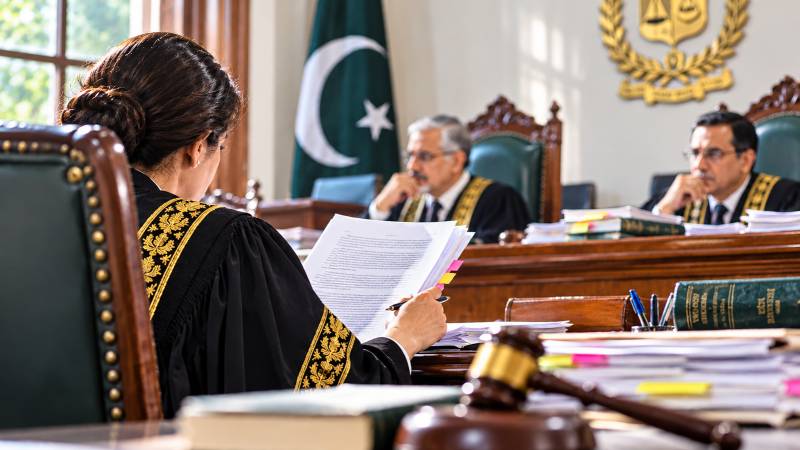
A seat on the bench is a fact about who sits. Jurisprudence is a fact about what the law becomes.
When Justice Musarrat Hilali retired from the Supreme Court on 7 August, the coverage did what it always does. It counted. She was the second woman ever to sit on the bench, and reports say a third, Justice Aalia Neelum, is on her way to Supreme Court. Each appointment gets called a milestone. Almost none asks the only question a lawyer should ask: what did she write?
The case that answers it is Nadia Naz. Nadia Naz was a resource person in the camera department at Pakistan Television. She complained of harassment by male colleagues, and her complaint travelled from the President's office to the Islamabad High Court to the Supreme Court. In July 2021, a three-member bench headed by Justice Mushir Alam held that the Protection against Harassment of Women at the Workplace Act, 2010 covers only harassment of a sexual nature, and her complaint failed.
Two years later, on review, a bench led by Justice Yahya Afridi and including Justices Muhammad Ali Mazhar and Ayesha Malik heard it again. Justice Malik wrote the judgment, reported as PLD 2023 SC 588. It found that the earlier reading conflicted with the Act and its objects, and that harassment includes gender-based conduct that makes a workplace hostile. It asked courts to apply "the standard of a reasonable woman," and it sent Nadia Naz's representation back to the President to be decided afresh. Same statute. Same litigant. Same court. Two readings, two years apart.
The next time a woman is sworn in to the Supreme Court, the more meaningful question is not what her appointment symbolises, but what she writes, how her reasoning develops the law and whether future courts find it persuasive enough to follow.
This is not a story of a woman outvoting men. Justice Afridi wrote his own concurring note, and the bench was not all women. The lesson is smaller and more useful. The outcome turned on the reasoning of the judge who wrote it, and on whether that judge treated the statute's purpose as the question. The reasoning is also contestable. An Indian Law Review case comment argues that the Court strained plain-meaning principles to reach a favourable policy result. That criticism can be made and answered on the merits, and it can only be made because the judgment exists to be read.
Counting substitutes a symbol for a substance. It credits the institution for an appointment instead of an achievement. It loads every woman judge with the impossible job of representing all women. And it leaves the scrutiny to people who already distrust her. It also hides the price of getting law wrong. Nadia Naz's representation was decided by the President in January 2018. It was remanded for a fresh decision in 2023, five years later, after a Supreme Court judgment had said her complaint did not qualify. Whoever writes the reasoning decides how long a woman waits.
The standard we apply to the woman we celebrate should be the standard we apply to any judge. Bar associations and law schools could publish an annual audit of every gender-related judgment of the superior courts. It should record who authored each one, whether it developed the law or merely applied it, and whether later courts followed it. The sample is small enough to read. Justice Malik's earlier Lahore High Court judgment declaring virginity tests unconstitutional would appear next to Nadia Naz, and every author, of any gender, would appear beside her. The next time a woman is sworn in to the Supreme Court, resist the urge to ask what it means. Wait a year, then read what she has written.