

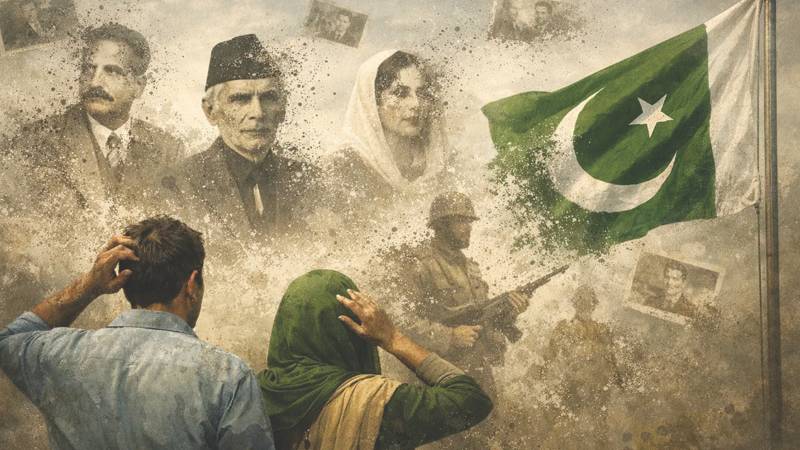
Every country has a territory, but a nation has a memory. Maybe that is why 14 August feels different in Pakistan. There is patriotism, pride and respect, but above all, there is nostalgia. It does not matter whether you are rich or poor, Baloch or Punjabi, there are certain memories that seem to belong to all of us. Someone playing Sohni Dharti, Dil Dil Pakistan coming on for the umpteenth time, children with green and white painted on their faces, flags hanging from balconies and families sitting together for the day. For a day, Pakistan feels less like a country on a map and more like something we grew up with. And perhaps that is the point. What we celebrate today was once a dream, and for many, achieving that dream came at a price.
14 August is not simply the day we celebrate Pakistan. The idea had already been formalised through the Lahore Resolution on 23 March 1940. On 14 August, that idea became a state. But getting there came at an enormous human cost. Around eight million Muslims made their way into Pakistan during Partition, many leaving behind homes, savings, possessions and loved ones. By February 1948, more than six million had settled in West Punjab and another 600,000 in Sindh. Around a million people are estimated to have lost their lives, although the exact figure may never be known. These are not simply numbers. Behind everyone was a family whose life was changed overnight, carrying with them little more than what they could save and the hope of a country they believed was worth the sacrifice.
Muslims and Hindus had lived together for centuries. By the 1940s, however, the question had become much bigger than simply living together. The issue was political, who would govern whom? The Two-Nation Theory argued that Muslims and Hindus had distinct political, religious and cultural identities, and that Muslims needed the security to shape their own political future. It was a demand for self-determination, not hatred of another faith. Pakistan's founding vision did not shut minorities out. The white stripe on our flag remains a reminder of that. Even the name Pakistan brings together Punjab, Afghania, Kashmir, Sindh and Balochistan. From its very name to its flag, the idea was clear: different identities, one Pakistan.
The places that make up Pakistan's name have all helped shape the country and carry its name beyond our borders. From sacrifice to sporting records and achievements in science, film and politics, Pakistanis have done it all. Punjab gave us Arshad Nadeem, whose Olympic javelin throw put Pakistan on the world's biggest sporting stage, and M.M. Alam, whose extraordinary feats in the skies became part of our national memory. Sindh gave us Sharmeen Obaid-Chinoy, Pakistan's first Oscar winner, and Benazir Bhutto, the first woman to lead a democratic government in a Muslim-majority country. From Khyber Pakhtunkhwa came Jahangir Khan, whose 555-match unbeaten run remains one of sport's great records, alongside Madam Tahira Qazi, whose courage during the APS attack showed a bravery that words struggle to capture. And from Balochistan came Qazi Muhammad Isa, a close associate of Jinnah who played an important role in building the Muslim League's support in the province. These are only a few names, but they all tell the same story: Pakistan's people have carried the green and white far beyond our borders. And a country with such people could hardly have been given anything less than extraordinary land to call home.
Perhaps patriotism is not just about celebrating Pakistan once a year but remembering what was sacrificed for it and doing our part to make sure the Pakistan we leave behind is one worth celebrating.
There is then the land itself. Pakistan somehow has a little bit of everything. Punjab has the ancient ruins of Taxila and the old grandeur of Lahore, Sindh takes us from Mohenjo-daro to the Arabian Sea, KP gives us the mountains of Swat and the old streets of Peshawar, while Balochistan stretches from the junipers of Ziarat to the coast of Gwadar. But you do not always need a famous monument to appreciate Pakistan. Sometimes it is just an old street, a village road, a mountain you grew up seeing, or a view you have passed a hundred times and somehow still stop to look at.
14 August, like every other day, will eventually pass. But it reminds us that we are all ambassadors of this land and its people. Every student, doctor, athlete and artist represents Pakistan, whether at home or abroad. Benazir Bhutto recalled in her autobiography what her father, Zulfikar Ali Bhutto, told her before she left for university: “Your place is here. Your roots are here.” Perhaps that is what Pakistan ultimately means to all of us. We may travel, build lives elsewhere and see much of the world, but this will always be the country we call home. Our diversity should be a source of strength, not division. Unity does not mean becoming identical, it means belonging to the same national story. Perhaps patriotism is not just about celebrating Pakistan once a year but remembering what was sacrificed for it and doing our part to make sure the Pakistan we leave behind is one worth celebrating.