

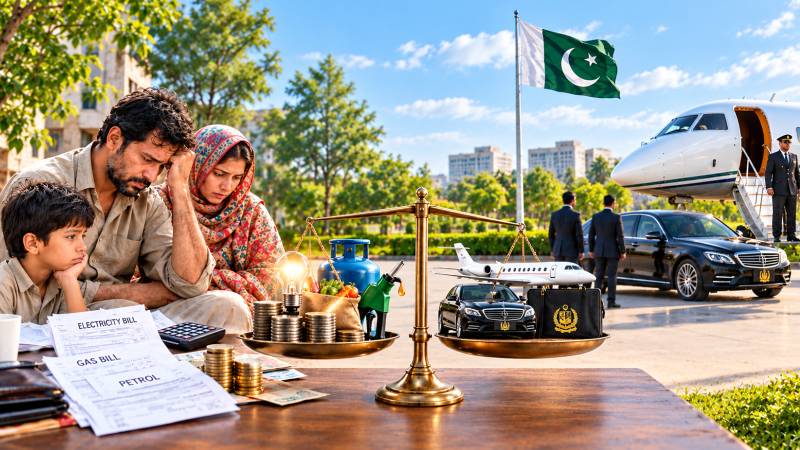
Since 2022, Pakistanis have repeatedly been told the same story: the country is facing an economic crisis, dollars are scarce, the treasury is under pressure, the IMF must be satisfied, subsidies must be reduced, taxes must rise, electricity and gas must become more expensive, the rupee must adjust, and everyone must sacrifice. The argument was difficult, but understandable. Pakistan had lived beyond its means, and someone had to pay the bill. And people did. They paid higher electricity and gas bills. They paid more for petrol and more in indirect taxes on almost everything they consumed. They watched their savings lose value through currency depreciation, while businesses cut investment and families postponed education, healthcare, housing and even marriage. They were repeatedly told to endure today for the sake of tomorrow. But after years of sacrifice, a more difficult question has emerged: who, exactly, is being asked to sacrifice?
The question is not whether Pakistan faced genuine economic difficulties. It did. The country has experienced balance-of-payments pressures, debt accumulation, inflation and repeated IMF programmes. The question is whether the burden of adjustment has been shared fairly. A state may legitimately ask its citizens to sacrifice in a national emergency, but it cannot indefinitely demand sacrifice from society while exempting itself from equivalent fiscal discipline.
The contradiction becomes visible in the numbers. Pakistan collected a record Rs1.567 trillion through the petroleum levy in FY2025-26, compared with Rs1.22 trillion the previous year, while the cost of running the civil government crossed Rs1 trillion. For the ordinary citizen, these are not abstract budgetary figures. They are built into every litre of petrol, the cost of commuting to work, transporting food, running a factory, operating a shop and sending children to school.
At the same time, the machinery of the state continues to find money for privileges. The federal cabinet approved another Rs1.8 billion special allowance for senior bureaucracy, reportedly the second such allowance in four years, while austerity measures continued elsewhere. There may be legitimate reasons for competitive compensation in the public service. A capable state cannot be built by permanently underpaying those responsible for running it. But the question should always be the same: what additional responsibility, performance or measurable public value justifies an additional privilege?
The same principle should apply to public procurement. Punjab's acquisition of a long-range Gulfstream jet costing more than Rs10 billion became controversial because of the timing and circumstances. The government initially linked the aircraft to the proposed Air Punjab project and later described it as a replacement for an older aircraft on safety grounds. A provincial government may legitimately conclude that an aircraft is necessary. But taxpayers are entitled to ask whether its cost, operation, utilisation and public purpose were subject to sufficient transparency and independent scrutiny. The issue is not the aircraft alone. It is the credibility of the state.
A state that can arrange official vehicles, aircraft, accommodation, petrol, electricity and protocol for powerful citizens but cannot provide ordinary citizens with reliable public services has created more than inequality of income. It has created inequality of citizenship.
A government does not merely collect money from its citizens; it makes a promise in return. The citizen pays taxes expecting security, education, healthcare, infrastructure, justice and functioning public institutions. When citizens pay more and receive less, the fiscal problem begins to become a problem of citizenship. Now consider the human cost. The World Bank estimates that around 77 per cent of Pakistani children are learning poor, meaning they cannot read and comprehend a simple written text by age 10. Roughly 25 million children between five and sixteen are out of school, giving Pakistan the world's second-largest out-of-school population. Around 40 per cent of children are stunted.
These are not merely education or health statistics. They are forecasts of Pakistan's economic future. A child who cannot read is not simply a child who has failed an examination; he is a future worker with lower productivity and earning capacity, a future taxpayer contributing less to the formal economy and potentially another generation trapped in low productivity. A malnourished child represents lost human capital. A child who never enters school represents an opportunity that the state may never recover. This is why the debate about government privileges is not petty, nor is it about resentment towards judges, civil servants, politicians or anyone else who serves the state. Constitutional offices deserve dignity and reasonable retirement security. Public servants deserve fair compensation. The real question is whether privilege is connected to public responsibility and performance.
According to information placed before the Senate by the Ministry of Law, the monthly pension of a retired Chief Justice rose from Rs1.657 million in 2023 to Rs2.39 million in 2024, while associated benefits can include a driver and orderly, 2,000 units of electricity and 300 litres of petrol, among other facilities. Again, the issue is not whether a retired Chief Justice deserves dignity. It is whether benefits created in another fiscal era should remain beyond periodic review when the country is asking ordinary citizens to accept higher taxes, fuel prices and utility bills.
The same principle should apply to political privilege. Proposals to extend official blue passports to former parliamentarians and their families, and the subsequent controversy over similar privileges for legislators in Khyber Pakhtunkhwa, reveal a dangerous institutional logic: if one privileged group receives something, another should receive it too. But the answer to one unjustified privilege cannot be another privilege. If a benefit is no longer necessary, it should be reconsidered rather than replicated.
For the ordinary Pakistani, the state is experienced very differently. The privileged citizen may encounter the state through protocol, an official vehicle or preferential access. The ordinary citizen encounters it through queues at NADRA, biometric verification, passport offices, hospital registration, document attestation and court dates. He waits, returns because the system is down, waits again and is often told to come back tomorrow. For some, justice becomes a lifetime waiting room. This is where the debate about privilege becomes a debate about state capacity. A state that can arrange official vehicles, aircraft, accommodation, petrol, electricity and protocol for powerful citizens but cannot provide ordinary citizens with reliable public services has created more than inequality of income. It has created inequality of citizenship.
Pakistan therefore does not simply need austerity. It needs discipline within the state itself. We cannot tax our way out of a productivity crisis or borrow our way out of a governance crisis. We cannot continually increase electricity tariffs and petroleum levies while allowing public institutions to remain inefficient. Nor can we indefinitely rely on the documented salaried and formal economy because it is easier to tax while politically difficult sectors remain inadequately documented.
The answer is not to punish the successful or turn the debate into class warfare. It is to make the state more productive and accountable. Major public offices should have measurable service indicators. Significant privileges should have transparent legal and financial justification. Allowances should, where appropriate, reflect responsibility, scarcity of skills and measurable institutional performance rather than simply rank. Ministries should be able to demonstrate what they cost and what they deliver. Government vehicles, aircraft, residences and discretionary facilities should be subject to transparent utilisation rules. And where savings are made, citizens should be able to see where the money goes: into a classroom, a hospital, a water system, a road, a court, a police station or a functioning digital public service. The principle is simple: the state must live by the same fiscal reality it imposes on society.
Pakistan's citizens have already demonstrated that they can sacrifice. They accepted higher prices, higher taxes, currency depreciation and the removal of subsidies because they were told there was no alternative and that these sacrifices would eventually create stability. What they cannot indefinitely accept is the perception that there was no alternative for them, but there were alternatives for those with power. That is when an economic crisis becomes a crisis of legitimacy. The citizen does not necessarily resent someone who has more. He resents a system in which the rules become harsher as one moves down the social ladder and softer as one moves up it.
Pakistan does not need another speech asking its people to sacrifice. It needs a state willing to demonstrate shared sacrifice. Before asking citizens for another tax, another levy or another round of austerity, government must first show that it has examined its own house and removed what it can reasonably afford to remove. That is what leadership demands. Not that citizens sacrifice less, but that the state sacrifices first where it can afford to. Ultimately, the question confronting Pakistan is not whether its people can endure more. They have already demonstrated that they can. The real question is whether the state can finally become worthy of the sacrifices its people have already made.