

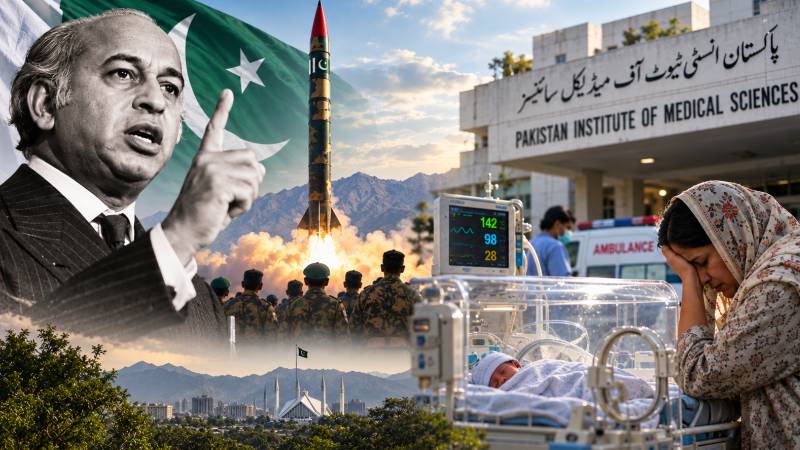
Something is unsettling about the vision of a nation willing to eat grass to get a bomb. “We will eat grass but we will get one,” declared former President Zulfikar Ali Bhutto, and this statement stands the test of time precisely due to what it implies: an unparalleled spirit of sacrifice for the sake of national survival. The danger was external then. India had shown its intentions of developing a nuclear capability, and Pakistan felt threatened that it may not exist as a country without the capacity to defend itself. Almost five decades have passed, and Pakistan has the bomb. However, there is another question that we seem less willing to ask: what will we sacrifice to save our citizens?
The tragedy at the Pakistan Institute of Medical Sciences is hard to ignore. Fourteen newborns perished in a fire at one of the most prominent public hospitals in the country. Fourteen infants, who had just come into the world, were killed in the place which was supposed to safeguard them from any danger. Reports that followed the incident highlighted some serious issues related to fire safety and emergency measures at the medical facility. The number of victims might seem insignificant but imagine how many lives were lost, how many mothers anxiously waiting in front of a ward for their babies, how many families expecting to bring their baby back home.
The sad truth is that this incident is just another case in a long series of tragic episodes in the healthcare of Pakistan, which has experienced similar issues during the last twenty years without taking appropriate measures. In 2019, there was an outbreak of HIV cases in Ratodero, and most of those affected were children. Then came the COVID-19 pandemic with all the challenges it put to the healthcare sector of Pakistan, such as shortage of supplies and resources and high pressure on an already fragile healthcare system. Other outbreaks, maternal and infant deaths, inadequate medical procedures, hospital emergencies and shortages have been uncovering the same issue: Pakistan often discovers the weaknesses of its healthcare system only when people begin dying.
Nevertheless, healthcare issues are seldom described in the context of national security. National security is comprehended in cases of border invasion or missile launch, military action and questions of nuclear deterrence. An existential threat becomes evident when the invader wears an army uniform. But how to address the situation in which the threat consists of a virus, infection, or a malfunctioning fire safety system in a hospital? Is this any less threatening due to the lack of an opponent?
When the security of a nation depends on the defense of its boundaries without considering the people it holds, it cannot be called fully secured.
Traditionally, the understanding of security in Pakistan has been determined by the history of the country and its external vulnerability. There is nothing irrational and unnecessary about such concerns; the only issue is the narrowness of the concept itself. The threats of today cannot always come from the country’s borders. Pandemics cross borders; climate change causes floods, heat waves, new diseases. Antimicrobial resistance can make simple infections fatal. Poor healthcare leads to the increase of poverty, reduced productivity, loss of human capital and puts millions of people at risk of crises they can barely survive.
When the security of a nation depends on the defense of its boundaries without considering the people it holds, it cannot be called fully secured. Here, Bhutto’s “eating grass” is something far more than just a quotation from history. It becomes a matter of priorities within the nation. If Pakistan once believed that an external threat was serious enough to justify extraordinary sacrifice, why have we never treated the health of our own population with the same urgency? To what extent are we willing to go when the threat is not outside our borders, but already inside them?
What would it mean if Pakistan were to treat healthcare as seriously as national defence? Would there be a tolerance for hospitals lacking even the most rudimentary safety measures if they were seen as strategic infrastructure? Would the operational primary health centres qualify as security infrastructure rather than just a part of bureaucracy? Would doctors, nurses, paramedics and community health workers qualify as a part of security architecture of the country? This may sound exaggerated; however, the events over the last two decades indicate that Pakistan has come to a point where healthcare cannot be treated as an auxiliary policy area to be attended only following catastrophes.
What is being said is that Pakistan does not have to choose between hospitals and defence; rather, it needs to reconsider the notion of security. It has to protect its citizens from not only external threats, but also the vulnerabilities which keep killing its citizens. Pandemics, preventable diseases, maternal deaths, malfunctioning hospitals and health emergencies can destabilize a community as much as any conventional security threat. Technology can also be incorporated in the security infrastructure. AI could be used to monitor the outbreaks of diseases, assess high-risk populations, manage resources in hospitals and develop warning systems.
This leads us to the question of who should provide this security. The Pakistani health system may be planned at the center, but its failure is always intensely localized. Islamabad can announce programmes and provincial ministries can allocate budgets, but neither can know every village where a basic health unit has no doctor, every maternity centre without equipment or every ambulance that has stopped functioning. The people who understand these problems most clearly are the communities and local governments living with them.
The example of Kerala provides a useful insight into this matter. The decentralized structure of government ensured that decisions were shifted to the local level in terms of planning and public services including healthcare provision. Pakistan cannot simply replicate Kerala, given its different political and administrative realities, but the principle is relevant: healthcare becomes more responsive when decisions are made closer to the people who depend on it. The local governments with the necessary powers and resources could determine whether there was a need for maternal care, disease surveillance, operational ambulances or well-equipped health units in their community. Decentralisation would not solve every problem, but excessive centralisation has its own costs: distance, bureaucracy and slow responses to local crises.
In essence, it boils down to the issue of what Pakistan values. Bhutto’s generation questioned how much was the nation ready to risk to ensure its safety against the threat from an external foe. Now it is our generation’s turn to ask how much we are prepared to spend on ourselves for safeguarding ourselves against threats which are already threatening to kill us from within. We once asked how much Pakistan was willing to sacrifice for the bomb; perhaps it is time to ask the harder question: how many lives are we willing to lose before we decide that keeping our people alive is also a matter of national survival?