

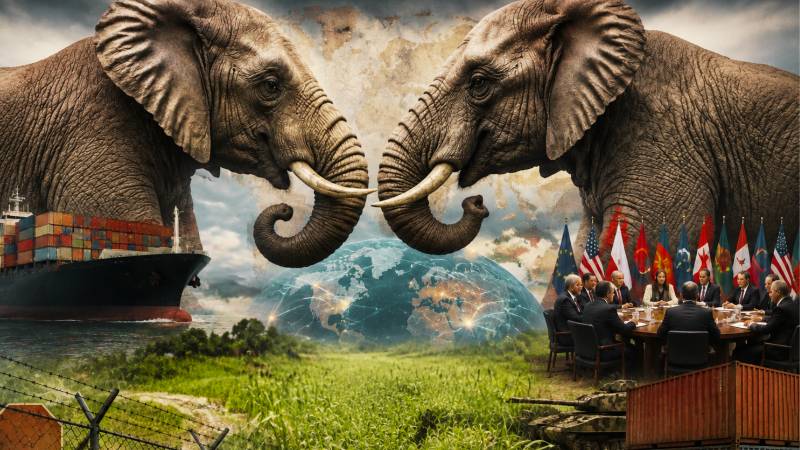
There is an old African proverb: “When two elephants fight, it is the grass that suffers.” Few expressions capture the unequal consequences of power politics as vividly. The elephants represent the powerful; the grass represents those who have little influence over the struggle but are inevitably crushed by it. In international politics, the proverb is particularly relevant because wars, rivalries and strategic confrontations are rarely confined to the governments that initiate them. Their consequences eventually reach ordinary people.
The history of the modern world is, in many ways, a history of powerful states competing for influence. Yet the cost of that competition has often been borne by societies that were neither powerful enough to determine the outcome nor influential enough to prevent the confrontation. The two World Wars provide the most devastating examples. Political leaders pursued strategic objectives, but millions of civilians paid through death, displacement, hunger and economic ruin.
The Cold War demonstrated a different version of the same problem. The United States and the Soviet Union avoided a direct war with each other, but their rivalry was played out across weaker states. Korea, Vietnam, Afghanistan and parts of Africa and Latin America became arenas of ideological and strategic competition. For the superpowers, these conflicts were part of a larger struggle for influence. For ordinary people living there, they were simply wars that destroyed homes, livelihoods and futures. That is the uncomfortable truth behind the proverb: the powerful may choose the battlefield, but the powerless often become its casualties.
The same principle applies beyond conventional warfare. In today's interconnected world, geopolitical rivalry also travels through trade, energy, finance and technology. When major powers impose sanctions, restrict exports or compete over strategic resources, the consequences do not stop at government offices. They appear in factories, markets and households. A rise in international energy prices, for instance, can increase transportation and production costs. Businesses then raise prices, governments face higher import bills and families find their purchasing power reduced. A dispute between powerful states may begin as a strategic calculation, but its final bill can arrive at the doorstep of an ordinary citizen.
This is why economic security has become inseparable from national security. A country that depends heavily on imported energy, food, technology or industrial inputs is vulnerable whenever international tensions disrupt supplies. The poorer the country, the fewer options it has to absorb such shocks. The developing world has repeatedly experienced this vulnerability. Countries with strong economies can use financial reserves, diversified industries and robust institutions to cushion external crises. Fragile economies have no such luxury. When external pressure arrives, governments are often forced to choose between protecting citizens from rising prices and preserving already limited resources for development. Pakistan knows this dilemma well.
A country that depends heavily on imported energy, food, technology or industrial inputs is vulnerable whenever international tensions disrupt supplies.
Its geographical location places it at the crossroads of several important strategic regions. Throughout its history, Pakistan has had to navigate relationships with major powers while dealing with conflicts in its immediate neighbourhood. Geography cannot be changed, but the manner in which a country responds to its geography can be. Pakistan therefore needs a foreign policy that recognises a basic distinction: having strategic partners is different from becoming dependent on their strategic priorities.
There is nothing wrong with cooperation with major powers. In fact, diplomacy requires engagement. But cooperation becomes dangerous when a country's own interests disappear behind the interests of stronger partners. Pakistan's foreign policy must ultimately be judged by one question: does it make ordinary Pakistanis safer, more prosperous and more secure? This question becomes even more important because geopolitical rivalry has consequences that extend beyond the present generation.
When conflict destroys schools, the loss is not simply a damaged building. It is lost education. When instability drives businesses away, the loss is not simply investment. It is lost employment. When inflation prevents families from educating their children, the loss is not simply household income. It is lost human potential. When young people grow up surrounded by insecurity, the psychological and social consequences can continue long after the immediate conflict has ended.
The greatest damage caused by geopolitical rivalry is therefore sometimes invisible. It is the opportunities that never materialise.
A young person who could have become an engineer may never reach university. A business that could have employed hundreds may never be established. A community that could have prospered through trade may instead spend its resources dealing with instability.This is how the grass suffers.
Yet the proverb should not be interpreted as a message of helplessness. The grass may be vulnerable, but societies are not powerless. Countries can strengthen themselves against the consequences of great-power competition. Economic diversification is one such protection. A country dependent on a narrow range of exports or a single source of energy is more vulnerable than one with diversified economic relationships. Strong institutions provide another layer of protection. When institutions function effectively, governments can respond to external shocks without allowing every crisis to become a national emergency. Education is perhaps the most important protection of all. A society with skilled citizens can adapt more quickly to technological and economic change. It can produce knowledge rather than merely purchase it.
This is particularly important in the emerging competition over artificial intelligence, cybersecurity, biotechnology, advanced manufacturing and other strategic technologies. The countries that develop these capabilities will have greater freedom to make independent decisions. Those that remain dependent on imported technology will have fewer choices. For Pakistan, this means that the protection of national sovereignty cannot be separated from the development of human capital.
The strongest defence against becoming the grass in someone else's geopolitical struggle is not simply a larger arsenal. It is a stronger economy, better education, stronger institutions, technological capability and intelligent diplomacy. There is also a broader lesson for the Muslim world. Many Muslim countries occupy strategically important locations and possess significant natural and human resources. Yet strategic importance can become a vulnerability when external powers compete for influence. The answer should not be to choose one elephant against another.The answer should be to develop enough internal strength to engage with all powers on the basis of mutual interest.Diplomacy should create choices, not eliminate them. Economic relationships should create resilience, not dependence.Strategic partnerships should strengthen sovereignty, not replace it.Above all, governments must remember that the ultimate purpose of foreign policy is not to impress other governments. It is to protect their own people.
The international system will remain competitive. Powerful states will continue to pursue their interests. Rivalries over security, technology, resources, trade routes and influence will not disappear. Smaller states cannot always prevent the elephants from fighting.But they can decide whether they will stand directly beneath them.That is the real lesson of the proverb. When elephants fight, the question is not simply which elephant will win. The more important question is what will remain of the grass when the fight is over?
For Pakistan and other developing countries, wise statecraft therefore requires a simple priority: protect the people before pursuing prestige, protect the economy before pursuing grand strategy, and protect national interests before becoming part of someone else's rivalry.The elephants may fight for power.The grass fights for survival.
And in the final analysis, the success of a state is not measured by how closely it stands to the elephants, but by how safely its people can live beneath their shadow.